

NA President urges removal of outdated regulations to spur development
Amending laws must not replace the responsibility to enforce them, but outdated regulations must not be allowed to continue obstructing development, said NA President Tran Thanh Man.
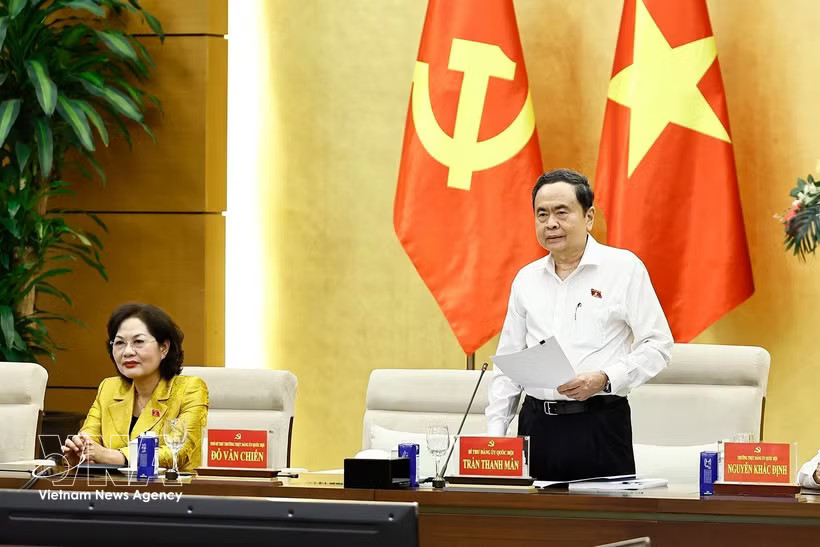
Hanoi (VNA) – President of the National Assembly (NA) Tran Thanh Man has called for outdated regulations that hinder development to be removed, stressing that legislation must address institutional bottlenecks, mobilise resources and deliver practical results.
The top legislator made the request while chairing a conference in Hanoi on October 16 between the Standing Board of the NA Party Committee and heads of the Party delegations from provincial and municipal NA deputies' delegations. The meeting aimed to reach a common understanding of key issues to be submitted to the second session of the 16th NA that is set to start on October 17.
NA President Man, who is also Secretary of the NA Party Committee, said the session will face a heavy workload, with many important issues requiring consideration.
The third and fourth plenums of the 14th Party Central Committee made decisions on major matters, and the NA’s task is to translate these policies fully, promptly and accurately into high-quality laws and resolutions, he noted.
The legislature is expected to consider 57 items or groups of issues, including 39 laws and four normative resolutions for adoption, four other draft laws for discussion, and 10 groups of issues related to socio-economic development and the state budget, alongside supervisory activities and other important matters.
Given the workload and limited time, NA President Man called for urgency without complacency, decisive action without oversimplification, and strong innovation without compromising quality.
He stressed that the success of the session should not be measured by the number of laws passed, but by whether decisions made remove bottlenecks and unlock resources. Lawmakers must identify whether obstacles stem from policies, legislation or implementation and address them at the appropriate level.
Amending laws must not replace the responsibility to enforce them, but outdated regulations must not be allowed to continue obstructing development, he added.
He described lawmaking as the “top priority among priorities”. If the NA adopts the planned 39 laws and four resolutions at this session, together with the 21 laws and 11 resolutions passed at the previous session, the legislature will have issued 63 laws and 15 normative resolutions in 2026. This represents a significant effort to remove institutional bottlenecks.
Major legislation under consideration includes amendments to the Penal Code, Criminal Procedure Code, Land Law, Housing Law and Law on Real Estate Business, as well as a consolidated State Budget Law. These laws have direct implications for human and civil rights, people’s lives and business activities.
The top legislator asked deputies to focus discussions on major policy questions, institutional bottlenecks and issues where opinions remain divided, rather than repeating information already contained in legislative dossiers or focusing excessively on drafting techniques.
He also stressed strict compliance with Politburo Regulation No. 178-QD/TW on control over the exercise of power and the prevention of corruption and other negative practices in lawmaking.
Despite GDP growth of 9.01% in the first nine months of the year, only 12 of the country’s 34 provinces and cities recorded growth above 10%, he noted, asking deputies to identify specific obstacles to faster growth, whether related to institutions, resources or implementation.
Looking ahead, NA President Man said 2027 must be a year of acceleration and breakthroughs, with GDP growth targeted at 10% or higher. Budget and public investment decisions should focus on priority tasks with broad spillover effects, ending scattered and inefficient investment.
He also called for stronger supervision linked to clear responsibilities and tangible results. At the upcoming session, question-and-answer activities in the written format will be increased, and one day allocated to questioning on groups of issues./.