

Lawmakers discuss land price tables, adjustment coefficients
The draft amended Land Law comprises 13 chapters and 112 articles, three chapters and 148 articles fewer than the 2024 Land Law.
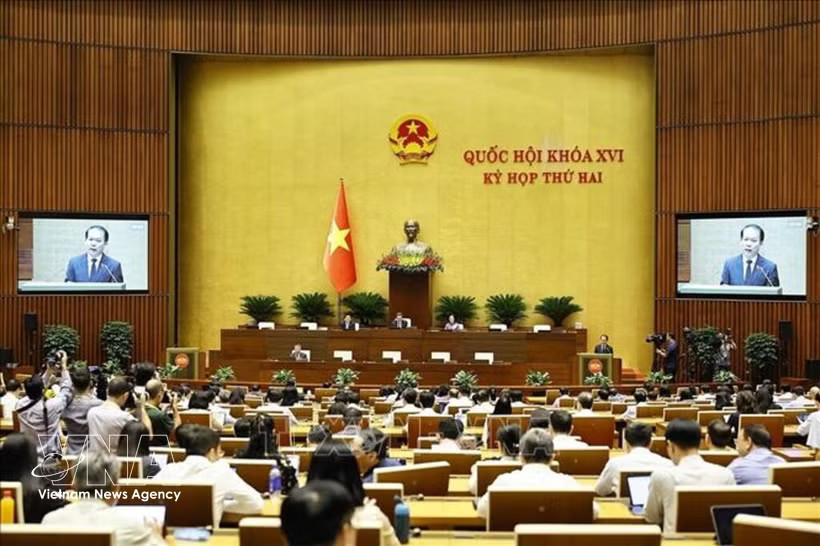
Hanoi (VNA) – Under the agenda for the second session of the 16th National Assembly, deputies will discuss in plenary two draft laws on October 29, namely the amended Land Law and the Law on Small- and Medium-sized Enterprise (SME) Development.
The draft amended Land Law comprises 13 chapters and 112 articles, three chapters and 148 articles fewer than the 2024 Land Law.
The draft no longer provides for land-use planning as a separate category, but instead stipulates land-use content in provincial-level planning.
At the commune level, land-use plans will be drawn up in a simplified and digitalised form, incorporating relevant content from provincial-level planning, urban and rural planning, and detailed sectoral plans. These will serve as a basis for state management of land.
Regarding land allocation, land leasing and changes in land-use purposes, the draft clearly specifies cases in which land may be allocated or leased without auction or bidding, as well as cases requiring auctions of land-use rights or bidding to select investors for project implementation. It also allows individuals leasing land from the State to choose between a one-off payment and annual payments.
The draft law also introduces new provisions on compensation, support and resettlement when the State recovers land.
Regarding land finance and pricing, it removes provisions on specific land prices and land price appraisal consultancy organisations, focusing instead on refining the principles and bases for land pricing, land price tables and land price adjustment coefficients. It also adds regulations on the rates used to calculate land-use fees, land rental and compensation.
In addition, it stipulates that each land parcel will be assigned a unique identification code.
Meanwhile, the draft Law on SME Development comprises four chapters and 35 articles. It builds on provisions of the existing Law on Support for SMEs that remain relevant, while amending and supplementing those that no longer meet requirements in reality.
It reviews and clarifies the relationship between the Law on SME Development and sector-specific laws, positioning the former as the overarching legislation governing policies to support businesses.
Where different laws contain conflicting provisions on the same support measure for SMEs, the bill stipulates that the Law on SME Development will prevail, ensuring consistency, transparency, ease of application and compliance with Vietnam’s international commitments.
The support policies aim to promote the fast and sustainable development of the SME sector, increase the number of businesses, improve the quality and efficiency of their operations, strengthen their competitiveness and contribution to the economy, and generate jobs and sustainable growth./.