

Deputy PM visits China’s Tsinghua University, seeking closer educational cooperation
Tsinghua has worked to implement the Vietnamese and Chinese leaders’ orientations for higher education cooperation. Last year, it admitted 27 Vietnamese students and postgraduates, the highest number to date, all of whom received scholarships. The university also hosted the second Vietnam-China Higher Education Cooperation Forum, helping promote exchanges and cooperation between the two countries’ educational institutions.
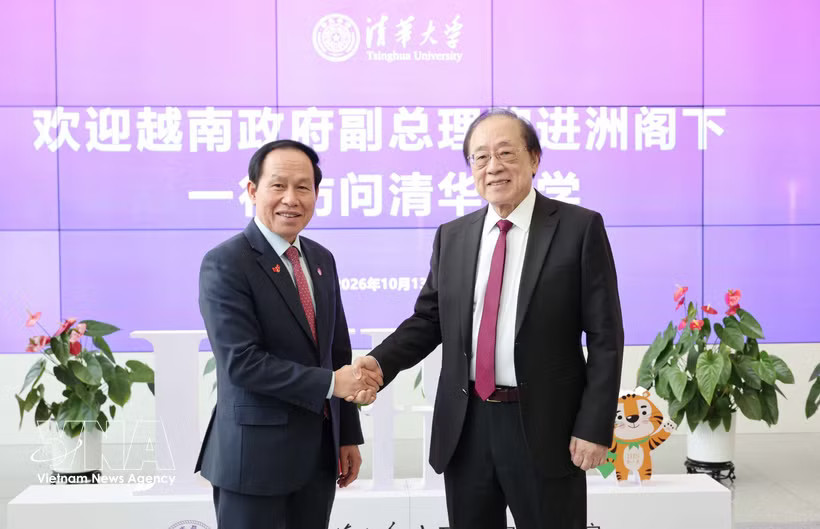
Beijing (VNA) – Vietnamese Deputy Prime Minister Le Tien Chau visited and held a working session with representatives from Tsinghua University, one of China’s leading institutions of higher education and scientific research, on October 13, as part of the official visit to China by National Assembly President Tran Thanh Man.
Introducing the university, Professor Qiu Yong, Secretary of Tsinghua University’s Party Committee, said that over more than a century of development, Tsinghua has achieved significant results in education and scientific research, earning high positions in international university rankings. Several of its disciplines rank among the world’s leading fields. The university has increased its investment in artificial intelligence (AI) research and application, while its affiliated technology enterprises have been listed on stock markets and expanded their presence worldwide.
Qiu recalled that in April this year, Tsinghua was the first destination during the state visit to China by the General Secretary of the Communist Party of Vietnam Central Committee and President To Lam. The Vietnamese leader’s visit left a strong impression on the university’s staff and students, while providing strategic orientations for bilateral cooperation in education and training, science and technology research, and human resources and talent development.
Tsinghua has worked to implement the leaders’ orientations for higher education cooperation. Last year, it admitted 27 Vietnamese students and postgraduates, the highest number to date, all of whom received scholarships. The university also hosted the second Vietnam-China Higher Education Cooperation Forum, helping promote exchanges and cooperation between the two countries’ educational institutions.
Chau congratulated Tsinghua on its achievements over 115 years, noting its emergence as a prestigious university in China and internationally, as well as its contributions to China’s development and Vietnam-China educational cooperation. He pointed out the results of the second Vietnam-China Higher Education Cooperation Forum, held during General Secretary and President Lam’s state visit, where several cooperation agreements were signed between universities from both nations.
He also introduced Politburo Resolution No. 71-NQ/TW on breakthroughs in education and training development, adopted more than a year ago, and key outcomes of the recent fourth plenum of the 14th Party Central Committee concerning the training, development, attraction, and effective use of talent to support the country’s rapid and sustainable development.
The Deputy PM called for stronger exchanges and joint research on university governance, training aligned with labour market demand, research linked to technology transfer, higher education network planning and international cooperation. He also emphasised public-private partnerships in human resources development, science and technology, and the commercialisation of research, alongside innovation linked to national development strategies and strategic industries.
Chau proposed expanding cooperation in high-quality personnel training in AI, semiconductors, digital technology, new materials, green energy and data technology. He called on Tsinghua to increase scholarships for Vietnamese students and consider joint training and supervision programmes, and shift from academic research towards joint research and innovation. Stronger links were also encouraged among the State, universities, research institutes and businesses, including through business incubation and research and training programmes tailored to social needs.
Following the meeting, the Vietnamese delegation visited Tsinghua’s Institute for Interdisciplinary Information Sciences, which conducts research into AI and quantum technologies. They were briefed on applications including versatile humanoid robots with dexterous hands for logistics and other tasks, large language models for translation and cultural and tourism services, and semiconductor chip technologies./.