

Capital Law 2026 paves way for Hanoi’s new development model
One of the key breakthroughs of the new resolutions is the shift from a traditional management-oriented approach to a development-enabling model. The proposed policies are designed not only to address current issues but also to establish the foundation for a more modern, proactive and flexible system of urban governance.
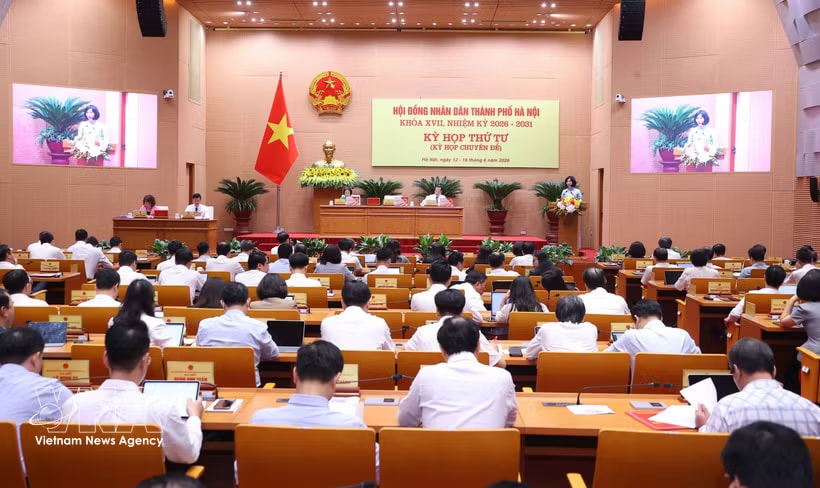
Hanoi (VNA) - The mechanisms and policies designed to implement the Capital Law 2026 will not only address immediate challenges but also open up new development opportunities, laying the foundation for a modern urban governance model and enhancing Hanoi’s long-term competitiveness.
The statement was made by Chairman of the municipal People’s Committee Vu Dai Thang while presenting a package of special mechanisms and policies to implement the law at the 4th session of the 17th Hanoi People’s Council for the 2026–2031 term on June 12.
According to Thang, the session carries particular significance as it seeks to complete the entire system of resolutions needed to implement the Capital Law before it takes effect on July 1.
Under the implementation roadmap, Hanoi is required to translate all mechanisms and policies authorised under the law into specific regulations. To date, the municipal People’s Council has approved a number of important resolutions, and many others are expected to be considered and adopted during this session in order to complete the legal framework for the capital city’s next phase of development.
One of the key breakthroughs of the new resolutions is the shift from a traditional management-oriented approach to a development-enabling model. The proposed policies are designed not only to address current issues but also to establish the foundation for a more modern, proactive and flexible system of urban governance.
A major focus is expanding development space for the capital through strategic policy instruments. These include urban development based on a multi-layered, multi-centre model aligned with transit-oriented development (TOD) principles, as well as more efficient management and utilisation of land resources and development space, including underground infrastructure and emerging urban areas.
A series of resolutions relating to high-tech parks and high-tech industrial zones are expected to facilitate pilot economic development mechanisms. Construction, transport, green mobility, clean energy transition, science and technology, innovation and digital transformation have also been identified as priority sectors to support Hanoi’s future growth.
In the fields of healthcare, education, culture and social development, the city is introducing a range of special policies aimed at strengthening public service systems while preserving and promoting its cultural heritage.
Thang emphasised that all resolutions have been developed with people and businesses at the centre. Many of the policies are intended to improve the investment and business environment, attract strategic investors, enhance public services, expand social welfare programmes and improve access to high-quality healthcare, education and transport services.
The resolutions also focus on improving the quality of public administration and human resources. The Capital Law allows Hanoi to introduce special mechanisms for recruiting and utilising highly skilled talents, and establish dedicated policies for public officials, civil servants and employees paid from the municipal budget.
Acknowledging the challenges involved, the city leader noted that many of the policies are unprecedented and involve entirely new approaches. He stressed that the resolutions under consideration are not merely legal documents, but strategic decisions that will shape a new development model for Hanoi in the years ahead./.