

500-day campaign to search for, recover and identify remains of fallen soldiersEnsuring absolute safety throughout the search for fallen soldiers’ remains
The excavation of a suspected mass grave at Le Thi Rieng Park in Ho Chi Minh City is not merely a mission to search for and recover the remains of fallen soldiers. It is a painstaking journey requiring exceptional caution, precision and responsibility. Every operation at the site is conducted under the strictest safety requirements to preserve human remains, personal belongings and valuable historical evidence that has lain deep underground for nearly six decades.
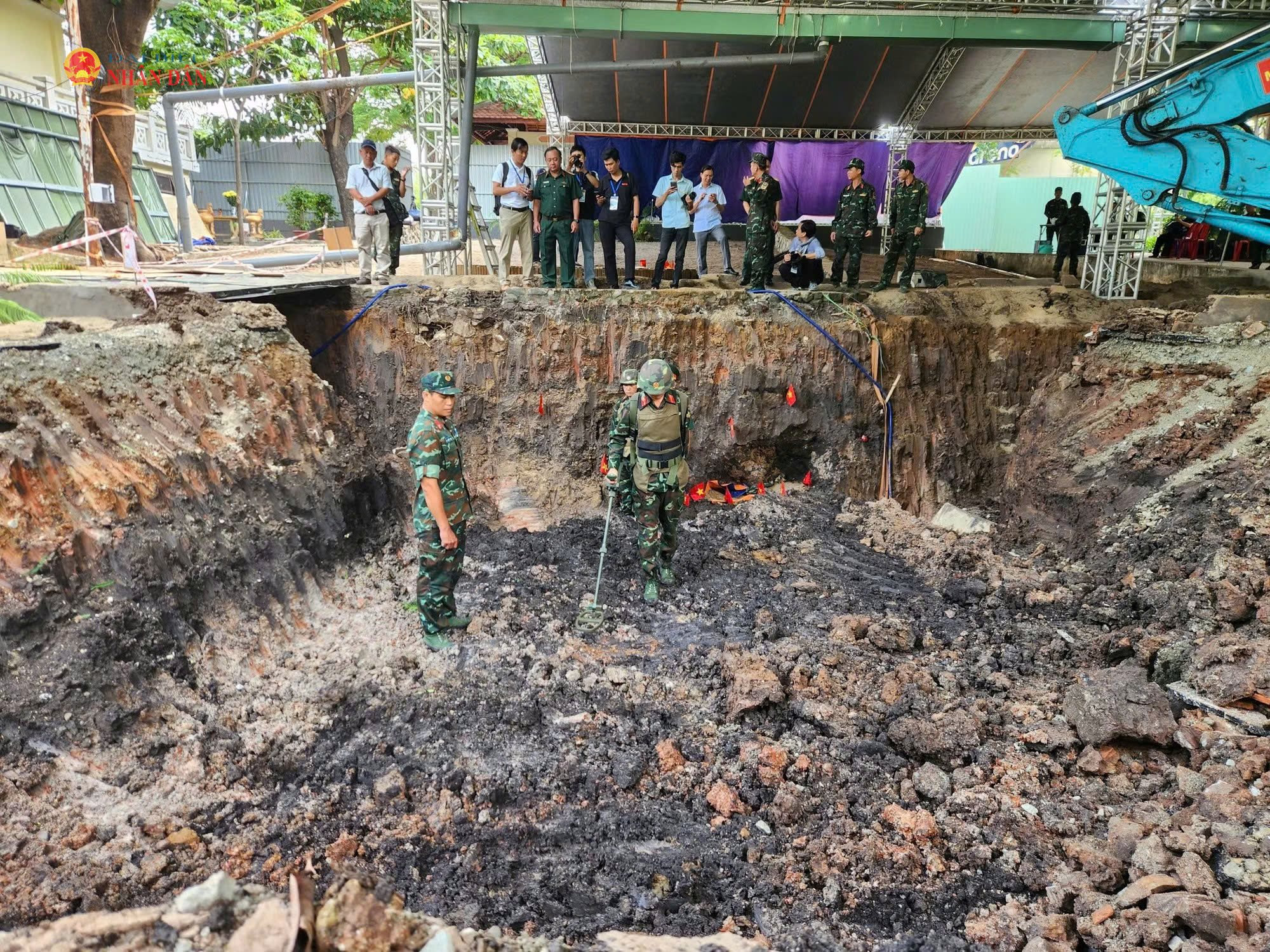
Meticulous work at every stage
The search and recovery operation at Le Thi Rieng Park involves close coordination among military units, scientific agencies, historical witnesses and forensic specialists.
As of 18 July, the search and recovery team under the Ho Chi Minh City High Command had recovered 100 sets of individual remains and two sets of collective remains. Throughout the operation, safety and compliance with professional procedures have remained the highest priorities.
Major General Nguyen Thanh Trung, Political Commissar of the Ho Chi Minh City High Command, said all participating forces had been instructed to strictly follow technical procedures and coordinate closely with scientists, witnesses and forensic organisations. This approach is intended to preserve the excavation site while gathering as much information as possible for identification purposes.
The work is being carried out according to the principle of proceeding only when sufficient evidence is available, ensuring that every stage is conducted scientifically and carefully and that no mistakes are made.
“Every set of remains discovered offers another family an opportunity to reunite with a loved one after decades of waiting. Therefore, there can be no haste at any stage,” Major General Nguyen Thanh Trung stressed.
The site has undergone considerable change during decades of urbanisation, making it particularly difficult to determine the precise location and boundaries of the suspected burial trench. Protecting the original condition of the excavation site is therefore essential.
At the site, personnel work with intense concentration. Each layer of soil is removed slowly and methodically. Beneath the ground lie not only the remains of those who sacrificed their lives but also small personal objects that may prove invaluable in establishing their identities. These may include buttons, personal belongings, fragments of military equipment, documents or other traces connected to the soldiers’ lives.
Sergeant Vu Duc Tam, a young member of the search and recovery team, said the soil layers were separated manually using specialised tools such as trowels, soft brushes and small shovels. Every movement must be slow and precise so that no trace is overlooked, as even the smallest object may provide crucial evidence for identification.
Once remains or objects are discovered, they are processed and classified under strict procedures to preserve the evidentiary value of every specimen.
Among those directly involved is Dr. Tran Van Ban, 82, a former member of Battalion 2, Regiment 268 of the Saigon–Gia Dinh Military Region 1. He is also a historical witness who fought in the area more than half a century ago.
According to Dr Ban, every bone fragment and object must be handled with the utmost care. A detail that may initially appear insignificant could become the decisive clue needed to identify a fallen soldier almost 60 years after the sacrifice.
Preserving every possible clue
In addition to ensuring safety during the excavation, the participating forces are paying special attention to preserving the site’s historical evidence.
Architect Nguyen Xuan Thang, who has spent many years studying records concerning mass burial sites at Le Thi Rieng Park, said the area had undergone repeated filling and renovation. These changes have made it difficult to identify the suspected burial trenches accurately.
Every layer of soil may contain historical evidence and must therefore be handled with scientific methods and the greatest respect.
In searches for fallen soldiers, even a small object found at the scene can provide an important clue, reconnecting fragments of information that have remained incomplete for decades. Safety requirements consequently extend beyond keeping the remains intact. They also cover the entire system of evidence and information associated with each individual.
Safety in this mission means protecting not only the personnel carrying out the work but also every historical trace, personal object and fragment of remains, giving the fallen soldiers the best possible chance of being identified and returned to their families.
Every careful movement and every specimen collected and preserved reflect responsibility towards history and gratitude to those who gave their lives for the country. Behind each set of remains is the story of a person who lived, fought and devoted themselves to national independence and freedom.
This is why the search cannot be rushed. It requires perseverance, accuracy and the highest sense of responsibility.
The participation of war veterans, military officers and soldiers, scientific experts and historical witnesses, together with the close direction of the Ho Chi Minh City High Command, has created a vital connection between historical memory, science and the responsibility of today’s generation.
Every stage of the search and recovery process is undertaken with the greatest caution and precision. Ensuring absolute safety is not merely a professional requirement; it is also an expression of profound respect and gratitude towards those who sacrificed their lives for the Fatherland.
Each gentle movement of a trowel into the soil and every object carefully preserved adds another ray of hope that the fallen soldiers will finally be identified and brought home to their families.