

Vietnam National University, Hanoi must always reflect on its national responsibility and the nation’s aspiration to advance
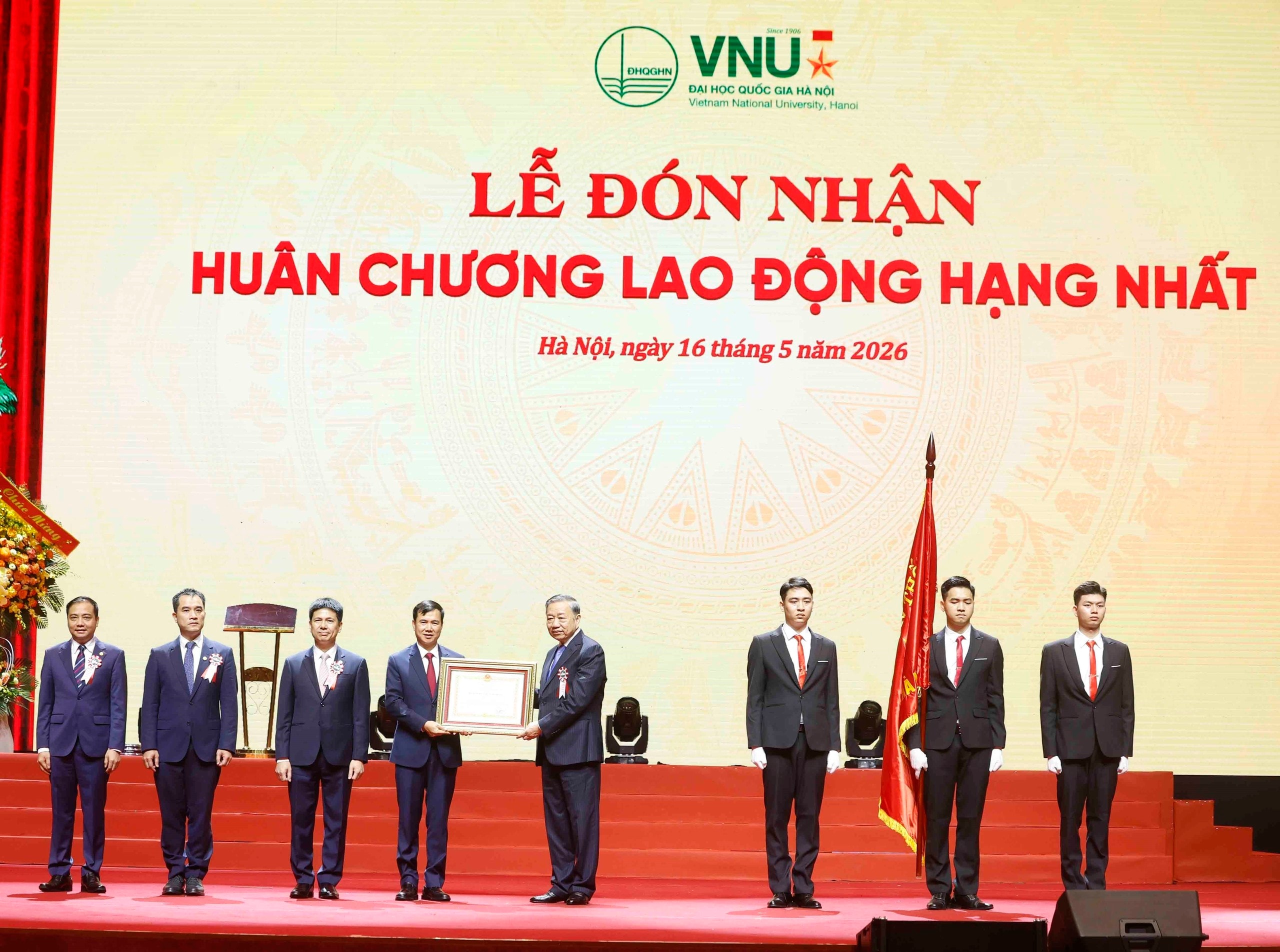
Editor’s note: On the morning of May 16 in Hà Nội, General Secretary and State President Tô Lâm attended and delivered an important address at a ceremony marking the 120th anniversary of Vietnam National University, Hanoi’s traditional day and receiving the First-Class Labour Order. Đại biểu Nhân dân Newspaper respectfully presents the full text of his address:
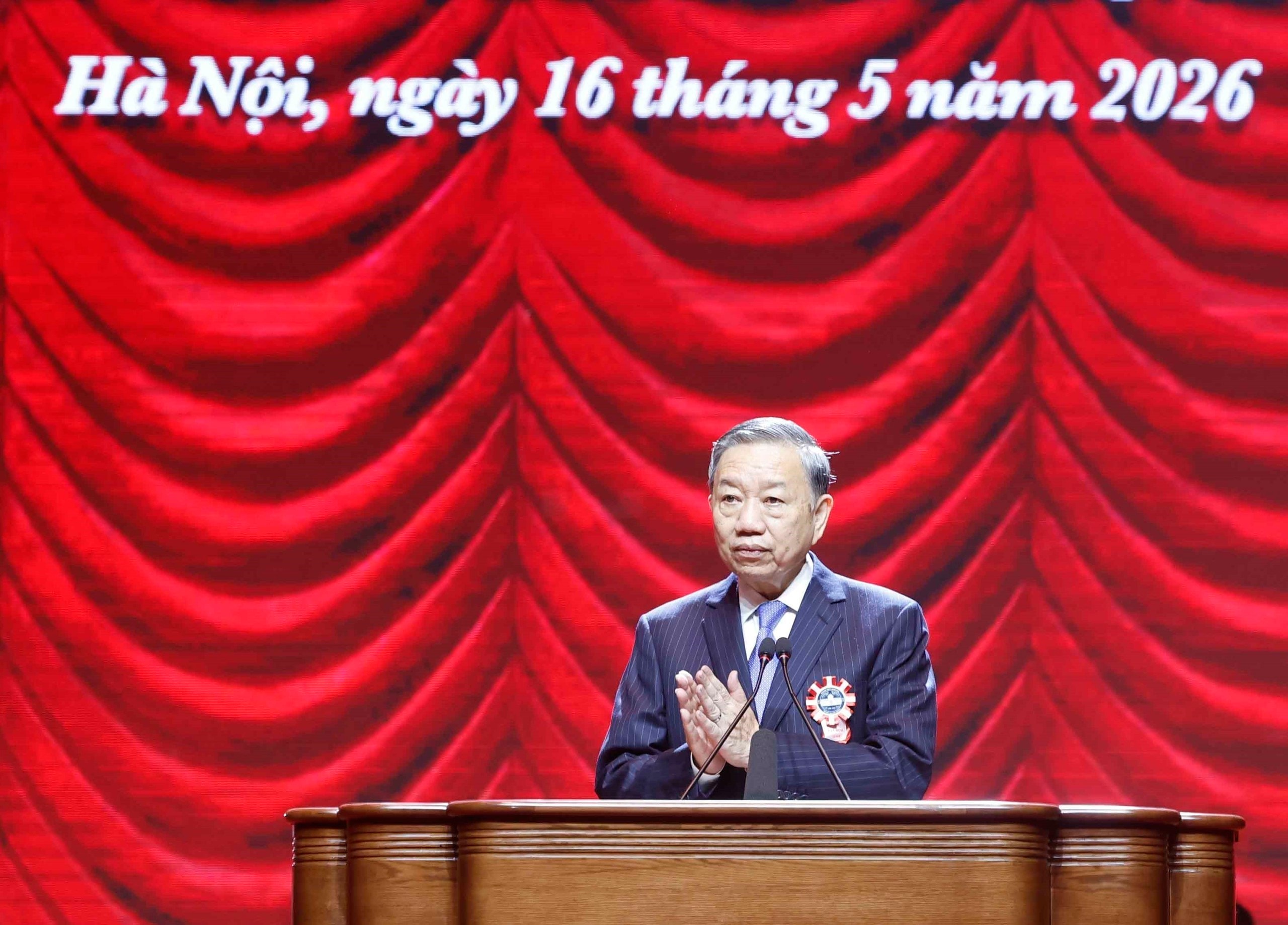
Leaders and former leaders of the Party, State and Vietnam Fatherland Front; leaders of central and local ministries, commissions and agencies,
Veteran revolutionaries, distinguished delegates, generations of educators and scientists, and dear students and learners,
International guests,
Today, as we joyfully celebrate the 120th anniversary of Vietnam National University, Hanoi’s traditional day, I am deeply moved to recall the university’s exceptional historical legacy. More than 80 years ago, President Hồ Chí Minh personally presided over the first opening ceremony of higher education in an independent Vietnam. From that sacred milestone, Vietnam National University, Hanoi has become a shining symbol of Vietnamese intellect—a place where academic aspirations converge, talented people are nurtured and important contributions are made to national construction and development.
In the solemn, proud and joyful atmosphere of this ceremony, on behalf of the Party and State leadership, I extend my warmest sentiments, sincere greetings and best wishes to the leaders, distinguished delegates, generations of professors and researchers, teachers, officials, students, learners, alumni and employees of Vietnam National University, Hanoi.
I congratulate Vietnam National University, Hanoi on receiving the First-Class Labour Order, a prestigious distinction conferred by the Party and State.
Comrades and distinguished delegates,
Our country possesses a thousand-year tradition of civilisation and learning and has always regarded talented people as “the lifeblood of the nation,” the foundation determining its prosperity or decline. This belief was inscribed on the stone stelae at the Temple of Literature–Imperial Academy, Vietnam’s first university, and is being carried forward within the development landscape of Vietnam National University, Hanoi.
Looking back at the history of the Indochina University, beginning in 1906, we can more profoundly appreciate the significance of Vietnam National University, Hanoi’s traditional day. That milestone marked the birth of modern higher education in Vietnam and the establishment of one of Southeast Asia’s earliest multidisciplinary universities.
Generations of Vietnamese intellectuals matured under this institution’s roof, choosing lives of commitment and service to the nation and bringing honour to the country. The 120th anniversary of Vietnam National University, Hanoi’s traditional day allows us to pay tribute to an enduring current of knowledge—from the nation’s thousand-year tradition of learning, through the inauguration of modern higher education, to today’s mission of nurturing talent to serve the Fatherland and the people and elevate Vietnamese intellect.
Comrades and distinguished delegates,
Following the August Revolution, at the first meeting of the Provisional Government on September 3, 1945, President Hồ Chí Minh affirmed that “an ignorant nation is a weak nation.” He simultaneously launched a campaign against the “enemy of illiteracy,” alongside the struggles against hunger and foreign aggression.
This reflected his profound strategic vision: to safeguard independence and build a strong and prosperous country, it was essential to enlighten the people, strengthen national spirit and value talented individuals. In his letter to students on the first school opening day of an independent Vietnam, he inspired the aspiration for the nation to “advance to the pinnacle of glory and stand shoulder to shoulder with the great powers of the five continents.”
That aspiration was swiftly translated into action. In late September 1945, President Hồ Chí Minh instructed that “universities be reopened promptly” and decided to establish Vietnam National University by inheriting and further developing the foundations of the Indochina University.
At this very institution on November 15, 1945, President Hồ Chí Minh attended and presided over the first opening ceremony of Vietnam National University. He personally presented graduation diplomas to medical students and joined Phạm Văn Đồng, Võ Nguyên Giáp, Vũ Đình Hòe and others in teaching important subjects, including constitutional studies, law and economics.
This image demonstrated the fledgling revolutionary State’s special attention to higher education while conveying a powerful message about the role of knowledge and talented people in building and defending the country. The establishment of Vietnam National University marked the birth of modern Vietnamese higher education in the era of independence.
From its first opening day, the university voluntarily embraced the mission of becoming “a powerful force among the fighting forces of the Vietnamese nation” and “a stronghold in the protracted resistance to fully restore the country’s territory and liberate the nation’s spirit.”
Over the 120 years since the establishment of the Indochina University and more than 80 years in the era of independence, under the Party’s leadership, Vietnamese higher education has continuously matured and developed vigorously. The country now has 244 higher education institutions, including two national universities and 10 multidisciplinary universities.
Through their intellect, patriotism, sense of responsibility and aspiration to serve, generations of Vietnamese educators, scientists, intellectuals and students have made tremendous contributions to national construction and defence. The Party, State and people have always respected, recognised and highly appreciated these valuable and enduring contributions.
In recognition of the outstanding contributions made by successive generations, Vietnam National University, Hanoi in 2006 became the country’s first higher education institution to receive the Gold Star Order—the highest distinction conferred by the Party, State and people. Today, it receives the First-Class Labour Order.
These honours acknowledge the university’s contributions, but they also embody the expectations and confidence placed in it, as well as the very high standards demanded of it by the Party, State and people on its development journey.
The policy adopted by the seventh-tenure Politburo to establish Vietnam National University, Hanoi was a strategic decision aimed at concentrating resources on building a high-quality, multidisciplinary university centre of regional and international standing. It was intended to play a core and leading role in Vietnamese higher education and make worthy contributions to the country’s renewal and international integration.
Looking back on its journey, Vietnam National University, Hanoi has made enormous efforts and achieved many important and highly commendable accomplishments. As the country enters a new era, however, the requirements for rapid and sustainable development demand that the university make even greater efforts, take stronger action and achieve clearer breakthroughs to become truly worthy of the stature and mission of a national university.
Our Party has repeatedly warned that falling behind is an overarching risk threatening the nation’s destiny and future. Developmental backwardness originates from lagging behind in science, technology and innovation, and from a low knowledge content in production, services and national governance. In an age of globalisation and rapidly advancing technological revolutions, falling behind means becoming dependent and weakened and losing opportunities to advance.
Our Party has therefore issued crucial strategic decisions, including Politburo Resolution No. 57 on breakthroughs in the development of science, technology, innovation and national digital transformation; Resolution No. 71 on breakthroughs in education and training; and Resolution No. 80 on the development of Vietnamese culture.
The direction is clear, the institutional framework is being opened up, and resources have been and are being prepared. The decisive issue now is action—resolute, effective and thorough action—to realise the country’s lofty development aspirations for the coming decades, enable it to escape the risk of falling behind and join the ranks of advanced, developed nations by 2045.
With these requirements in mind, I ask Vietnam National University, Hanoi to focus on successfully performing seven key tasks.
First and foremost, Vietnam National University, Hanoi must always reflect on its national responsibility and the nation’s aspiration to advance. The word “national” is a sacred reminder of the university’s responsibility, honour and mission to serve the country.
It must be a place where the finest minds converge, new horizons of knowledge are opened, solutions to major development challenges are developed, people capable of providing leadership are trained and Vietnamese intellectual resolve is nurtured in the new era.
In an age when national destinies are increasingly determined by knowledge, science, technology, innovation and human quality, Vietnam National University, Hanoi must advance even more vigorously. It must become a leading academic pillar, a major centre of innovation and a pioneering force in Vietnamese higher education, as well as a prominent and respected international representative of Vietnamese intellect.
Second, Vietnam National University, Hanoi must develop into a modern, elite and multidisciplinary university that operates according to an innovation-oriented model and possesses the capacity to lead the nation.
“Elite” status must be measured by academic quality, the capacity to generate new knowledge, nurture talented people and develop strategic technologies, as well as by substantive contributions to the country and internationally recognised prestige.
I agree with the objective set by the Director of Vietnam National University, Hanoi: for our university to rank among Asia’s top 100 universities by 2030 and among the world’s top 300 by 2035. I would further propose that several of its key disciplines rank among the global top 100.
To realise this vision, the university needs a modern educational philosophy, advanced governance and a liberal academic environment. It must promptly complete the Hòa Lạc university township as a green, intelligent and modern campus organically connected with Hòa Lạc Hi-Tech Park, thereby forming the country’s leading ecosystem for education, research, technology and innovation.
I call for a specific roadmap under which objectives and tasks are assigned to every member institution, unit and research group and governance is oriented towards measurable results.
Investment in Vietnam National University, Hanoi must be regarded as strategic investment in the nation’s future. It should be supported by special financial mechanisms, sufficiently strong resources and exceptional policies for building modern scientific infrastructure and attracting and effectively employing talented people from Vietnam and abroad.
Third, Vietnam National University, Hanoi must be willing to lead, experiment and pave the way for new models in education, science, technology, innovation and digital transformation. It must thereby provide practical foundations enabling the Party and State to continue improving development policies for the new era.
The central requirement is to vigorously reform university governance based on objectives, quality, results and output efficiency; expand autonomy in conjunction with accountability; thoroughly decentralise and delegate authority; and take the quality of education, value of research, innovation products, academic culture and substantive contributions to the country as the highest measures of performance.
Fourth, Vietnam National University, Hanoi must take the lead in implementing the Party’s strategic resolutions. It must focus on solving major national challenges, especially those involving strategic, core and foundational technologies and technological products bearing Vietnamese brands.
The university must become a focal point for national intellect, bringing together leading scientists, top technology experts, technology entrepreneurs and outstanding students to research, master and develop foundational technologies such as artificial intelligence, semiconductors, biotechnology, advanced materials, new energy, big data, and green and sustainable technologies.
Action programmes must be implemented resolutely and thoroughly, with measurable results and clearly demonstrated effectiveness. Achievements in education and research must directly serve the country, the capital city of Hà Nội and other localities, thereby affirming the university’s pioneering role in building a knowledge-based economy, advancing innovation and strengthening national self-reliance.
Fifth, Vietnam National University, Hanoi must become a centre connecting knowledge with development and forge closer links between the university and the State, businesses, localities and society.
University knowledge cannot remain confined to lecture halls, laboratories or scientific publications. It must be translated into better policies, more useful technologies, stronger businesses, more developed localities and better lives for the people.
The university must therefore proactively establish major research, policy consultancy and innovation programmes commissioned to address national priorities. It must strengthen cooperation with ministries and sectors, the capital city of Hà Nội, other localities, technology enterprises, research institutes and international expert networks.
It must promote the commercialisation of research results, facilitate the establishment of science and technology enterprises originating in its laboratories and pay due attention to the interests of the scientists directly involved.
Vietnam National University, Hanoi must become a “think tank” to which the State turns when it needs a scientific basis for strategic decisions. It must be an institution to which businesses turn to jointly develop technologies, human resources and new business models, and a place where society finds confidence in the power of Vietnamese knowledge, science and education.
General Secretary and State President Tô Lâm and other delegates visit an exhibition at the anniversary ceremony. Photo: Thống Nhất/VNA
Sixth, given its long-standing tradition and position as one of the country’s leading universities, Vietnam National University, Hanoi must become an outstanding centre of Vietnamese academic diplomacy.
The university has welcomed numerous heads of state, international leaders, prominent scholars and executives of global corporations who have delivered policy addresses and participated in intellectual and cultural exchanges.
Every official, lecturer, pupil and student at Vietnam National University, Hanoi must therefore remain profoundly aware that they are helping to represent Vietnamese intellect, culture and dignity in all academic, diplomatic and international exchange activities.
Through world-class knowledge, civilised conduct, confidence in international integration and a strong national identity, Vietnam National University, Hanoi must help vigorously project Vietnam’s soft power in the new era.
Seventh, Vietnam National University, Hanoi must effectively organise extensive political and ideological education for all officials and students regarding its proud traditions and the role, responsibility and mission of intellectuals in the country’s new era of development.
This tradition is a precious legacy that must be preserved, promoted and transformed into a driving force for action. This institution has produced outstanding Party and State leaders such as General Secretaries Trường Chinh and Nguyễn Phú Trọng and General Võ Nguyên Giáp; many prominent scientists, writers and artists; and numerous heroic intellectuals and exemplary students who devoted their energy, intellect, youth and even their blood and lives to shaping “the stature of Vietnam.”
Every educator, scientist, pupil and student at Vietnam National University, Hanoi today must live, study, conduct research and contribute in a manner worthy of previous generations, the confidence of the Fatherland and people, and the special attention that the Party and President Hồ Chí Minh have always devoted to the country’s education, science and technology.
To successfully perform these tasks, I ask Vietnam National University, Hanoi to proactively coordinate with the relevant agencies in researching and proposing breakthrough mechanisms and policies to the Politburo and Government for the development of the university in particular and Vietnamese higher education in general.
Particular attention must be paid to removing institutional, governance, financial and human-resource bottlenecks, as well as those relating to university autonomy, academic freedom and investment in basic science and strategic technologies.
This will enable Vietnam National University, Hanoi to develop in a manner commensurate with its position while generating momentum for vigorous reform throughout Vietnam’s higher education system in the new era.
Comrades and distinguished delegates,
Although the road ahead remains challenging, given its long and glorious history, I am confident that Vietnam National University, Hanoi will continue to advance vigorously and become a symbol of Vietnamese intellect, making contributions worthy of the cause of building an increasingly dignified and beautiful country, as our beloved President Hồ Chí Minh always wished.
I wish the leaders, distinguished delegates and all generations of teachers and students of Vietnam National University, Hanoi good health, happiness and many more brilliant achievements.
Thank you very much.
*The headline was written by Đại biểu Nhân dân Newspaper.