

Three global crises and Vietnam’s constructive message
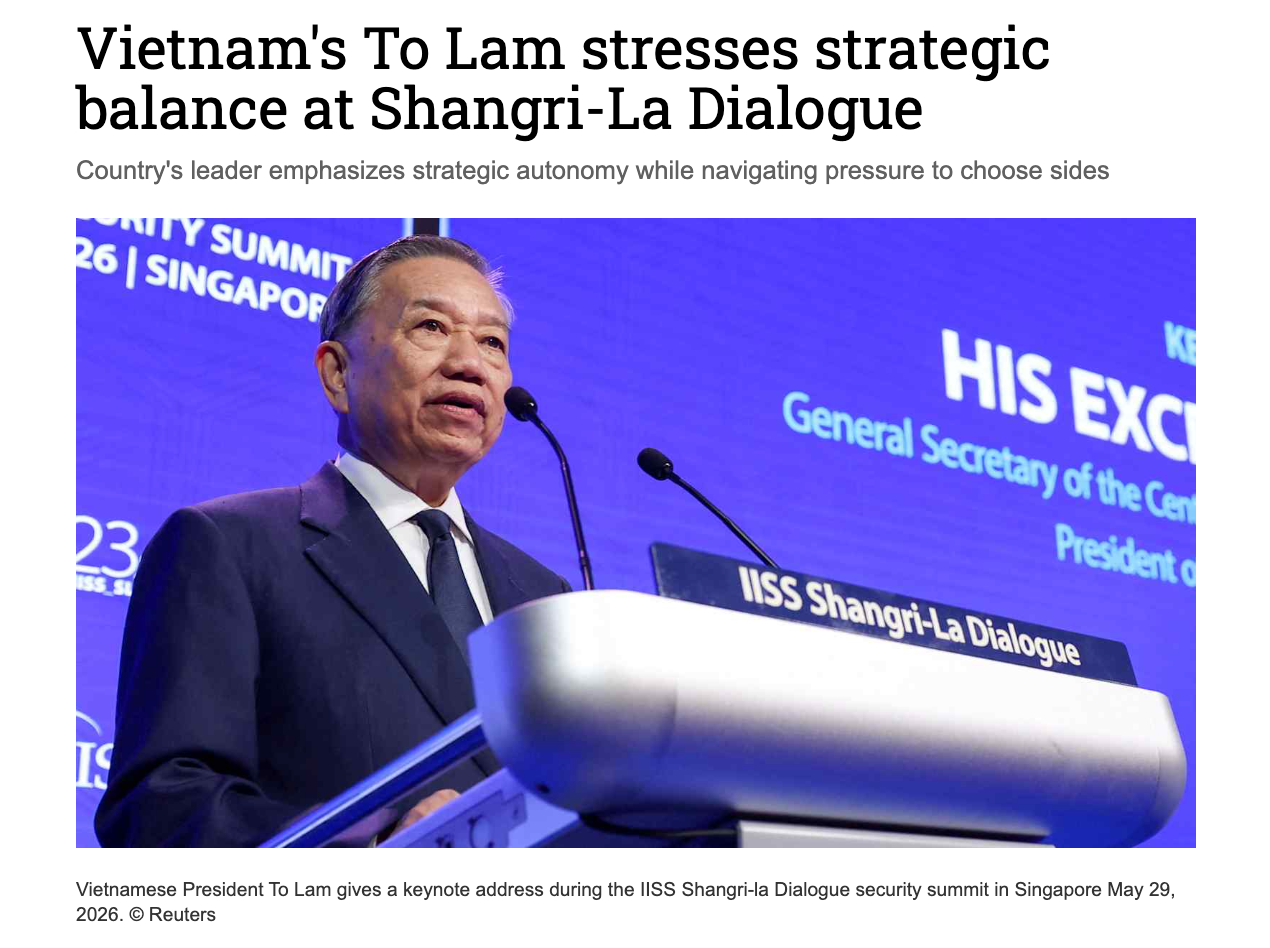
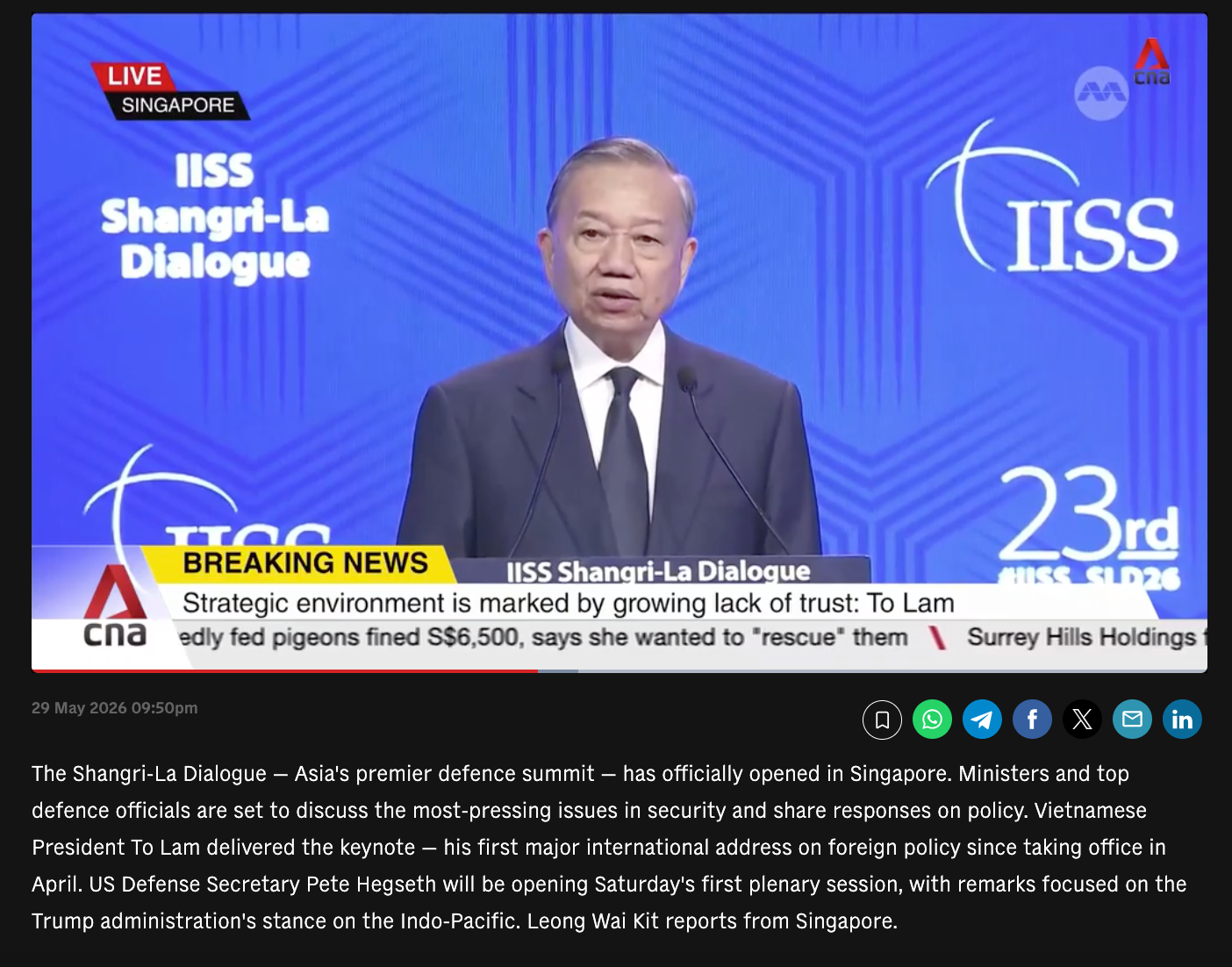
At the opening session of the 23rd Shangri-La Dialogue on May 29, General Secretary of the Communist Party of Vietnam and President of Vietnam To Lam delivered a keynote address entitled “Proactively shaping to peace, stability and development in a world of turbulence”. The speech drew attention from Reuters, AP, The Straits Times, The Business Times and South China Morning Post, particularly for its identification of three major global crises and its proposal for a constructive approach originating from the Asia-Pacific region.
Peace is never a natural gift of history
Throughout modern history, some speeches transcend the significance of diplomatic occasions and come to reflect a nation’s vision, resolve and standing amid major transformations of the era. General Secretary and President To Lam’s keynote address at the 23rd Shangri-La Dialogue was one such speech.
The Shangri-La Dialogue has long been regarded as one of the most important security forums in the Asia-Pacific region, bringing together national leaders, defence ministers, policymakers, strategic experts and international media. Against this backdrop, the appearance of Vietnam’s top leader at the opening session signalled a new posture: Vietnam does not stand on the sidelines of major global issues but actively contributes to shaping peace, stability and shared development.
.jpg)
The most striking aspect of the speech was the way General Secretary and President To Lam identified three foundational crises confronting the world. Reuters reported that the Vietnamese leader highlighted three major challenges: the erosion of international law and rules; a crisis of development models amid slowing growth and climate change; and a crisis of trust among nations. Reuters also underscored his important message that these crises “are not inevitable realities that humanity must simply accept”, while noting the proposed solutions, including strengthening international law, creating inclusive and sustainable growth drivers, and promoting dialogue and transparency.

This is a profound perspective because today’s instability does not stem solely from individual conflicts or regional flashpoints. Today’s instability is structural. When international law is weakened, small and medium-sized countries face greater pressure. When traditional development models reveal their limitations, growth may no longer automatically generate fairness, stability and prosperity. When strategic trust declines, even a minor incident may escalate into a major crisis.
By naming these three crises directly, Vietnam delivered a clear message: preserving peace requires addressing not only the visible manifestations of conflict but also the deeper fractures in global order, development and trust.
The first crisis: the crisis of international order.
This crisis directly affects all nations, especially those committed to peace, respect for law and rejection of a return to the logic of “might makes right”. After the Second World War, humanity sought to build an international order based on the Charter of the United Nations, international law, sovereign equality, the non-use or threat of force, and the peaceful settlement of disputes. That order has never been perfect, but it remains one of humanity’s most important achievements after the devastation of war. When rules are ignored, when power outweighs justice and when norms are interpreted selectively, peace inevitably becomes fragile.
For Vietnam, this message emerges from the historical experience of a nation that endured war, sacrifice and division. Vietnam understands that independence and sovereignty are sacred, but it also understands that peace can only endure when protected by law, justice and responsibility. Vietnam’s voice at Shangri-La therefore was not an abstract call for peace. It was the voice of a nation that paid a high price for peace and understands that peace is never a natural gift of history.
.jpg)
The second crisis: the crisis of the development model
For decades, the world believed that globalisation, trade, investment, technology and supply chain integration would naturally generate shared prosperity. Today’s reality suggests otherwise. Growth that is not inclusive may deepen inequality. Technology without proper governance may widen social divides. Climate change may disrupt livelihoods, food security, energy systems and migration. Supply chain disruptions may turn distant risks into immediate pressures on people’s daily lives. In his speech, General Secretary and President To Lam connected the crisis of development models to slowing economic growth and climate change while proposing inclusive and sustainable growth drivers as a key solution.
This message carries particular significance for Vietnam in its new stage of development. Vietnam aspires to advance rapidly while remaining sustainable; to modernise while remaining humane; and to integrate deeply while preserving national identity and strategic autonomy. Development therefore cannot be measured solely by growth rates. It must also be assessed through quality of life, economic resilience, equality of opportunity, cultural strength, human capital and social trust. In other words, development itself forms the deepest foundation of sustainable security.
The third crisis: the crisis of strategic trust
It is a quiet but dangerous crisis. When trust deteriorates, countries increasingly view one another with suspicion. Defensive actions may be interpreted as provocation. Technical incidents may be seen as deliberate escalation. Differences in interests may turn into confrontation. In the age of artificial intelligence, cyberspace, autonomous weapons, big data and high-speed decision-making systems, the risk of miscalculation grows even greater in the absence of dialogue, transparency and crisis management mechanisms.
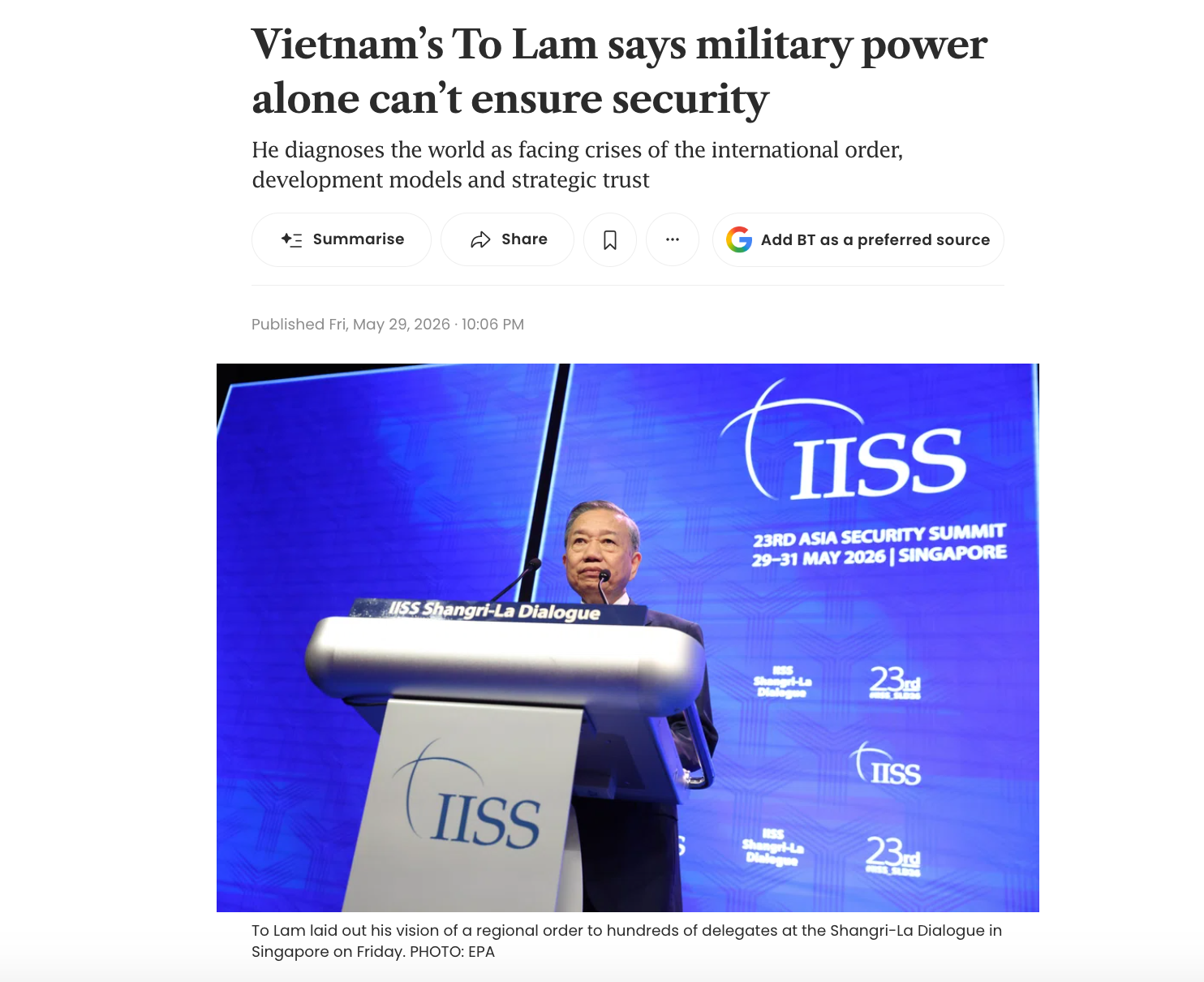
The Straits Times and The Business Times both highlighted an important point from the speech: in an unstable world, solutions to global crises should emerge from the Asia-Pacific because this region is where those crises are increasingly concentrated. The Business Times framed this message within the context of intensifying strategic competition between the United States and China, while The Straits Times highlighted Vietnam’s emphasis on a rules-based order, restraint and trust-building.
This demonstrates the broader significance of Vietnam’s message. The Asia-Pacific is not only the world’s most dynamic growth centre but also home to vital maritime routes, advanced supply chains, emerging economies, major powers and numerous security hotspots. If the region becomes unstable, global stability will be difficult to sustain. But if it succeeds in building a peaceful, cooperative, inclusive and rules-based framework, it can become a major force for global peace and development.
AP took a practical angle by highlighting To Lam’s reference to the Strait of Hormuz as a warning relevant to Asia-Pacific rivals. According to AP, the Vietnamese leader argued that a single hotspot could send shockwaves throughout the world and that tensions along strategic maritime routes could rapidly disrupt trade, energy, logistics and socio-economic life.
Three messages for building peace
International media coverage suggests that Vietnam’s message was not a generic appeal for peace. Rather, it offered a concrete understanding of the relationship between security and development. In an interconnected world, the security of a strait, maritime area or shipping route is no longer a regional issue. It affects energy prices, inflation, supply chains, employment, livelihoods and social stability across nations. Protecting peace at sea, safeguarding freedom of navigation and defending international law therefore also means protecting people’s lives and development prospects.
Vietnam’s constructive message contains three layers. First, peace must be built through international law. Competition is a reality, but competition must have limits. Differences in interests are inevitable, but they must be managed through dialogue and rules. The security of one country cannot be built upon the insecurity of another.
Second, development must be built through an inclusive and sustainable model centred on people. A world focused solely on growth while neglecting fairness, environmental protection, culture and human well-being cannot remain stable over time. Likewise, a region concerned only with military security while overlooking livelihood security, climate security and human security cannot achieve lasting peace. For Vietnam, cultural development, human development, science and technology, innovation, green transformation, digital transformation and institutional strengthening are all essential components of national security in a broader sense.
Third, trust must be built through dialogue, transparency and responsibility. In a world marked by suspicion, trust cannot be created through declarations but through consistent action. A responsible nation exercises restraint, respects international law, honours commitments, maintains policy transparency and remains open to dialogue. This is also why international media paid close attention to the speech: Vietnam not only identified problems but also proposed a balanced, constructive approach that avoids extremism, confrontation and imposition.
Looking back from Shangri-La, one can trace a consistent theme in Vietnam’s national journey. Vietnam has always chosen peace but never passivity in protecting peace. Vietnam values cooperation but does not compromise independence and sovereignty. Vietnam pursues deep integration while preserving confidence and identity. Vietnam develops for itself while contributing more to the region and the world. The speech by General Secretary and President To Lam therefore represented not only a foreign policy message but also an affirmation of Vietnam’s position in a new era.
In a world facing crises of order, development and trust, Vietnam’s voice carries weight because it stems from historical experience, the achievements of Doi Moi, a culture of harmony and the aspiration for national advancement. It is a voice that is not grandstanding but profound; not extreme but principled; not imposing but responsible. And through that voice, Vietnam helps affirm a simple but powerful truth: peace is not merely to be enjoyed - it must be built; development is not merely about wealth - it must make people safer and happier; and national standing is measured not only by where a country stands on the map, but also by what it contributes to humanity’s shared future.