

OECD report outlines priorities for Vietnam’s capital market development
The OECD identifies five policy priorities to deepen the country's capital market: strengthening market confidence, facilitating companies' access to equity financing, expanding long-term funding through corporate bonds, developing the investor base, and enhancing international integration.
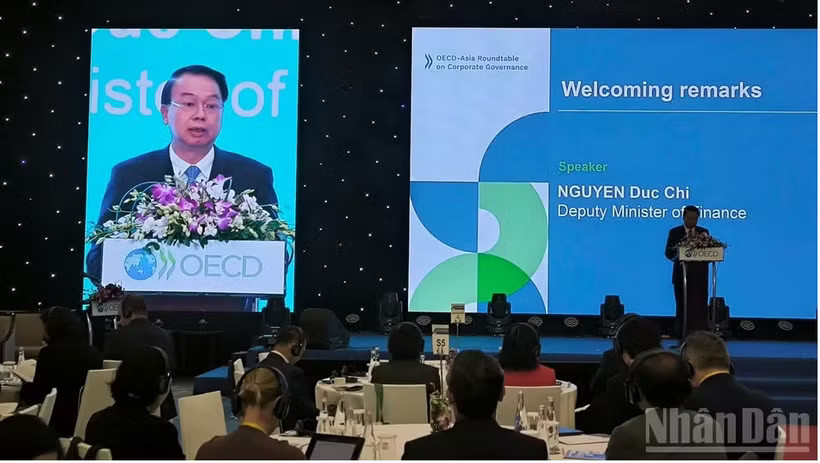
Vietnam should continue reforms to improve transparency, strengthen corporate governance and diversify sources of long-term financing to ensure sustainable capital market development, the Organisation for Economic Co-operation and Development (OECD) said in Hanoi on November 26.
The recommendations were made at the OECD-Asia Roundtable on Corporate Governance 2026, jointly organised by the State Securities Commission of Vietnam (SSC) and OECD on November 26–27.
The event, hosted by Vietnam for the third time, brings together representatives of securities regulators, stock exchanges, market participants and international organisations. It features six thematic sessions, a high-level discussion among ASEAN securities regulators and the launch of several OECD publications.
The roundtable is part of activities marking the 30th anniversary of Vietnam’s securities industry. It also provided a platform for economies to exchange experience in corporate governance, corporate finance and sustainable development.
Speaking at the opening ceremony, Deputy Minister of Finance Nguyen Duc Chi stressed the important role of the capital market in achieving Vietnam’s development goals towards 2045.
He said the capital market should become a major source of medium- and long-term financing for the economy, complementing bank credit, diversifying investment resources and easing pressure on the banking system.
The recent upgrading of Vietnam’s stock market from frontier market to secondary emerging market status is recognition of the country's efforts to improve its legal framework and market accessibility, he said. However, it also marks the beginning of a new phase requiring higher standards of quality, transparency and sustainability.
“Market upgrading is not our ultimate destination, but the beginning of a new journey with higher requirements for market quality, transparency and sustainability,” Chi said.
He highlighted corporate governance as a particularly important factor in this process, noting that sound governance not only improves business performance but also strengthens investor confidence and helps attract more international capital.
The Ministry of Finance will focus on improving the effectiveness of corporate boards, enhancing transparency and information disclosure, and protecting shareholders' rights. It will also work to improve governance quality at State-owned enterprises in line with OECD standards.
The ministry will study and consider the OECD report's recommendations in accordance with Vietnam's practical conditions, ensuring that the adoption of international standards goes hand in hand with domestic institutional reforms to support the long-term development of capital markets.
OECD Deputy Secretary-General Yasushi Masaki underlined the need for continued reforms and stronger international cooperation. He said capital market development is a long-term process requiring consistent reforms, robust institutions and close coordination between government agencies and market members.
Jean-Paul Servais, Chair of the OECD Corporate Governance Committee, Chair of the International Organisation of Securities Commissions (IOSCO) and Chair of Belgium's Financial Services and Markets Authority (FSMA), highlighted the importance of corporate governance to capital market development in Asia.
Resilient capital markets in the region, he said, could help promote investment, business development and global economic growth.
Five priorities for deeper capital markets
At the opening session, the OECD officially launched its 2026 capital market review for Vietnam, produced under a cooperation project with the SSC.
The report assesses major changes in Vietnam's capital market and provides policy recommendations to support further reforms. It acknowledges significant progress in modernising the market, particularly through improvements to the legal framework and market access conditions that have facilitated foreign investment.
A major milestone was FTSE Russell's decision to upgrade Vietnam's stock market to secondary emerging market status, effective from September 2026.
However, the report stresses that market upgrading does not mark the end of the reform process. Vietnam needs to continue improving market quality, transparency and investor protection to maintain confidence among domestic and foreign investors.
The OECD identifies five policy priorities to deepen the country's capital market: strengthening market confidence, facilitating companies' access to equity financing, expanding long-term funding through corporate bonds, developing the investor base, and enhancing international integration.
First, strengthening market confidence requires greater transparency, stronger shareholder protection and improved corporate governance. These factors directly influence investment decisions and the ability to attract long-term capital.
Second, facilitating access to equity financing will give businesses more opportunities to diversify funding sources, raise capital for production and business expansion, and reduce their reliance on bank loans.
Third, developing the corporate bond market is essential to expanding long-term financing options. The OECD recommends improving transparency and the quality of information disclosure to ensure the market operates efficiently and meets the needs of both issuers and investors.
Fourth, broadening the investor base could improve market liquidity and increase its capacity to mobilise capital. Greater participation by institutional investors is also important to developing investment activities and market services.
Finally, stronger international integration will help Vietnam align its capital market with advanced standards and governance practices, improve competitiveness and attract more foreign investment.
Overall, the OECD recommendations aim to support the development of a deeper, more efficient and resilient capital market, enabling it to play a greater role in mobilising long-term resources for Vietnam's economic growth./