

Shenzhen APEC outcomes provide momentum for Vietnam in 2027: Australian scholar
Vietnam has an advantage as many of the priorities recently agreed upon by APEC members are already being pursued domestically. The challenge for the host economy is to quickly persuade members to reach consensus so that these priorities can be translated into tangible outcomes, said Emeritus Professor Carl Thayer.
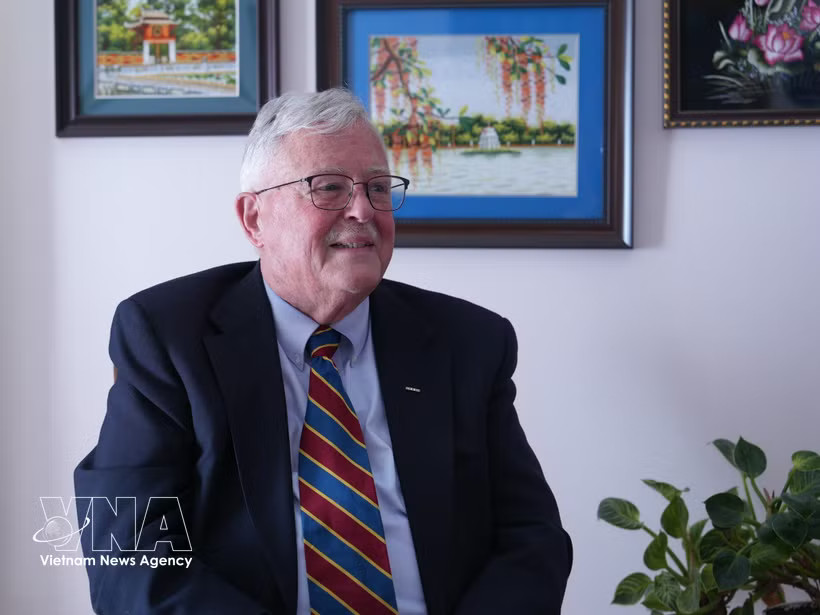
Sydney (VNA) – Progress in trade digitalisation and innovation achieved at the 33rd APEC Economic Leaders’ Meeting in Shenzhen, China, has laid the groundwork for Vietnam to advance concrete cooperation programmes during its hosting year of APEC 2027.
Emeritus Professor Carl Thayer of the University of New South Wales’ Australian Defence Force Academy, said Vietnam has an advantage as many of the priorities recently agreed upon by APEC members are already being pursued domestically. The challenge for the host economy is to quickly persuade members to reach consensus so that these priorities can be translated into tangible outcomes.
In an interview granted to Vietnam News Agency correspondents in Sydney, Thayer identified the most notable outcome of the Shenzhen meeting as APEC’s efforts to translate its orientations for cooperation in digital transformation and innovation into concrete initiatives. Alongside the leaders’ declaration, the APEC Trade Digitalisation Cooperation Framework for 2027–2030 and the APEC Connectivity Blueprint provide a foundation for promoting paperless cross-border trade and support for small- and medium-sized enterprises (SMEs) in their digital transformation.
He noted that APEC only works on consensus and has no enforcement. The value of the adopted documents will therefore depend on the extent to which member economies implement them. As 2027 will mark the first year of implementation of the trade digitalisation framework, Vietnam will have an opportunity to incorporate follow-up activities into the agenda for its host year.
The scholar also highlighted remarks by General Secretary of the Communist Party of Vietnam Central Committee and President To Lam at the APEC CEO Summit. He said that linking digital transformation with workforce skills training, support for SMEs and efforts to narrow the digital divide demonstrates that Vietnam’s priorities are aligned with the broader cooperation agenda.
Vietnam can share experience from programmes already underway at home while working with other members to identify areas that can be implemented at the regional level, he said.
Regarding the goal of establishing the Free Trade Area in the Asia-Pacific (FTAAP), a proposal long promoted by China, Thayer suggested that Vietnam could choose digital cooperation as an initial step as it’s not just for trade, but also for health and demographics.
Reaching agreement on a roadmap, setting priorities and defining concrete outcomes for each stage will also be consistent with the approach taken by General Secretary and President Lam in promoting the implementation of cooperation programmes, he noted.
According to the scholar, hosting APEC 2027 will give Vietnam the ability to convene meetings and setting the agenda, but outcomes will ultimately be determined collectively by member economies.
He recalled Vietnam’s experience in 2017, when Vietnamese diplomats and partners continued negotiations to maintain the Trans-Pacific Partnership (TPP) process after the US announced its withdrawal. Sideline talks during the APEC Economic Leader’s Week in Da Nang that year helped the remaining 11 countries reach agreement on the core elements of the pact, which later became the Comprehensive and Progressive Agreement for Trans-Pacific Partnership (CPTPP).
That experience demonstrates the importance of early preparation and persistent efforts to bridge differences, he noted.
Vietnam can make use of the preparation period to consult member economies and build consensus on several issues ahead of the APEC Economic Leaders’ Week. Its membership in ASEAN also provides an additional channel for coordination with Southeast Asian partners.
Thayer said securing the attendance of leaders from major economies will be an important part of the preparations. He predicted that General Secretary of the Communist Party of China Central Committee and President of China Xi Jinping and Russian President Vladimir Putin could visit Vietnam, creating further opportunities for high-level dialogue.
Vietnam’s advantage lies in the close alignment between APEC’s cooperation agenda and its domestic development priorities, he said, adding that if early consensus is reached on a roadmap for trade digitalisation and support for SMEs, Vietnam could deliver tangible results during its APEC Year 2027./.