

Vietnam, Japan seek to deepen cooperation in leadership training, human resources development
Politburo member, Secretary of the Communist Party of Vietnam (CPV) Central Committee and Chairman of its Organisation Commission Nguyen Duy Ngoc spoke highly of the effective cooperation between the Organisation Commission and JICA in training and developing Vietnamese officials, particularly those holding leadership and management positions.
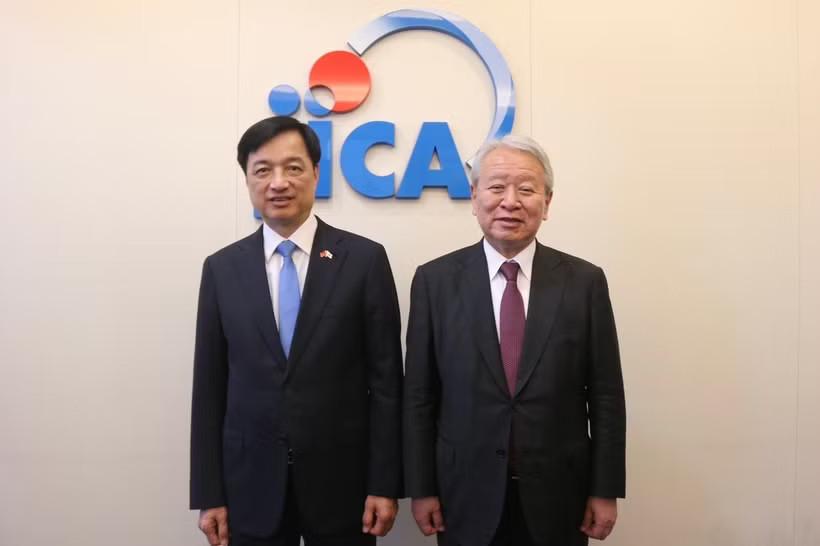
Tokyo (VNA) – Politburo member, Secretary of the Communist Party of Vietnam (CPV) Central Committee and Chairman of its Organisation Commission Nguyen Duy Ngoc held a working session with President of the Japan International Cooperation Agency (JICA) Tanaka Akihiko in Tokyo on November 10, within the framework of the official visit to Japan by General Secretary of the CPV Central Committee and President To Lam.
The meeting was attended by Vietnamese Deputy Ministers of Foreign Affairs, Justice, Home Affairs, and Education and Training, as well as representatives of the National Assembly and members of the Vietnamese delegation.
Ngoc briefed Tanaka on the outcomes of the talks between General Secretary and President Lam and Japanese Prime Minister Takaichi Sanae, during which the two leaders agreed to adopt a Vietnam-Japan Joint Vision Statement, establishing a new framework for cooperation as partners working together to co-create shared benefits, promote high-quality growth, and strengthen strategic autonomy and resilience. The two leaders witnessed the exchange of nine cooperation documents, out of 11 signed during the visit.
Ngoc spoke highly of the effective cooperation between the Organisation Commission and JICA in training and developing Vietnamese officials, particularly those holding leadership and management positions. Projects implemented since 2018 have helped improve officials' capabilities and link acquired knowledge with practical work at the local level.
He welcomed the signing of minutes of discussions on the project to enhance the capacity of Vietnamese leaders and managers at all levels, describing it as an important basis for improving the quality and effectiveness of bilateral cooperation in the new period. To translate the two countries' cooperation orientations into concrete results, Ngoc proposed JICA focus on four priorities.
First, he called for continued support for Vietnam in pursuing its two centenary development goals of becoming a developing country with modern industry and upper-middle income by 2030, and a developed, high-income country by 2045. He proposed promoting next-generation official development assistance (ODA) to help Vietnam shift towards a growth model driven by science, technology, innovation and digital transformation towards green and sustainable development.
Second, he urged stronger collaboration in education, training and human resources development, particularly in strategic technology fields such as artificial intelligence (AI), semiconductors and digital transformation.
Third, he proposed JICA work closely with the Organisation Commission to effectively implement the leadership capacity-building project, with two to three training courses organised annually, each accommodating around 20 participants. He also suggested including a specialised course or module on healthcare management, health services and adaptation to population ageing, while encouraging business cooperation between the two countries in these fields.
Fourth, Ngoc called for the development of a larger-scale, longer-term project to meet Vietnam's requirements for building a capable contingent of officials, particularly at the grassroots level.
For his part, Tanaka praised the significance of the top Vietnamese leader’s visit, his address to the National Diet and the adoption of the Joint Vision Statement. He noted that the visit and Vietnam's major development orientations have attracted considerable attention from Japanese political circles and business community.
Recalling their previous meeting in Hanoi on June 9, Tanaka updated Ngoc on progress in bilateral cooperation, including an exchange of notes on an ODA loan for the Vietnam-Japan University project, a loan agreement for the O Mon 3 thermal power plant project, an agreement on a project to improve the quality and effectiveness of lawmaking and law enforcement in Vietnam for 2027–2030, and the minutes of discussions on the leadership capacity-building project.
Thanking Ngoc for his substantive proposals, he affirmed that JICA will coordinate with relevant Vietnamese agencies to promote projects aligned with the country's needs and priorities, with particular attention to training officials in AI, digital transformation, science and technology. Training programmes will be designed to address practical challenges, including the division of responsibilities between central and local authorities, public service delivery and administrative reform.
He underscored the importance of human resources development to Vietnam's ambition of becoming a high-income country, adding that JICA is promoting support for the development of the Vietnam-Japan University and studying potential ODA projects in AI and digital transformation. On population ageing, he expressed his desire for greater experience-sharing to identify suitable collaboration projects and reaffirmed JICA's commitment to implementing a cooperation project with Vietnam's Ministry of Justice.
Representatives of Vietnamese ministries also highlighted priorities for future cooperation. Deputy Minister of Justice Mai Luong Khoi appreciated Japan's support and pledged effective coordination in implementing the new phase of legal cooperation. Deputy Minister of Education and Training Pham Quang Hung called for greater investment in doctoral training, adjustments to postgraduate training structures and stronger links between lecturers from the two countries.
Deputy Minister of Home Affairs Vu Chien Thang shared Vietnam's reforms in evaluating public employees based on job positions and performance, stressing the need to attract talent and develop high-quality human resources. Meanwhile, Standing Deputy Minister of Foreign Affairs Nguyen Minh Vu welcomed the progress made following the JICA President's visit to Vietnam in June and called for further Japanese support tailored to Vietnam's human resources development needs.
On the occasion, Ngoc invited Tanaka to visit Vietnam and hold working sessions there in the near future./.