

The 1946 Constitution: The Strategic Vision of the First National Assembly
The Vietnamese National Assembly was formed and developed amidst the flames of the struggle to protect and preserve the fledgling independence of Vietnam. It was the founding National Assembly, the National Assembly of national independence, national unity, and national solidarity. Despite the widespread and increasingly fierce war waged by French colonialism, and the frenzied opposition of reactionary forces, the National Assembly still managed to hold two sessions in 1946, accomplishing significant and historically important tasks, including the promulgation of the first Constitution of the Democratic Republic of Vietnam.
Following the Declaration of Independence (September 2, 1945), the Government convened and decided to hold a general election nationwide. Simultaneously with the general election, a draft Constitution had to be prepared so that it could be discussed and approved upon the establishment of the National Assembly. Therefore, on September 20, 1945, the President of the Provisional Government of the Democratic Republic of Vietnam issued Decree No. 34-SL.
Article 1 of the Decree stated: “Establish a Constitution Drafting Committee to submit to the National Assembly a Constitution for the Democratic Republic of Vietnam. The Committee shall consist of: Ho Chi Minh, Vinh Thuy, Dang Thai Mai, Vu Trong Khanh, Le Van Hien, Nguyen Luong Bang, and Dang Xuan Khu.” Article 2 stated: “The Minister of the Interior is responsible for implementing this Decree.”
In just two months, under the direction of President Ho Chi Minh , the first draft of the Constitution was completed and published for public comment starting in November 1945.
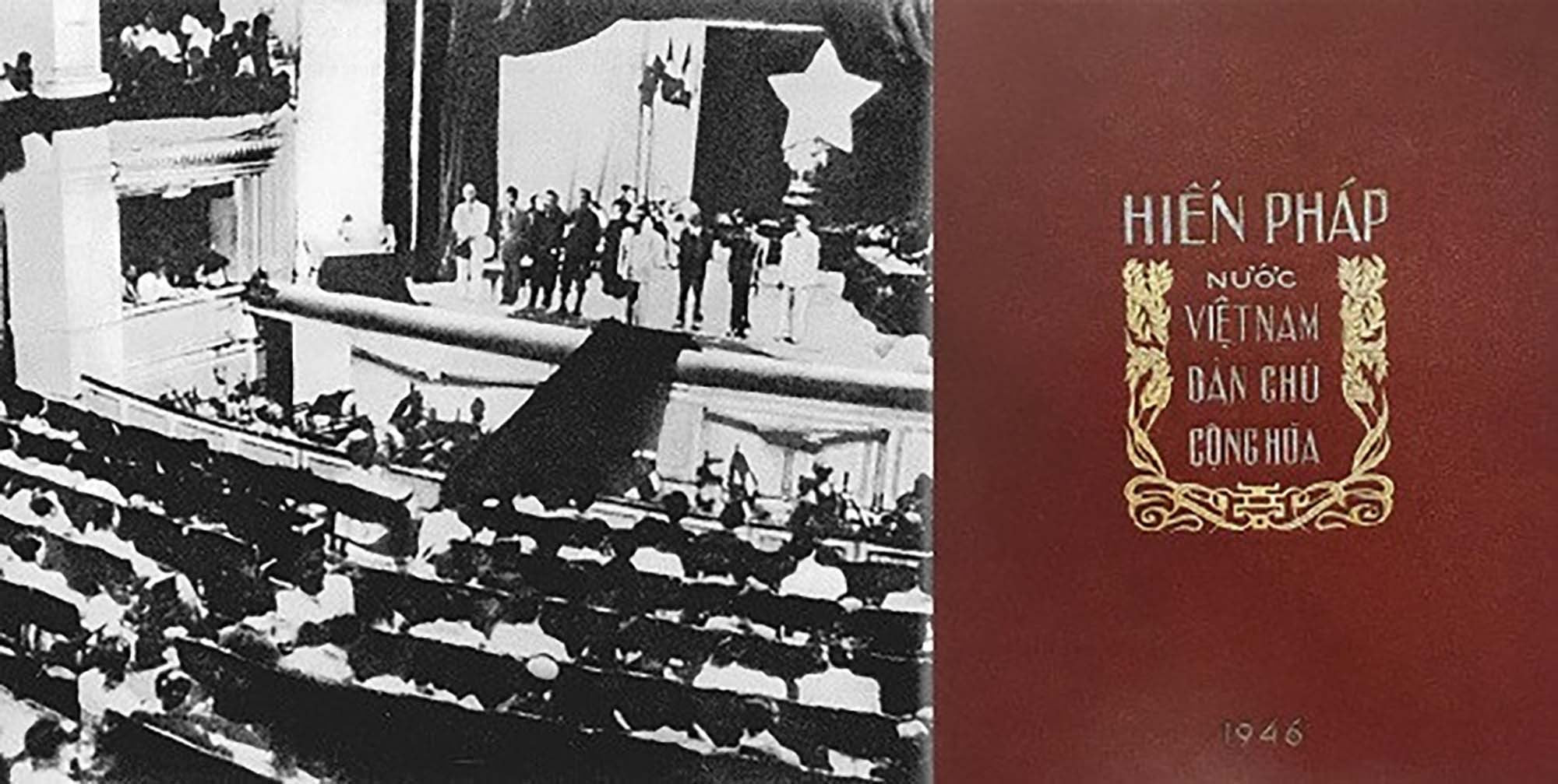
It should also be added that the first National Assembly had quite a few unique (even unusual) features compared to later National Assemblies. One of these unique features was that the National Assembly included many political parties: the Vietnam National Party (Viet Quoc); the Vietnam Revolutionary Party (Viet Cach); the Marxist group, the Democratic group, the Socialist group, the Viet Minh group, etc.
At the first session of the first National Assembly, the National Assembly established the Constitutional Subcommittee to continue studying the draft that had been published for public opinion. This subcommittee consisted of 11 delegates: Tran Duy Hung, Ton Quang Phiệt, Do Duc Duc, Cu Huy Can, Nguyen Dinh Thi, Huynh Ba Nhung, Tran Tan Tho, Nguyen Cao Hach, Dao Huu Duong, Pham Gia Do, and Nguyen Thi Thuc Vien. Based on the Government's draft, gathering the rich opinions of the entire population and drawing on the experience of European and Asian countries, the Constitutional Subcommittee compiled a new draft to be submitted to the National Assembly for consideration.
At the Second Session, on October 29, 1946, the Constitutional Subcommittee was expanded to include 10 additional members, comprising representatives from neutral groups, representatives from Southern Vietnam, and representatives from ethnic minorities, to participate in revising the new draft.
After the draft was revised, the National Assembly began discussions on November 2, 1946. Representative Do Duc Duc, a member of the drafting committee, was assigned to present the revised draft Constitution to the National Assembly. His presentation highlighted observations on the progress of the Vietnamese Constitution on the new democratic path compared to the constitutions of some other democratic countries.
At the same time, the draft Vietnamese Constitution also reflected the realities of the country and the rights and obligations of the people under the new regime.Representatives of the political parties in the National Assembly included: Ho Duc Thanh, representing the Viet Cach group; Tran Huy Lieu, representing the Marxist group; Hoang Van Duc, representing the Democratic group; Le Thi Xuyen, representing the Socialist group; Nguyen Dinh Thi, representing the Viet Minh group; Tran Trung Dung, representing the Viet Quoc group... all of whom successively expressed their group's opinions. All opinions highlighted the advantages and progressive nature of the draft Constitution, while also contributing specific aspects, and ultimately, they all voted in favor of passing the draft...
Delegate Tran Trung Dung, while agreeing with the idea, disagreed with the unicameral system. He argued that the Vietnamese people have not received much political training and feared that a unicameral system would not be suitable for Vietnam. Delegate Viet Quoc Pham Gia Do also disagreed with the unicameral system, arguing that a bicameral system is necessary because a unicameral system is "dictatorship of the majority"!
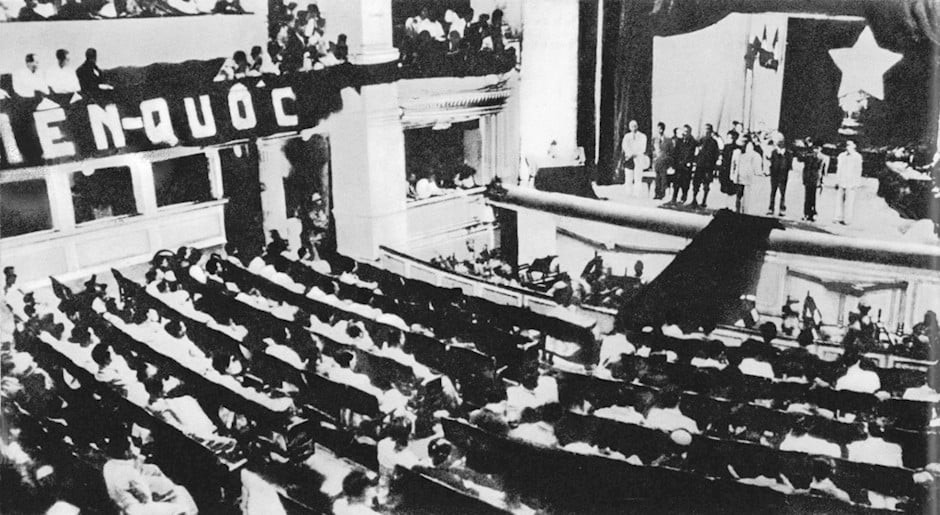
Delegates Ho Duc Thanh, Do Duc Duc, Dinh Gia Trinh, Dao Trong Kim, and many others all supported the unicameral system. Delegate Dao Trong Kim emphasized: The Constitution has reflected the aspirations of the people. A centralized system with a division of labor is very suitable for responding quickly to ever-changing circumstances.Representative Khuất Duy Tiến debated with Phạm Gia Đỗ and clearly stated that the Vietnamese Constitution is very progressive. The Vietnamese political system is a centralized system with a clear division of labor. We all cherish freedom, but we must remember that individual freedom must not conflict with the supreme interests of the nation. Individuals who want freedom must strive to fight to protect their country.
Delegate Tran Trung Dung also spoke extensively about citizens' freedoms but deliberately criticized the Government , claiming that in its first year in power, it had not yet granted the people the freedoms they desired (as outlined in the draft Constitution). Delegate Pham Van Dong, the chairman of the session, immediately argued with Tran Trung Dung that his criticism of the Government was incorrect, as the Government had made strenuous efforts to preserve the newly won independence of the country during the past year. Delegate Khuat Duy Tien, in turn, criticized Tran Trung Dung for denying the democratic foundations of Vietnam after the August Revolution.
After numerous lively discussions and debates, and revisions to each article, the National Assembly unanimously approved the draft Constitution. The entire National Assembly recognized the red flag with a yellow star as the sacred flag of the Fatherland, a recognition beyond dispute, and all stood up solemnly to salute the national flag and sang the "Marching Song" in unison. On November 9, 1946, the National Assembly voted to approve the Constitution of the Democratic Republic of Vietnam with 240 votes in favor out of 242 delegates present. Two delegates, Pham Gia Do and Nguyen Son Ha, voted against it.The first Constitution consisted of a Preamble, 7 chapters, and 70 articles. The Preamble clearly stated the great achievements of the Vietnamese revolution, the tasks of the entire nation in the new stage, and the principles for building the Constitution. These were: “The August Revolution regained sovereignty for the country, freedom for the people, and established a democratic republic.”
After eighty years of struggle, the Vietnamese people have escaped the oppression of colonial policies and simultaneously overthrown the monarchical system. The nation has embarked on a new path.Our nation's task during this period was to preserve our territory, achieve complete independence, and build the nation on a democratic foundation.Entrusted by the nation with the responsibility of drafting the first Constitution of the Democratic Republic of Vietnam, the National Assembly recognized that the Vietnamese Constitution must record the glorious achievements of the Revolution and must be built upon the following principles:
- Unity of all people, without distinction of race, gender, class, or religion.
- Ensuring democratic freedoms and rights.
- Implementing the strong and wise policies of the people.
With the spirit of solidarity and the inherent striving of the entire people under a broad democratic regime, independent and unified Vietnam is advancing on the path of glory and happiness, in sync with the progressive trend of the world and the aspiration for peace of humanity " (1) .
The Constitution, the fundamental law of the Democratic Republic of Vietnam, stipulates: the form of government (Chapter I), the duties and rights of citizens (Chapter II), the People's Parliament (Chapter III), the Government (Chapter IV), the People's Councils and People's Committees (Chapter V), the judicial system (Chapter VI), and amendments to the Constitution (Chapter VII).
Regarding the great significance of the Constitution, in "The message of the Vietnamese National Assembly at its 2nd session on November 9, 1946 to the people of the whole country," on behalf of the Presidium, the Head of the delegation, Mr. Ton Duc Thang, once again emphasized: "The National Assembly has completed the most arduous task entrusted to it by the people, which is to draft the first Constitution of the Democratic Republic of Vietnam. That Constitution has recorded the glorious victories of the August Revolution. That Constitution has upheld the spirit of national unity and established a broad democratic political system. The national flag, the red flag with a yellow star, and the national anthem, the Marching Song, have been officially recognized" (2) .
Looking back at the historical context of 1946, immediately after the success of the August Revolution, the French colonialists frantically waged war to seize our country once again; they occupied the South, gradually expanding into the South Central region and the Central Highlands. However, the young Democratic Republic of Vietnam remained steadfast and operated with remarkable effectiveness. The National Assembly held its full two sessions each year, making extremely important decisions.
The people at that time clearly understood that the National Assembly was responsible for drafting the Constitution so that all activities would aim to consolidate and promote the independence, freedom, and democracy of the country. In that context, the National Assembly continued to highly promote democracy in its parliamentary chamber. Despite differing opinions from various parties and factions, under the brilliant leadership of the Communist Party of Vietnam and President Ho Chi Minh, the National Assembly fulfilled its noble mission, consolidating the state apparatus, passing the first Constitution – the 1946 Constitution – and many other laws, including the Labor Code.
Perhaps we all realize that the fundamental provisions of the 1946 Constitution have been inherited and developed through the Constitutions of 1959, 1980, 1992, and 2013. Even after 80 years, the core contents of the first Constitution retain their historical value and clearly reflect the strategic vision of the first National Assembly – the first term of the National Assembly.
This article is based on the Complete Collection of National Assembly Documents and the History of the Vietnamese National Assembly 1946-1960.
(1) Complete National Assembly Documents, Volume I, National Political Publishing House, Hanoi. 2006, pages 103-104.
(2) As in (1), page 100.
Translated by Hong Nhung