

Ensuring the rights of the holder of a Plant Variety Protection Certificate
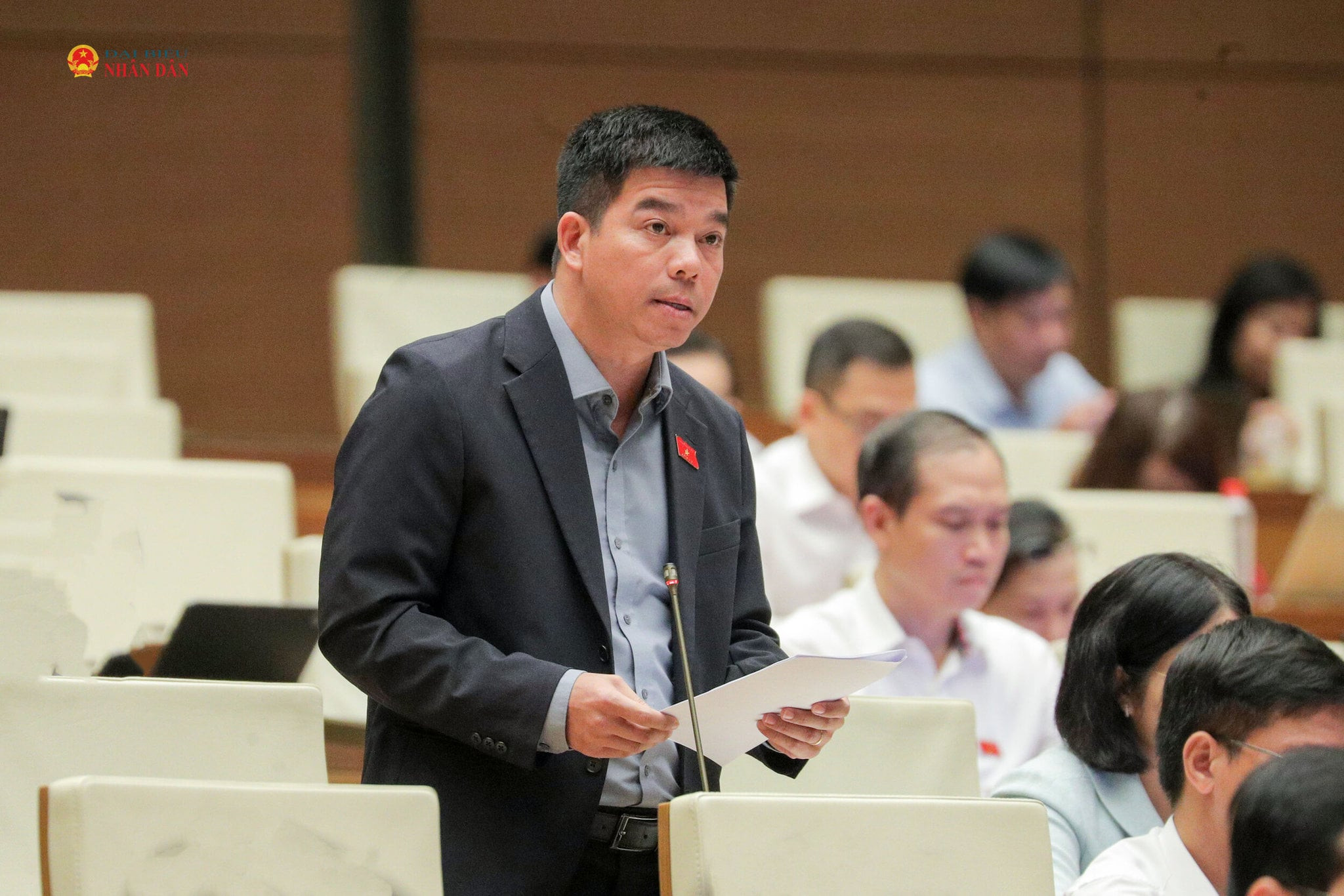
During the National Assembly discussion on the draft Law amending and supplementing a number of articles of the Intellectual Property Law on the morning of November 3rd, National Assembly Deputy Nguyen Van Ngoc (Lam Dong) proposed adding a regulation to notify the holder of a plant variety protection certificate before suspending its validity; and also clarifying the transitional provisions and strengthening control over plant variety testing activities.
Don't lose protection rights just because late paying fees
Agreeing with the necessity of amending the Law and bringing plant variety protection under a single authority along with inventions and trademarks, delegate Nguyen Van Ngoc argued that the new regulations need to ensure a balance between the requirements of administrative procedure reform and the protection of the legitimate rights and interests of organizations and individuals owning plant varieties.
Commenting on the regulation regarding the suspension of patents due to non-payment of fees in Article 170, Representative Nguyen Van Ngoc argued that the draft Law stipulates that patents are automatically suspended but omits the requirement to notify the patent holder and the deadline for rectification as currently stipulated. This approach does not ensure that the patent holder is required to fulfill their fee payment obligations under the UPOV Convention.
According to the delegates, plant variety protection certificates in Vietnam include farmers, research institutes, and universities that own varieties created with state budget funds. In one case, a farmer in Hung Yen province owned 14 protected rice varieties. Meanwhile, developing a new plant variety takes many years, even a lifetime of effort. Therefore, protection rights should not be lost simply because of a single late payment of fees without prior notification to the certificate holder.
Delegates argued that publishing information in the Official Gazette cannot replace direct notification to the rightful parties; moreover, the deadline for rectification stipulated in the circular may change, lacking the necessary stability.
Therefore, the delegates proposed adding to Article 170 a provision that the state management agency for plant variety rights must send notifications to the holder of the protection certificate electronically. The certificate holder has the right to request reinstatement within 6 months from the date the certificate was suspended; reinstatement does not affect the rights of those who exploited the variety in good faith during the period the protection certificate was suspended.
Regarding the transitional provisions in Clause 5 of Article 3, concerning the regulations on varieties of primary origin, Representative Nguyen Van Ngoc supported expanding the scope of this concept in Article 187 to conform with the UPOV Convention. However, the representative noted that applying the new regulations to all previously granted protection certificates could have legal consequences for entities legally exploiting plant varieties.
In fact, in the field of flowering plants and fruit trees, selecting a mutated branch from an existing variety for propagation is a fairly common breeding method. This is also a group of varieties that are at high risk of being significantly affected when the range of varieties originating from the same source expands.
The delegates emphasized that determining the primary origin of a breed should be based on prescribed criteria, but the new regulations should not create liability for activities that were legally carried out before the law came into effect.
Therefore, the delegates proposed adding a provision to Clause 5 of Article 3 to exclude the provisions of Clauses 1 and 2 of Article 187 from applying to plant varieties that have already been registered for protection, recognized for circulation, self-declared for circulation, or legally exploited before the effective date of the Law.
Avoid retroactive liability for lawful exploitation activities
Commenting on the regulation allowing applicants to conduct DUS trials themselves in Article 178, delegate Nguyen Van Ngoc assessed this as a suitable direction, contributing to reducing costs and creating favorable conditions for small businesses and farmers. Based on practical experience in Lam Dong, many businesses and farmers have reported that the cost of testing new varieties remains high.
However, delegates noted that DUS testing involves monitoring crops over multiple seasons, comparing them with similar varieties to assess distinctiveness, uniformity, and stability. If the selection of samples or control varieties is not objective, the test results may be inaccurate, directly affecting the quality and legal validity of the protection certificate.
Therefore, delegates argued that, in addition to granting organizations and individuals the right to conduct their own tests, it is necessary to establish a sufficiently rigorous inspection and supervision mechanism. Regulations on the right to conduct on-site inspections, take control samples, and request retesting should not be limited to the decree level but should be codified into law, especially since the draft expands the self-testing mechanism to include dossiers submitted before the Law comes into effect.
The delegates proposed adding to Clause 2 of Article 178 the responsibility of organizations and individuals conducting trials to retain seed samples and original data, and to be legally responsible for the accuracy of the results; at the same time, clearly defining the rights of state management agencies regarding plant variety rights in conducting on-site inspections, taking control samples, and requesting re-trials.
Emphasizing that good plant varieties are the culmination of many years of research, selection, and the efforts of farmers, delegate Nguyen Van Ngoc suggested that the drafting committee finalize the draft Law in a way that both simplifies procedures and ensures the strictness and stability of the law; thereby protecting the legitimate rights of plant variety owners and limiting the occurrence of disputes in practice.