

Vietnam, Czech Republic look to foster locality-to-locality cooperation
The Czech Republic's Karlovy Vary Region wishes to strengthen cooperation with Vietnamese localities in areas of mutual interest, including tourism, healthcare, education, heavy industry, and crystal and ceramic production.
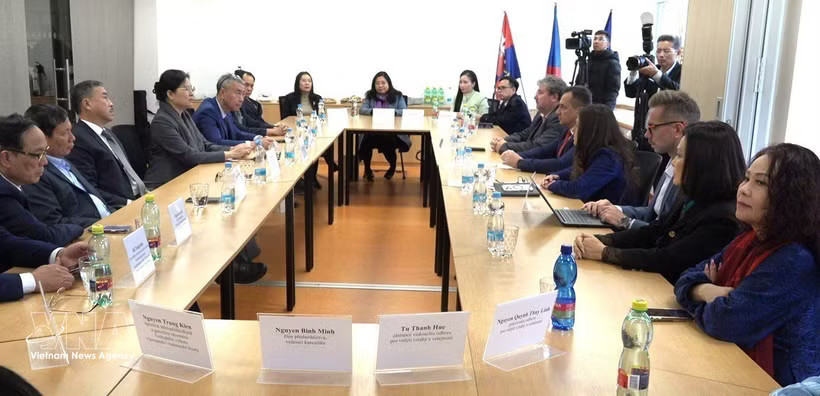
Prague (VNA) – Vietnam and the Czech Republic are looking to expand cooperation among their localities across various fields while providing greater support for the integration of the Vietnamese community into local society while preserving its national cultural identity.
This was the main focus of a November 3 meeting between a high-level delegation from the Vietnam Fatherland Front (VFF) Central Committee led by its Vice President and Secretary-General Ha Thi Nga, and Petr Kubis, Governor of the Karlovy Vary Region.
Kubis spoke highly of the Vietnamese community's contributions to the socio-economic development of the Czech Republic in general and the Karlovy Vary Region in particular.
He affirmed that the regional authorities would continue creating favourable conditions for Vietnamese residents to integrate more deeply into local society. Regarding local-level cooperation, he said that alongside its twinning agreement with Quang Ninh, the Karlovy Vary Region is ready to expand cooperation with other Vietnamese localities.
Building on its strengths in resort tourism, supporting industries and high technology, the region wishes to strengthen cooperation in areas of mutual interest, including tourism, healthcare, education, heavy industry, and crystal and ceramic production.
Nga briefed the meeting on Vietnam's socio-economic development achievements and praised the Karlovy Vary authorities' efforts to develop the region and their attention to the Vietnamese community. She stressed that nearly 90,000 Vietnamese people living in the Czech Republic, including those in Karlovy Vary, not only make active contributions to local socio-economic development but also serve as a bridge of friendship between the two countries' people.
To further promote this role, Nga called on the regional authorities to create favourable conditions for Vietnamese residents to settle down, conduct lawful business activities and enjoy their legitimate rights and interests. She also expressed her wish to step up people-to-people, cultural and educational exchanges, organise activities to introduce Vietnamese culture, and promote exchanges between young people and students of the two countries. She further proposed exploring expanded cooperation between Karlovy Vary and Vietnamese localities in tourism, human resource training and business networking.
Vietnamese Ambassador to the Czech Republic Duong Hoai Nam expressed support for these cooperation orientations, adding that the Vietnamese Embassy is working with the Czech Embassy in Hanoi to prepare for Prime Minister Andrej Babis's upcoming visit to Vietnam. He also proposed expanding cooperation in the training and recruitment of Vietnamese nursing staff to work in the Czech Republic, helping meet the country's healthcare workforce needs.
Referring to the Vietnamese community in Karlovy Vary, which numbers around 6,000 and accounts for approximately 2% of the region's population, the ambassador called on local authorities to facilitate the organisation of Vietnamese language classes in schools, helping younger generations of Vietnamese descent maintain their language and cultural identity. He also proposed that the authorities provide a site for the construction of a Vietnamese pagoda to meet the community's cultural and religious needs.
In response to these proposals, Kubis said he will give them due consideration, including the possibility of introducing Vietnamese language classes in schools across the region./.