

Proposal to accept and utilize assets that have been requisitioned in cases of genuine urgency
Speaking in the National Assembly on the morning of November 3rd regarding the draft Law on the Acquisition and Requisition of Assets (amended), National Assembly Deputy Ngo Nam Cuong (Nghe An) proposed allowing the acceptance and use of assets that have been legally requisitioned in truly urgent situations without waiting for the owner or direct manager to hand them over. However, the deputy also noted the need to clarify the mechanism for receiving assets when there is no one to hand them over.
Ensure that the lack of personnel during the handover process does not slow down the rescue operation
While generally agreeing with the necessity of amending the Law on the Purchase and Requisition of Assets, National Assembly Deputy Ngo Nam Cuong acknowledged that the draft has incorporated and improved many positive contents, most notably promoting decentralization of power to the Chairman of the People's Committee at the commune level in urgent situations, supplementing mechanisms for mobilizing professionals to operate requisitioned assets, and strengthening the protection of the legitimate rights and interests of asset owners.
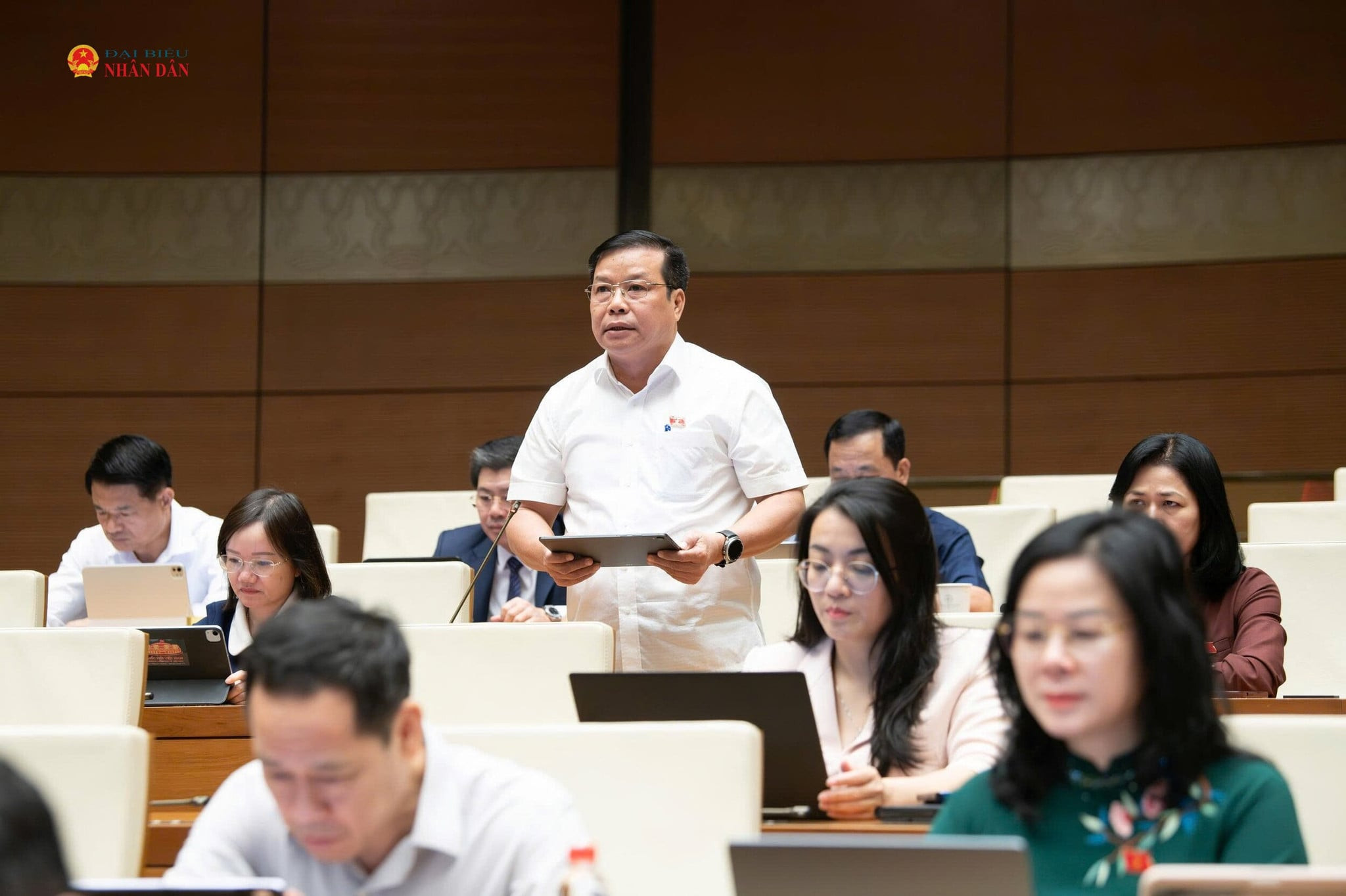
Based on practical experience in civil defense, rescue, and relief work in the North Central region, delegates proposed further improvement of the mechanism for receiving assets when the area is isolated, communication is lost, and the owner of the assets is absent.
According to the delegates, the "four on-the-spot" principle requires proactive preparation, the use of local resources, and support from outside. However, when floods and landslides disrupt transportation, cause power outages, and cut off telephone signals, rescue efforts cannot wait until communication is restored.
The delegate presented a scenario where a village was isolated and needed excavators, bulldozers, and trucks to open roads to rescue residents. The equipment was available in the area, and the rescue team had qualified personnel to operate it, but the owners and managers had evacuated and could not be contacted. The equipment was available, and there were operators, but no one to directly take over the operation.
Meanwhile, Article 24 of the draft Law stipulates the authority of the Chairman of the People's Committee at the commune level to requisition assets in cases prescribed by law; Article 30 allows for the mobilization of other individuals with sufficient professional qualifications to operate the requisitioned assets. However, according to the delegates, the mechanism for receiving assets when there is no one to hand them over needs to be clarified.
Based on this reality, delegate Ngo Nam Cuong proposed amending Clause 2 of Article 24 to the effect that, in truly urgent situations, when a legally prescribed requisition decision has been made, the organization receiving and using the asset should be allowed to do so without waiting for the owner or direct manager to hand it over.
At the same time, the current state of the asset, the time and reason for the absence of the person handing it over must be recorded; the receiving unit, scope of use, responsibility for safe maintenance and operation, return and compensation must be clearly identified; and the asset owner must be notified as soon as contact can be made.
The delegates also proposed that the Law should immediately stipulate the principles, conditions, and limitations for applying the special mechanism; and that Clause 3 of Article 24 should be revised to entrust the Government with the authority to regulate the detailed procedures for inventory, verification, handover, and completion of documentation in the event of communication loss, avoiding the addition of a clause that assigns the responsibility for detailed regulations.
Clearly define the conditions and legal limitations for the extension
Regarding the duration of property requisition, Representative Ngo Nam Cuong stated that Clause 3, Article 25 of the draft Law stipulates that each extension of requisition shall not exceed 15 days; Clause 1 already has a separate time limit mechanism for some special situations.
According to the delegates, in civil defense, disaster prevention and control, and disease control, there are tasks that require the continuous use of assets for weeks or months. The practical experience of COVID-19 prevention and control shows that the need for facilities to serve disease prevention can be prolonged.
If the 15-day extension procedure had to be repeated in every case, it could create additional procedures and affect the continuity of the task.
Therefore, the delegates proposed amending Clause 3 of Article 25 to distinguish between regular extensions and cases of special tasks requiring continuous use of assets for extended periods; clearly defining the conditions and legal limitations for longer extensions, while avoiding duplication with the special time limit mechanism in Clause 1.
In addition, National Assembly Deputy Ngo Nam Cuong proposed amending Clause 4 of Article 25 to stipulate that before each extension, the competent authority must reassess the necessity, scope of assets to be requisitioned, the expected duration, and the feasibility of applying alternative measures; and simultaneously be held responsible for the extension decision.
According to the delegates, such regulations would both prevent procedures from disrupting urgent tasks and avoid prolonging requisition beyond actual needs, thus protecting the legitimate rights of citizens and businesses.