

FDI attraction requires outcome-based support policies: minister
According to the minister, the draft law is being revised against the backdrop of projected total social investment demand for 2026-2030 being 2.21 times that of the 2021-2025 period. Disbursed foreign direct investment (FDI) alone needs to reach an average of 30-40 billion USD annually, six to seven times the level recorded in the previous period.
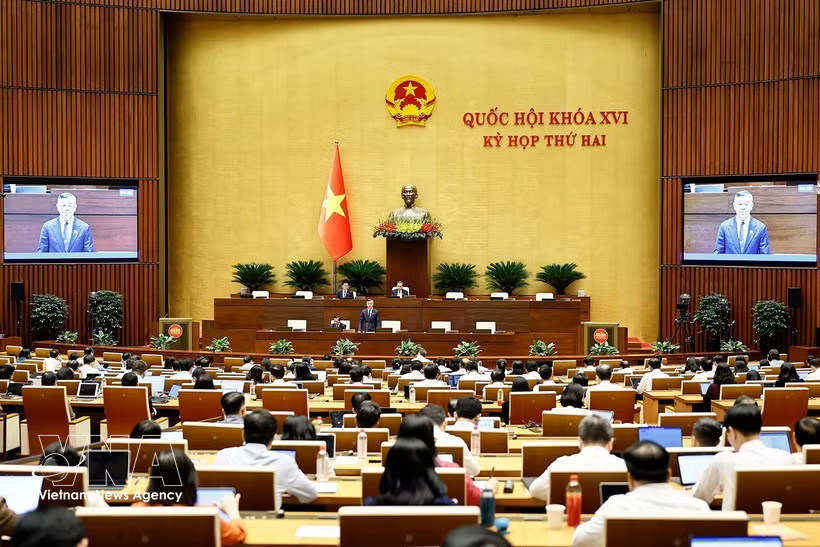
Hanoi (VNA) – Draft amendments to the Law on Investment are intended to meet the requirement for growth of at least 10%, enhance Vietnam’s competitiveness in attracting foreign investment and ensure the quality of capital inflows, particularly the level of participation by Vietnamese businesses in global value chains, Finance Minister Ngo Van Tuan said at a discussion on the bill during the 16th National Assembly’s second session November 2.
According to the minister, the draft law is being revised against the backdrop of projected total social investment demand for 2026-2030 being 2.21 times that of the 2021-2025 period. Disbursed foreign direct investment (FDI) alone needs to reach an average of 30-40 billion USD annually, six to seven times the level recorded in the previous period.
This is one of the reasons why further improvements to the investment environment are needed to make Vietnam more attractive to international investors. The amendments are also aimed at institutionalising Party resolutions on reforming FDI attraction, as well as revising the Land Law, spatial planning and regional spatial restructuring.
Tuan stressed that competition among countries for FDI is becoming increasingly fierce. Many countries in the region and around the world are offering incentives in sectors prioritised by Vietnam, including electronics, computers, mobile phones, semiconductor chips and digital transformation. He said Vietnam needed to continue refining its incentive policies to enhance competitiveness and attract high-quality projects.
However, the key issue is not simply attracting large volumes of capital, but also ensuring tangible results. Accordingly, the draft law provides for special investment incentives in priority industries and sectors, particularly innovation, scientific and technological transfer, and digital transformation.
Notably, investment support policies should be tied to measurable outcomes, with specific criteria for inspection, supervision and evaluation. The minister said the drafting body will take on board deputies’ views to the fullest extent in this direction, while studying conditions for terminating support if investors fail to fulfil their commitments.
Clearly stipulating responsibilities and conditions for terminating incentives is also intended to minimise the risk of international investment disputes, which are often complex.
Regarding the scope of the Law on Investment, previous amendments have focused mainly on cutting business conditions, removing 62 business lines and reducing requirements for 14 conditional business lines.
Taking deputies’ opinions into account, the minister said a comprehensive review and assessment are needed to clearly distinguish business and investment conditions from market access and entry requirements. This will ensure consistency between the Law on Investment and other relevant laws, while enhancing the long-term stability of the legal system.
Regarding the National Investment Fund, Tuan said it is being implemented under existing regulations and has initially operated in a stable and effective manner.
To strengthen oversight and ensure resources are used for their intended purposes and effectively, the minister proposed conducting annual State Audit examinations of the fund’s operations, alongside regular inspections.
For market access conditions falling under the authority of the Prime Minister and the National Assembly Standing Committee, the Government will compile a report and submit it to the National Assembly for consideration of amendments and supplements under simplified procedures, ensuring compliance with their respective mandates and the required timeline.
Tuan affirmed that the drafting body will seriously and fully consider deputies’ opinions to finalise the draft law for submission to the National Assembly for consideration and approval./.