

Vietnam seeks to unlock growth potential of low-altitude economy
Vietnam had significant opportunities to develop the low-altitude economy, given strong market demand and its potential applications across various sectors.
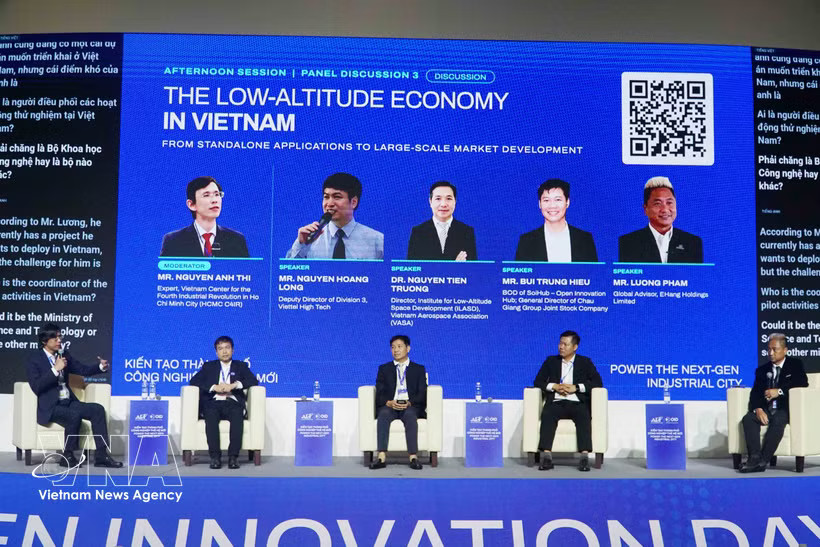
The low-altitude economy, built on unmanned aerial vehicles (UAVs), autonomous systems, connectivity infrastructure and data, is opening up new growth opportunities for Vietnam. However, unlocking its potential requires coordinated efforts to address institutional, technical infrastructure, market and investment efficiency challenges.
These issues were touched upon by domestic and international experts and businesses at a panel discussion on low-altitude economy in Ho Chi Minh City on October 26, as part of Open Innovation Day 2026, the opening event of the Autumn Economic Forum (AEF) 2026.
Bottlenecks need to be addressed
Nguyen Tien Truong, Director of the Institute for Low-Altitude Space Development (ILASD) under the Vietnam Aerospace Association (VASA), said Vietnam had significant opportunities to develop the low-altitude economy, given strong market demand and its potential applications across various sectors. These range from precision agriculture, urban surveillance and traffic management to search and rescue, disaster response, and border and island monitoring for national defence and security. Emergency medical deliveries and urban logistics are particularly promising amid increasingly congested roads.
Truong said Vietnam had research capabilities and the potential to develop technological infrastructure, catch up with global advances and gradually master digital infrastructure solutions while ensuring integration with international standards and maintaining control over data.
Based on research and field surveys, ILASD proposed prioritising four areas: precision agriculture, infrastructure monitoring, medical logistics and digital mapping, with data collection and development serving as the foundation for subsequent applications.
However, three major bottlenecks remain: the lack of a unified legal framework for low-altitude airspace management, insufficient battery life to meet operational requirements, and flight safety over populated areas. Without trial flights, safety data cannot be collected; yet the lack of such data makes it difficult to establish an appropriate legal framework, creating a risk of delays if testing must wait until regulations are fully developed, he said.
Nguyen Hoang Long, deputy director of the innovation division at Viettel High Technology Industries Corporation, said the biggest challenge was not necessarily technological capability but market demand and investment efficiency. State support during the initial stage was therefore needed to stimulate market development, he added.
Bui Trung Hieu, a member of the management board of SAIGONTEL’s SoiHub Open Innovation Centre, shared this view, noting that the domestic market was not large enough to drive growth of the low-altitude economy. Businesses conducting pilot projects faced uncertainty over future buyers, even if the State helped with initial orders. He said his company was pursuing two approaches: gradually developing domestic demand and joining global supply chains.
Infrastructure and regulatory sandboxes
Experts highlighted controlled testing mechanisms, or sandboxes, and infrastructure development as essential to advancing the sector.
Truong stressed that low-altitude space and data were national resources. Over the next one to two years, priority should be given to completing the sandbox mechanism and establishing testing zones to provide a practical basis for an appropriate legal framework.
Following Politburo Conclusion No. 99-KL/TW on exploiting, managing and protecting low-altitude space for national development in the new context, ILASD proposed establishing three testing zones representing different terrains in Dien Bien, Tay Ninh and Da Nang.
Joe Felter, CEO of US-based Pickaxe Technologies, said Vietnam should focus on practical missions rather than hardware alone. Testing zones should form a network, integrating sandbox mechanisms, technical standards, and research, testing, training, and manufacturing activities to accelerate product development and build manufacturing capabilities.
Long proposed prioritising valuable applications, infrastructure development and measures to stimulate market demand. While UAV manufacturing was increasingly accessible to technologically capable companies, operating an integrated low-altitude economy system safely required large-scale infrastructure, advanced technology and cross-sector coordination.
Luong Pham, global adviser at China's EHang, said Vietnam should initially establish local testing zones to demonstrate the feasibility of technologies, business models and operational approaches. The results of these real-world trials would then serve as a basis for further refining policies at the national level./.