

NA considers revised law to curb auction profiteering
To curb the activities of intermediaries who manipulate auctions and participants who have no genuine intention to buy, the draft stipulates that bidders who submit valid applications, pay the required deposits and attend an auction are deemed to have agreed to bid at least the starting price.
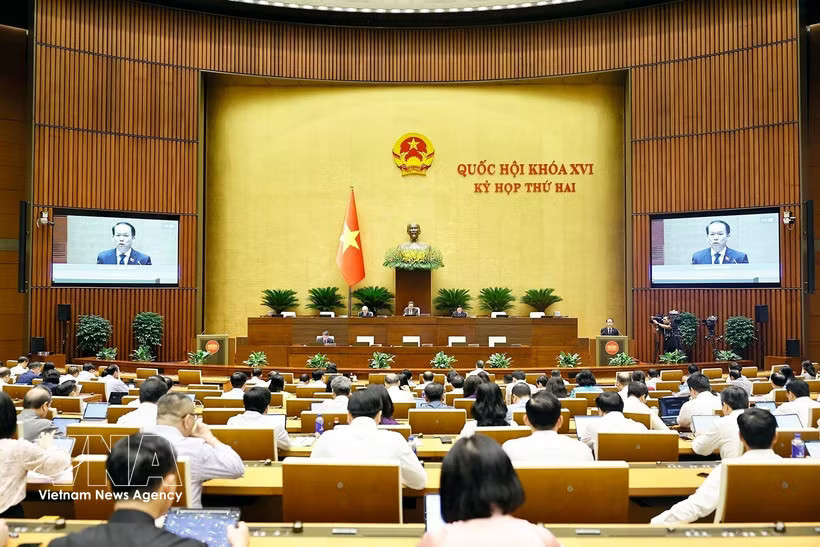
Hanoi (VNA) – A proposal and a verification report on the draft revised Law on Asset Auction were delivered to the National Assembly (NA) on October 19, aiming to curb profiteering, discourage speculative bidding and improve the transparency and efficiency of asset auctions.
Presenting the Government’s proposal at the ongoing second session of the 16th-tenure NA, Minister of Justice Hoang Thanh Tung said the draft law seeks to institutionalise Party policies on power decentralisation, administrative reform, digital transformation and the development of auction services under a socialist-oriented market mechanism. It would also strengthen efforts to prevent corruption, wastefulness and misconduct.
The draft comprises seven chapters with 64 articles, retaining effective existing provisions while addressing shortcomings in auction activities and improving state management.
Regarding auction businesses, the provisions incorporate regulations under Government Resolution No. 66.18/2026/NQ-CP on decentralisation and the simplification of administrative procedures and business conditions. The bill provides for their establishment and operation under the Law on Enterprises, provided they register asset auction services as a business line.
For assets that must be sold through auctions by law, public posting at commune-level People’s Committees would be required only for real estate.
The draft also proposes raising the deposit for auctions of land-use rights for residential land allocation to individuals to 20–50% of the starting price.
To curb the activities of intermediaries who manipulate auctions and participants who have no genuine intention to buy, the draft stipulates that bidders who submit valid applications, pay the required deposits and attend an auction are deemed to have agreed to bid at least the starting price.
It also introduces simplified auction procedures for certain low-value assets or cases requiring urgent handling, alongside online auctions for selected asset categories.
Individuals who win auctions of residential land-use rights but forfeit their deposits would face a ban on participating in such auctions. In addition, winners whose violations of the law lead to the cancellation of auction results would not receive their deposits back, helping cover compensation obligations arising from the cancellation.
Presenting the verification report, Chairman of the NA’s Committee for Economic and Financial Affairs Phan Van Mai said the draft basically meets legal requirements and is eligible for consideration by the legislature.
However, the reviewing body raised concerns about the proposed deposit range of 20–50%, noting that the maximum level could restrict access to auctions, increase capital costs and reduce competition.
It called for more data on cases of high bids followed by non-payment, an assessment of the proposed measure’s effectiveness, and clearer criteria for determining the deposit within the proposed range.
Regarding mandatory online auctions for assets established under public ownership with a total starting price of at least 200 million VND (over 7,700 USD), the committee requested further evidence supporting this threshold and measures to prevent assets from being divided into smaller lots or undervalued to avoid the requirement.
The committee also called for clearer legal safeguards for bona fide buyers who have paid in full, received assets or registered ownership before auction results are cancelled. The draft should clarify the handling of assets, payments, reasonable expenses, compensation and the rights of innocent third parties.
It further recommended clarifying the legal consequences when asset owners cancel transactions or auction approvals, and ensuring consistency in complaint and lawsuit deadlines with civil, administrative and related laws./.