

Swiss President’s visit to Vietnam to translate cooperation potential into tangible results
Ambassador Chau Mai Anh noted that while the past 55 years have laid a solid foundation of trust and cooperation, the Comprehensive Partnership heralds a new phase for the countries to expand areas of collaboration and translate commitments and existing potential into concrete projects delivering practical, long-term benefits for both countries.
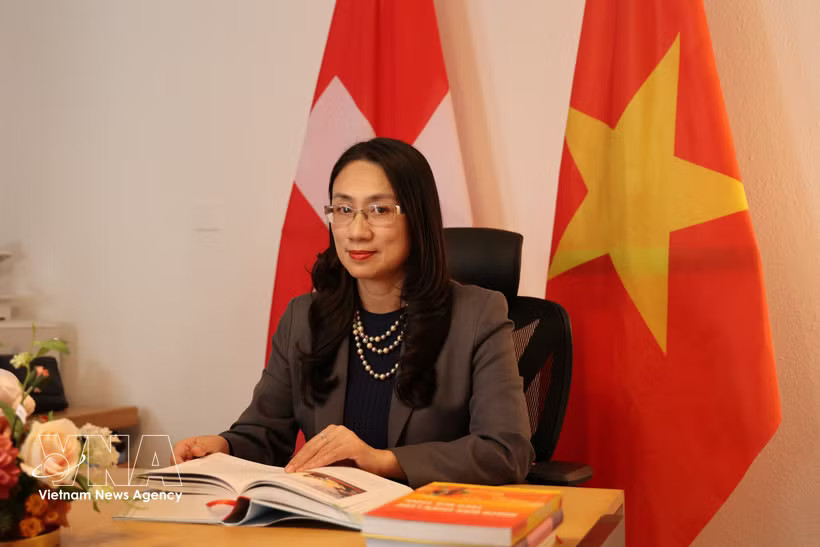
Geneva (VNA) – The official visit to Vietnam by Swiss President Guy Parmelin is expected to inject fresh momentum into bilateral relations, translating the two countries’ cooperation potential into tangible results, Vietnamese Ambassador to Switzerland Chau Mai Anh told a Vietnam News Agency (VNA) correspondent in Geneva.
The visit comes as Vietnam and Switzerland mark the 55th anniversary of diplomatic relations in 2026 and step up the implementation of their Comprehensive Partnership, established in January 2025. This provides a cornerstone for deeper political ties, more substantive economic cooperation and broader collaboration in emerging areas, the ambassador said.
Particularly, she noted, the trip is set to help turn existing cooperation opportunities into concrete results.
The planned signing of a free trade agreement between Vietnam and the European Free Trade Association (EFTA), involving Switzerland, Norway, Iceland and Liechtenstein, in Hanoi is a significant milestone that could make a new breakthrough for bilateral economic ties, Anh went on, adding that the deal is expected to create more favourable conditions for the two countries' businesses to increase investment, expand partnerships and better tap into both sides' market potential.
Swiss businesses' growing interest in the Vietnamese market has created more chances for new partnerships and joint projects while facilitating Vietnamese firms' access to science – technology and workforce improvement, thus supporting the country’s development ambitions.
The ambassador noted that while the past 55 years have laid a solid foundation of trust and cooperation, the Comprehensive Partnership heralds a new phase for the countries to expand areas of collaboration and translate commitments and existing potential into concrete projects delivering practical, long-term benefits for both countries.
Regarding the Vietnam–EFTA FTA, whose negotiations concluded on July 2, 2026, she stressed that the agreement should be viewed as more than a tariff-cutting mechanism. Its comprehensive scope covers trade in goods and services, investment, intellectual property, government procurement, sustainable development, small and medium-sized enterprises, cooperation and capacity building.
It will serve as a stepping stone of economic ties between Vietnam and EFTA members, including Switzerland, to grow more intensively and extensively, she opined.
Vietnamese industries with established export capabilities and foothold in Switzerland, including textiles and garments, footwear, electronics, machinery, equipment and certain agricultural and processed food products, are expected to benefit from improved market access.
Small and medium-sized enterprises capable of meeting international standards and producing higher value-added goods could also gain opportunities, alongside domestic manufacturers, original equipment manufacturers (OEMs) and suppliers seeking to join Swiss companies’ supply chains.
Technology-intensive and innovation-driven sectors are another potential beneficiary as the agreement could help expand exports while attracting Swiss investment, technology and research cooperation, Anh added.
Switzerland’s strengths in technology, innovation, pharmaceuticals, finance and high-tech manufacturing complement Vietnam’s strategic location in Asia and extensive network of FTAs. Given the two countries' economic complementarity, Swiss businesses should use Vietnam not only as a market of more than 100 million people but also as a base for investment, manufacturing, research and development, access to the wider ASEAN market and deeper engagement in regional value chains.
To maximise the agreement’s benefits, Vietnam needs to continue improving its investment and business environment to make it more transparent, stable, business-friendly and predictable, the ambassador said.
She also highlighted the need to strengthen domestic companies’ capacity to join Swiss supply chains, develop partnerships in technology and business, and expand cooperation in innovation, research and development, workforce training and technology transfer.
Combining Switzerland’s strengths in technology, innovation and governance with Vietnam’s manufacturing capacity, market potential and human resources will help the two countries move beyond trade expansion towards joint production, research, innovation and deeper participation in global value chains, she said./.