

Da Nang hosts fourth ASEAN–China Justice Forum
The forum offers a venue for participants to share experience in handling cross-border criminal cases and civil and commercial disputes, as well as to explore ways for more effective cooperation in line with national laws and international treaties.
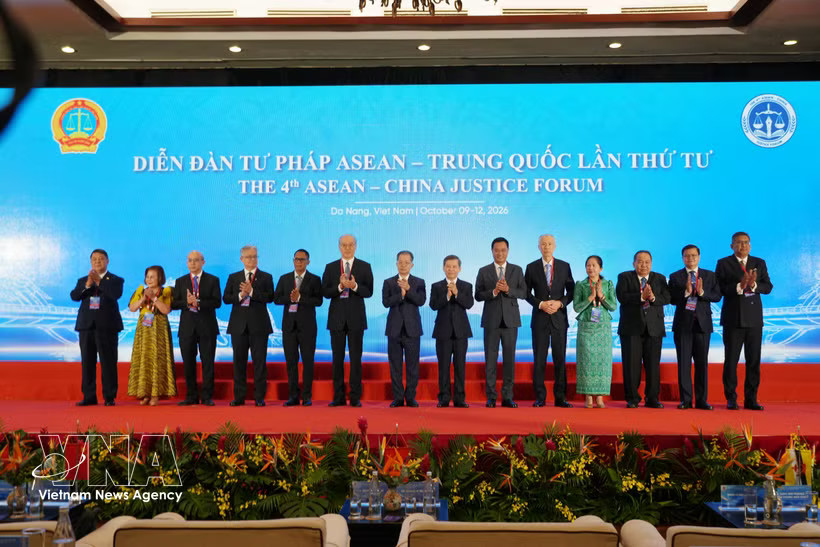
Da Nang (VNA) – The fourth ASEAN–China Justice Forum opened in the central city of Da Nang on October 10, focusing on strengthening regional judicial cooperation amid international integration and the digital era.
The forum brought together around 130 participants, including 70 representatives from foreign courts, 12 from foreign diplomatic missions in Vietnam and nearly 50 Vietnamese delegates.
Addressing the event, Chairman of the Party Central Committee’s Commission for Internal Affairs Le Minh Tri stressed that building and perfecting the socialist rule-of-law state, with judicial reform as a key component, remains a priority of the Vietnamese Party and State.
He noted that Vietnam shares many of the judicial challenges facing other ASEAN countries and China.
Vietnam always attaches importance to expanding international judicial cooperation, considering this as an effective measure to strengthen the capacity of judicial officials, including judges, and gradually modernise its judicial system. Such cooperation, he said, helps effectively combat crime, particularly transnational and high-tech crime, better protect the legitimate rights and interests of citizens and businesses amid integration, and promote public trust, fairness and justice.
Vietnam wishes to further deepen judicial cooperation with the Supreme People’s Court of China and the courts of ASEAN member states, thereby contributing to practical ASEAN–China cooperation based on peace, friendship, equality, sustainable development and mutual benefit, Tri stressed.
In his operning remarks, Chief Justice of the Supreme People’s Court of Vietnam Nguyen Van Quang highlighted the growing importance of judicial cooperation amid the flourishing economic and trade ties between ASEAN and China. He said such cooperation helps strengthen the legal framework, uphold justice and ensure a stable and transparent environment for cooperation.
The forum opens a new channel for promoting friendship, mutual understanding and experience sharing among judicial bodies in the region. Hosted by the Supreme People’s Court of Vietnam, the fourth edition of the forum continues the high-level dialogue mechanism, previously held in China in 2014, 2017 and 2022, Quang added.
The forum offers a venue for participants to share experience in handling cross-border criminal cases and civil and commercial disputes, as well as to explore ways for more effective cooperation in line with national laws and international treaties. Discussions also focus on developing electronic and smart courts, and applying artificial intelligence to modernise judicial systems, improve transparency and facilitate access to justice for citizens and businesses.
Zhang Jun, First-Rank Grand Justice and President of the Supreme People’s Court of China, described judicial cooperation as an important part of China–ASEAN relations, describing the forum as the highest-level, broadest-reaching and most comprehensive multilateral judicial cooperation platform between the two sides. The previous three editions, held in Nanning of China's Guangxi province, reached important common perceptions, including the Nanning Joint Statement.
He noted that this is the first time the forum has been held in an ASEAN member state, coinciding with the fifth anniversary of the elevation of China–ASEAN relations to a Comprehensive Strategic Partnership. The event is expected to support economic and social development in China and ASEAN and provide positive, stable and constructive judicial support for the region and the world.
Following the opening, discussions focused on cross-border criminal cases and civil and commercial disputes in the context of digital era, as well as experience in developing electronic courts and applying artificial intelligence to support adjudication. Participants also discussed and adopted a joint communiqué, recording the forum’s outcomes and setting orientations for future ASEAN–China judicial cooperation./.