

New value chains from two industrial – renewable energy centres
To implement the revised Power Development Plan VIII, the Ministry of Industry and Trade has proposed establishing two inter-regional renewable energy industrial and service centres in the northern and southern regions to develop the renewable energy sector and a complete value chain.
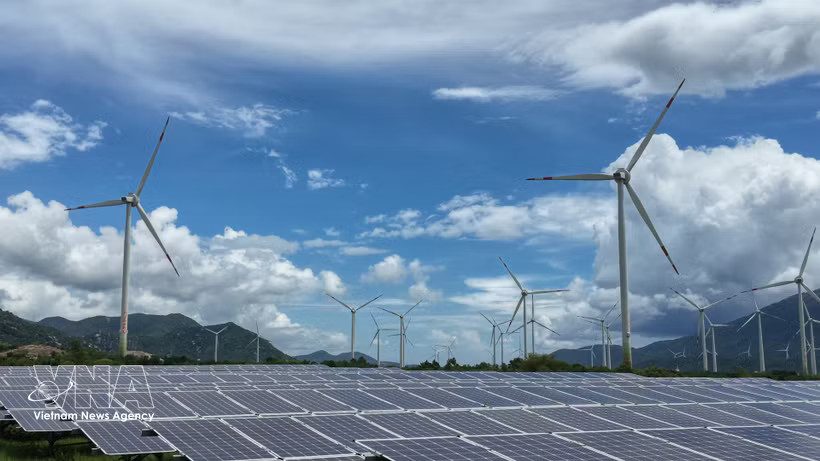
Under the revised Power Development Plan VIII, two inter-regional industrial – renewable energy centres in northern and southern Vietnam are expected to create ecosystems spanning the entire value chain, from clean power generation and mechanical manufacturing to logistics, operation and maintenance services, green industrial parks and human resources training.
The centres are hoped to help ensure energy security, cut emissions and create new growth drivers.
Clear policy direction in place
Under Politburo Resolution No. 70-NQ/TW, dated August 20, 2025, on ensuring national energy security through 2030 with a vision to 2045, national industrial – energy centres will be developed by integrating LNG, power generation, oil refining and petrochemicals, and renewable energy in localities with strong potential. The aim is to increase energy supply while building domestic industrial capacity through energy development.
The revised Power Development Plan VIII, covering the 2021–2030 period with a vision to 2050, also targets developing industrial and service ecosystems for renewable energy. It envisages the establishment by 2030, where conditions permit, of two inter-regional renewable energy industrial and service centres in areas with strong potential, including the northern, south-central and southern regions.
Each centre is expected to include renewable power plants, mainly offshore wind power ones, with a combined capacity of 2,000–4,000 MW, along with equipment manufacturing factories, support services, green industrial parks, research centres and training institutions.
To implement the revised Power Development Plan VIII, the Ministry of Industry and Trade has proposed establishing two inter-regional renewable energy industrial and service centres in the northern and southern regions to develop the renewable energy sector and a complete value chain.
The two centres will be strategically located to optimise the potential and advantages of each region. The northern centre has been selected for a developed seaport system and strategic geographical location, while the potential for future expansion into neighbouring areas has also been taken into account to ensure the project’s sustainability.
The southern centre is expected to capitalise on strong offshore wind and solar power potential, together with existing modern seaport infrastructure that facilitates equipment transport and product exports.
Policy support needed
Dr Pham Quy Ngoc, head of the Gas, Power and New Energy Department at the Vietnam Petroleum Institute (VPI) – a subsidiary of the Vietnam National Industry - Energy Group (Petrovietnam), said Vietnam already has the basic capabilities needed to develop an offshore wind power ecosystem, particularly in steel structure fabrication, offshore engineering, seaports, logistics and technical human resources.
Making full use of these capabilities could enable Vietnam to participate more deeply in the offshore wind value chain instead of focusing solely on power generation, he said.
Vietnamese enterprises already have the capacity to manufacture foundations and heavy steel structures, design and build offshore substations, work with international partners as main contractors, conduct offshore surveys and provide engineering and project services, as well as port, maritime operation and logistics services. The country also has a pool of personnel with experience in the oil and gas industry.
However, in areas where domestic enterprises cannot yet operate independently, Vietnam needs policies, including investment incentives, to develop domestic capacity while attracting FDI and promoting joint ventures, Ngoc noted.
Bui Vinh Thang, Vietnam Country Director of the Global Wind Energy Council (GWEC), shared the view that offshore wind power will not only generate electricity but also open up opportunities to develop a strategic industrial and service sector, enabling Vietnam to participate more deeply in global value chains.
With Vietnam targeting around 17GW of offshore wind capacity by 2035 under the revised Power Development Plan VIII, the country has considerable market potential for investors to develop equipment manufacturing and technology research and development. However, alongside market scale, investors need a clear development roadmap, with sufficiently large and stable demand and orders from year to year to feel confident about making long-term investments in manufacturing facilities, R&D and domestic supply chains, he said.
Vietnam also needs policies encouraging the development of domestic industries, services and supply chains, together with support in land access, taxation and market-facilitation mechanisms. These are key factors in promoting the offshore wind industry and related services in the country, Thang said.
Assoc. Prof. Dr Nguyen Van Thinh of the Faculty of Petroleum and Energy at the Hanoi University of Mining and Geology said Vietnam needs an appropriate roadmap for developing the industrial – renewable energy centres.
Initially, the centres should focus on areas where Vietnam already has demand and certain capabilities such as project development, surveying, engineering, construction, operation and maintenance, while gradually strengthening domestic manufacturing capacity.
At the next stage, the focus could shift towards establishing a complete value chain, from research, equipment design and manufacturing to project development, construction, operation and post-investment services.
Once the market scale and technological capacity reach an appropriate level, the centres could expand into green hydrogen, energy storage and marine energy technologies, he suggested./.