

Vietnam Int’l Financial Centre climbs global rankings, draws foreign capital
Ho Chi Minh City first entered the global financial centres ranking in 2022 at 102nd place and has risen consistently over the past three editions. In fintech, the city ranks 71st globally with 645 points, up 12 places.
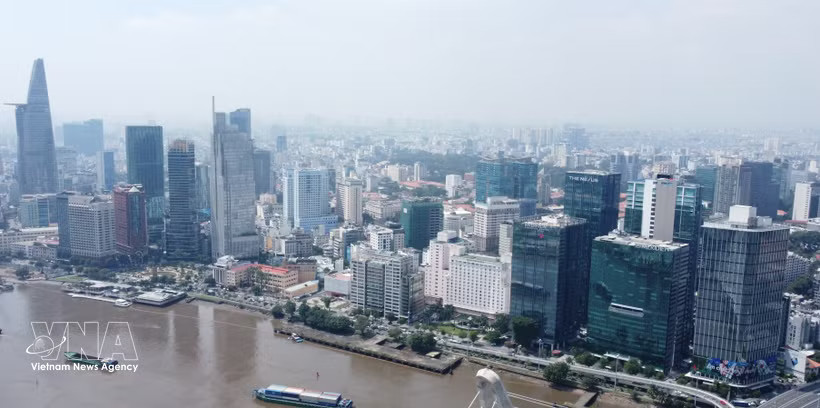
In the 39th edition of the Global Financial Centres Index (GFCI), released in March 2026, Ho Chi Minh City climbed 11 places from 95th to 84th. In the latest GFCI 40, released by the City of London's leading commercial think-tank Z/Yen and the China Development Institute (CDI) in September 2026, the city scored 692 points, gaining 17 places and 27 points from the previous edition.
This was the second-largest rise in the global rankings in the latest assessment, behind only Denmark's Copenhagen, which climbed 19 places. In Southeast Asia, Ho Chi Minh City currently ranks behind Singapore, Kuala Lumpur and Labuan, but ahead of Da Nang, Bangkok, Jakarta and Manila.
Ho Chi Minh City first entered the global financial centres ranking in 2022 at 102nd place and has risen consistently over the past three editions. In fintech, the city ranks 71st globally with 645 points, up 12 places.
In GFCI 40, Ho Chi Minh City was also voted by the international financial community among "the 15 centres likely to become more significant" over the next two to three years.
The city’s rise in the rankings has been accompanied by another important boost for Vietnam’s financial market, as FTSE Russell officially upgraded Vietnam’s stock market from frontier to secondary emerging market status on September 21, 2026.
Susan Langley, Lord Mayor of the City of London, said Vietnam’s progress was gaining international recognition, with the FTSE Russell upgrade reflecting major improvements in regulation, brokerage operations and capital mobilisation.
As GFCI 40 data were collected only through July 2026, the impact of the market upgrade was not reflected in the latest ranking. The move is therefore expected to provide further momentum for Ho Chi Minh City to attract stronger capital flows in subsequent editions.
Building financial ecosystem, connecting capital flows
Although the Vietnam International Financial Centre in Ho Chi Minh City (VIFC-HCMC) was officially launched only in February 2026, it has quickly moved beyond its initial stage to connect with actual investment resources.
Its capacity to connect with international finance is reflected in its strategic cooperation with the London Stock Exchange (LSE), the construction by Singapore’s UOB of the 450 million USD UOB Plaza Ho Chi Minh City, the first dedicated headquarters of a foreign bank within the VIFC-HCMC planning area, as well as its role in facilitating a 325 million USD international capital mobilisation deal for the education sector involving EQuest Group, Standard Chartered Bank’s New York branch and partners.
Bhaskar Dasgupta, a member of the VIFC-HCMC advisory board and former head of Market Infrastructure at Abu Dhabi Global Market (ADGM), the international financial centre and free economic zone of the United Arab Emirates, said that although VIFC-HCMC has been operating for only around seven months, its institutional framework, leadership structure, international partnerships and operating model have developed rapidly.
According to Associate Professor Dr Nguyen Huu Huan, Vice Chairman of the VIFC-HCMC Executive Board, the current priority is to move from a legal framework to a functioning market, with institutions operating, capital mobilised and financial products traded.
The FTSE Russell upgrade of Vietnam’s stock market opens broader access to international investment funds, particularly funds that allocate capital based on FTSE Russell indices. Ahead of the upgrade taking effect, major global asset managers such as BlackRock and Vanguard visited Vietnam for working sessions.
According to estimates by FTSE Russell, capital flows associated with the upgrade could reach around 6 billion USD, although the actual amount will depend on investors’ decisions and the market’s capacity to absorb the inflows.
For VIFC-HCMC, the opportunity lies not only in capital flowing into the stock market but also in directly connecting international funding with domestic development investment needs. A notable example is the cooperation agreement signed in September 2026 by Standard Chartered, EQuest and EQuest Capital to mobilise 325 million USD for education infrastructure in Vietnam.
International experts on the VIFC-HCMC advisory group said the city’s rise in global rankings is an encouraging signal, but stressed that the core strength of a financial centre lies in the depth of its operations and the quality of its ecosystem.
Sharing this view, Marc Knapper, a member of the VIFC-HCMC advisory group and former US Ambassador to Vietnam, noted that Ho Chi Minh City’s 17-place rise in GFCI 40 was among the strongest increases globally.
However, he said, the real measure is whether growing investor confidence translates into genuine capital flows. He said this would depend on a predictable regulatory environment, strong investor protection, increasingly deep and broad capital markets, and a highly skilled financial workforce.