

Ideological work must be grounded in reality and close to people: top leader
Ideological work must bring about tangible changes, stay close to reality and the people, proactively identify and promote the resolution of problems, provide timely information, and maintain honesty in dialogue, said top leader To Lam.
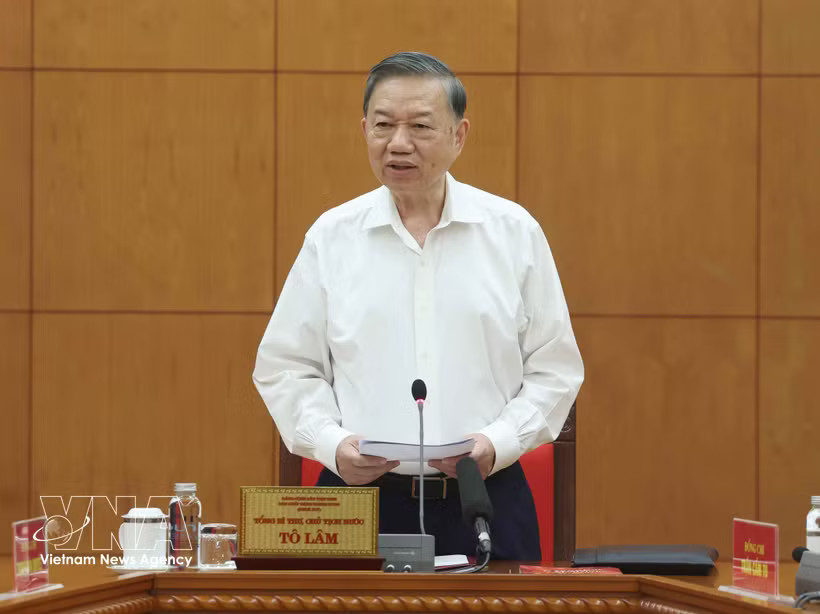
Hanoi (VNA) – General Secretary of the Communist Party of Vietnam Central Committee and President To Lam on October 1 chaired a working session with the Party Central Committee's Commission for Publicity and relevant agencies on public sentiment and the need to harness the combined strength of communications agencies.
Addressing the event, the top leader stressed that ideological work must begin with reality and that people's trust must be built through tangible results.
“A procedure resolved on time, a petition answered satisfactorily, a project completed on schedule, or a policy implemented fairly can all directly strengthen public trust,” he said.
According to him, ideological work is the leadership responsibility of Party committees and their heads, rather than the sole responsibility of the publicity sector. Agencies in charge of a particular field must explain and take responsibility for addressing issues arising in that field.
Agencies responsible for policymaking must be accountable not only for policy quality but also for implementation and for providing information and explaining policies. The Commission for Publicity should perform advisory, orientation, guidance, coordination and inspection functions, rather than assume the responsibilities of other agencies for accountability and correcting mistakes.
General Secretary and President To Lam said information about social life must reach those with decision-making authority and help drive the resolution of problems. Authorities must identify issues causing public concern and those responsible for addressing them.
A process should be established covering listening, verification, analysis, referral to the appropriate agency, handling, response and follow-up, he said, adding information on public sentiment must feed into the decision-making process.
“Building” and “fighting” must be closely combined, with “building” serving as the fundamental and long-term approach and persuasion as the primary method. Authorities must distinguish evidence-based criticism from inaccurate information caused by misunderstanding and from deliberate fabrication.
He noted that the effectiveness of ideological work must be measured by tangible changes in people's awareness and sentiment. It is necessary to assess what officials and citizens understand better after communication efforts and the degree of consensus achieved.
Regarding the need for innovation in policy making and implementation, General Secretary and President To Lam stressed that ideological work and policy communications must be closely linked to policy formulation and evaluation. From the preparation stage, there must be data, designated people responsible for explanations, and mechanisms for receiving feedback.
Forecasting and early warning capacity must be enhanced, along with efforts to promote problem-solving. Information must reach the appropriate authority and be accompanied by recommendations for action, he stated.
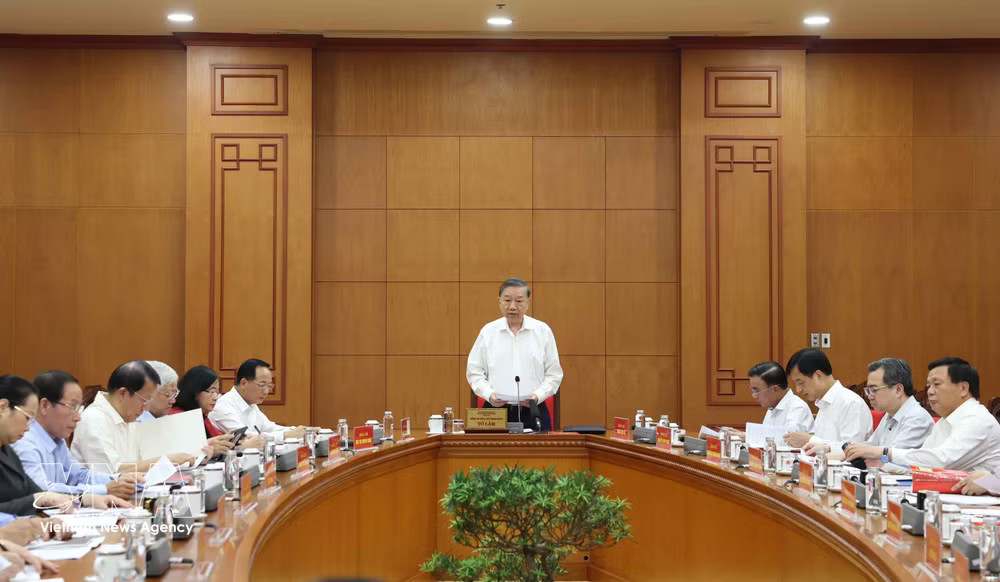
Outlining several key tasks for the coming time, the top leader said Party committee secretaries must directly monitor major ideological issues and emerging problems within their agencies and localities and personally direct the handling of complex situations. They must also listen to the concerns of officials directly serving the people. Those who shirk or evade responsibilities due to negligence must be dealt with strictly, while officials who dare to think, act and speak up for what is right and take responsibility for the common good must be protected.
Criteria on leadership of ideological work, discipline in public statements and responsibility for setting an example should be added to the review, assessment and classification of officials, he said.
Mechanisms to encourage and protect officials who dare to think, dare to act and dare to take responsibility for the common good should be urgently completed and submitted for promulgation, while those who evade or shirk responsibilities should be replaced in a timely manner, he stressed.
He called for fundamental reform of policy communications. From now on, for policies that have a major impact on people and businesses, the agency leading policy formulation must also be responsible for developing plans to provide information, explanations and receive feedback.
“Policy communications must be proactive but based on facts and accurate information, openly presenting both advantages and difficulties as well as impacts, without avoiding the mentioning of adverse effects on specific groups. When a policy gives rise to shortcomings, the first priority should be to study ways to fix them, rather than seek explanations to defend a decision that is not suited to reality,” he said.
General Secretary and President To Lam called for building truly capable leading press agencies that can explain issues and identify problems. Nhan Dan Newspaper, the Vietnam News Agency, Vietnam Television, the Voice of Vietnam and other leading press agencies must lead in credibility, analytical capacity, ability to explain major issues and ability to reach new audiences. They should share data, build on their respective strengths and create conditions for journalists to conduct well-grounded investigative reporting that identifies shortcomings in both policies and their implementation. In particular, their ability to reach, persuade and exert a positive influence on young audiences must be enhanced.
He also emphasised the importance of strengthening the capacity to master the digital space by proactively monitoring, analysing, orienting and handling information through appropriate technology, data, institutions and human resources.
“A shared data system should be developed to serve ideological work, with attention to access rights, data security, personal data, artificial intelligence applications, and the prevention and handling of fake and false information and violations. Technology should be used to better understand society, but it must not replace direct engagement with people, listening to them and addressing their concerns,” he stated.
Ultimately, ideological work is about people, stressed the top leader. To persuade the people, it is necessary to respect them; to strengthen trust, officials must act correctly and effectively; to build social consensus, policies and guidelines must stem from reality and the legitimate interests of the people; and to speak persuasively, it is necessary to listen.
“Technology may significantly change the methods of communication, but one thing will not change: lasting trust always stems from truth, responsibility, effective performance and a close relationship between the Party and the people,” he noted.
The effectiveness of ideological work must be assessed by whether public sentiment is genuinely and promptly understood, whether legitimate concerns are addressed, whether shortcomings are corrected, and whether feedback reaches those with decision-making authority, he added.
General Secretary and President To Lam said that following the working session, tangible changes must be achieved in practice. For every task, there must be a clearly identified lead agency responsible, along with clear assignments, deliverables, deadlines, coordination mechanisms and evaluation criteria. There must be no situation in which multiple agencies are assigned the same task but ultimately no one is clearly accountable.
“Ideological work must bring about tangible changes, stay close to reality and the people, proactively identify and promote the resolution of problems, provide timely information, and maintain honesty in dialogue,” he concluded./.