

Flexible fiscal policy helps drive economic growth
According to the Ministry of Finance, State budget revenue in the first eight months of 2026 was estimated at 2.02 quadrillion VND (77.7 billion USD), equivalent to 80% of the annual estimate and up 16% year-on-year. Domestic revenue reached 1.75 quadrillion VND, accounting for 86.6% of total revenue and rising 16.6%.
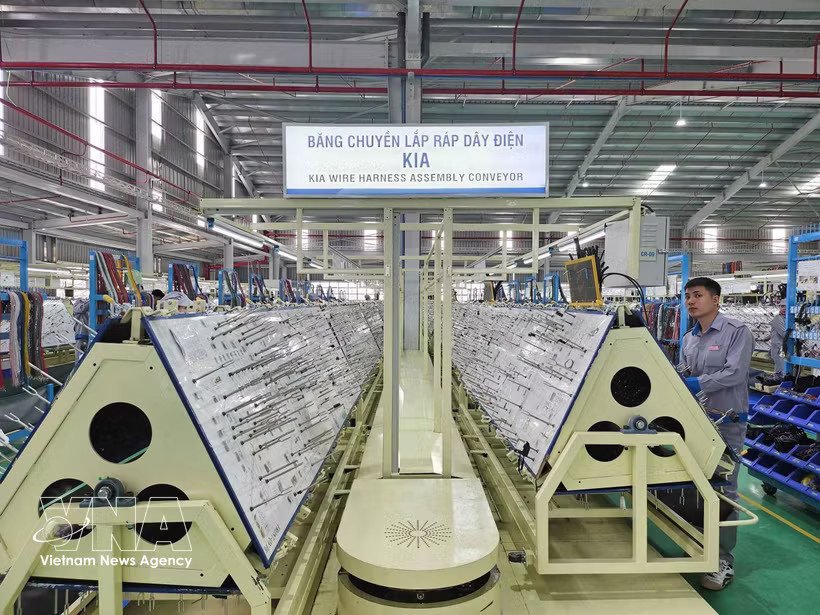
Vietnam’s fiscal policy has been implemented in a targeted expansionary manner since early 2026, helping maintain macroeconomic stability and supporting the country’s goal of achieving double-digit economic growth.
According to the Ministry of Finance, State budget revenue in the first eight months of 2026 was estimated at 2.02 quadrillion VND (77.7 billion USD), equivalent to 80% of the annual estimate and up 16% year-on-year. Domestic revenue reached 1.75 quadrillion VND, accounting for 86.6% of total revenue and rising 16.6%. Meanwhile, crude oil revenue stood at 43.6 trillion VND, exceeding the annual estimate by 1.5%, while revenue from import-export activities reached 223.9 trillion VND, up 7.9%.
The stronger revenue base has provided room for State budget spending and continued fiscal support. State budget expenditure in the period was estimated at over 1.6 quadrillion VND, equivelent to 50.0% of the estaimate and up 13.3% year-on-year. Tax, fee and land-rent exemptions, reductions and extensions were estimated to amount to around 209 trillion VND.
Dr. Mac Quoc Anh, Vice Chairman and Secretary General of the Hanoi Association of Small and Medium Enterprises, said tax and fee relief measures have had a noticeable impact on businesses, particularly amid pressures from input costs, capital, markets, competition and the need to transform growth models.
He noted that fiscal policy has shifted from temporary support to larger-scale, continuous and relatively comprehensive measures. The continued reduction of value-added tax (VAT) from 10% to 8% for many groups of goods and services through the end of 2026, for example, has helped reduce costs, stimulate consumption and support aggregate demand.
Under the National Assembly's Resolution No. 43/2026/QH16, businesses with annual revenue of no more than 10 billion VND are eligible for a 30% reduction in corporate income tax payable for the 2026 and 2027 tax periods, while business individuals meeting the corresponding revenue threshold are entitled to a 30% reduction in personal income tax.
Nguyen Van Duoc, General Director of Trong Tin Accounting and Tax Consulting Co., Ltd., said fiscal policy has shifted towards more targeted measures designed not only to ease immediate difficulties but also to create room for investment, production expansion and stronger competitiveness.
From the business perspective, An Phat JSC Director Nguyen Van Dieu said tax and fee relief, together with stronger public investment, could improve firms’ resilience, stimulate aggregate demand and expand business opportunities. He, however, stressed that policy effectiveness also depends on transparency, stability and accessibility, calling for simpler procedures and timely, comprehensive information on support programmes./.