

Key Party leader's visit to lay foundation for Vietnam-Singapore new-generation strategic relationship
The official visit to Singapore by Member of the Political Bureau and Standing Member of the Secretariat of the Communist Party of Vietnam (CPV) Central Committee Tran Cam Tu will provide an important political foundation for turning the Comprehensive Strategic Partnership (CSP) into concrete collaboration programmes.
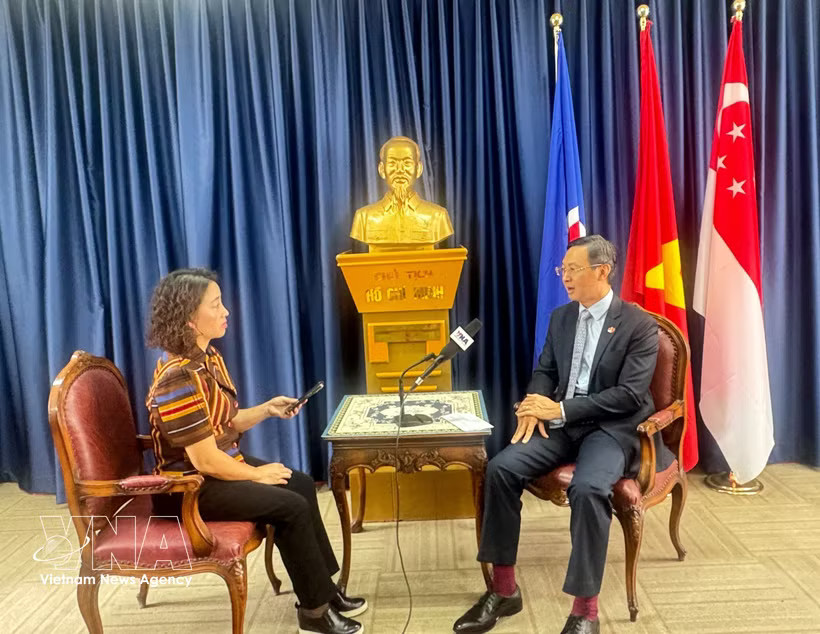
Singapore (VNA) – The official visit to Singapore by Member of the Political Bureau and Standing Member of the Secretariat of the Communist Party of Vietnam (CPV) Central Committee Tran Cam Tu and his co-chairing of the first Vietnam-Singapore Strategic Dialogue on August 24-25, carry landmark significance at the strategic, political and practical levels, said Vietnamese Ambassador to Singapore Tran Phuoc Anh.
First, the visit will open a new channel for strategic-level exchanges between the two countries - the Party-to-Party channel. This marks a shift from a “good relationship” towards a “strategic relationship”, enabling the two sides to engage in frank and in-depth discussions on long-term issues, including national development orientations, State building, economic development, social governance, personnel training, as well as regional and global developments, he told Vietnam News Agency correspondents in Singapore.
Second, the visit will provide an important political foundation for turning the Comprehensive Strategic Partnership (CSP) into concrete collaboration programmes. The first strategic dialogue will help the two sides identify new areas of cooperation beyond traditional fields such as trade, investment, education and defence-security. Particularly, Singapore has extensive experience in areas of interest to Vietnam, including artificial intelligence (AI), the digital economy, innovation, urban governance, human resource development, logistics, finance, and international connectivity.
Third, the visit offers an opportunity for the two sides to advance bilateral relations into practical areas aligned with Vietnam’s development priorities. Vietnam-Singapore cooperation in the coming period could move beyond the model of Singapore investing in Vietnam towards a deeper partnership model based on joint research, joint innovation, joint technology development, and joint participation in regional and global value chains.
Finally, Phuoc Anh said the most significant aspect of the visit is that it will create a new “architecture” for Vietnam-Singapore relations. Whereas bilateral ties have previously been driven mainly through Government-to-Government mechanisms and economic projects, a multi-layered structure could now emerge encompassing Party-to-Party, State-to-State, Government-to-Government, legislature-to-legislature, locality-to-locality and people-to-people ties, with the strategic dialogue serving as a bridge at the political-strategic level.
“I expect the dialogue to become not merely a high-level policy exchange mechanism, but a genuine new driving force for turning the major orientations of the two countries into concrete, breakthrough cooperation programmes and projects that create long-term value,” he said.
First, in the areas of green economy and energy transition, Vietnam wishes to draw on Singapore’s strengths in technology, green finance, governance and international connectivity to jointly promote clean energy, carbon credit and circular economy projects. A strategically significant avenue for cooperation will be to connect Vietnam’s energy production centres with Singapore’s financial, technological and market ecosystems, thereby developing cooperation models that could be replicated across the region.
Second, digital transformation, AI and innovation will form an important pillar. Singapore boasts extensive experience in developing digital government, data governance, AI and innovation ecosystems, while Vietnam has a large market, an increasingly strong technology workforce and substantial demand for digital transformation.
The two sides could go beyond experience-sharing towards jointly developing solutions, innovation centres, human resources training programmes and AI, data and digital technology projects serving public administration and businesses, the ambassador recommended.
Third, the dialogue could help remove bottlenecks in investment cooperation and business connectivity. Singapore is currently one of the largest investors in Vietnam, but there remains considerable room for further joint work, particularly in high technology, semiconductors, logistics, finance, smart cities, healthcare, education and emerging industries.
Finally, Phuoc Anh said the greatest value of the strategic dialogue lies in helping the sides anticipate new development trends in the region together, rather than simply addressing existing bilateral issues. With their CSP, high level of political trust and strong economic complementarity, the two countries are well placed to become ASEAN pioneers in green economy, digital transformation, AI, clean energy and innovation.
“If we can achieve this, the strategic dialogue will not only generate new projects, but, more importantly, create new models of cooperation, making a practical contribution to building a more dynamic, more creative, greener and more competitive ASEAN,” he said.
The ambassador noted that the visit and the dialogue carry significance beyond the bilateral framework, as they also represent a practical contribution to ASEAN solidarity, unity and centrality.
Vietnam and Singapore share core interests in building a united, self-reliant and adaptable ASEAN that plays a proactive role in the regional architecture. The dialogue will provide an additional channel for the two sides to discuss strategic issues, narrow differences, strengthen trust and coordinate more closely within ASEAN, he added./.