

Top leader’s New Zealand visit opens new phase in bilateral cooperation
The top Vietnamese leader’s state visit to New Zealand has generated fresh momentum for deeper bilateral ties, bringing practical benefits to Vietnamese and New Zealand people and businesses while contributing positively to peace, stability, cooperation and development in the region.
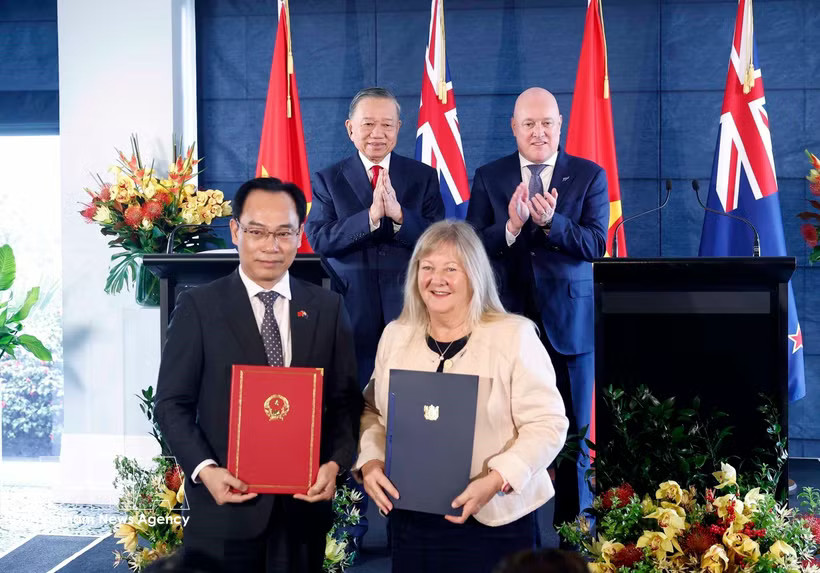
Hanoi (VNA) - The state visit to New Zealand by General Secretary of the Communist Party of Vietnam Central Committee and President of Vietnam To Lam and a high-ranking Vietnamese delegation from August 12-13 reaffirmed Vietnam’s consistent policy of valuing ties with New Zealand, a friendly partner with great potential and many similarities with Vietnam in the South Pacific, while marking an important milestone, opening a new phase of more substantive, effective, innovative and sustainable cooperation.
Promoting research, innovation and knowledge transfer
Over the years, education cooperation has become an important bridge between Vietnam and New Zealand. Education and training have consistently been one of the most sustainable and successful pillars of bilateral ties.
Speaking at the Viet Nam - New Zealand Higher Education and Skills Forum, General Secretary and President Lam proposed that the two sides jointly develop high-quality human resources for the digital, green, circular and knowledge economies, prioritising areas of strong demand and complementarity such as AI, data science, digital technology, cybersecurity, biotechnology, smart agriculture, food technology, renewable energy, environmental technology, public administration and emerging occupations of the future.
New Zealand Minister for Tertiary Education and Minister of Science, Innovation and Technology Penny Simmonds expressed a desire to continue educational cooperation to equip students with skills for success in the current era. She pledged that the New Zealand Government will continue supporting short-term English training courses for Vietnamese officials, facilitate student and academic exchanges, and promote cooperation between universities so that Vietnamese students can access New Zealand-quality education in Vietnam.
General Secretary and President Lam suggested that the two sides promote research, innovation and knowledge transfer. Universities and research institutes should become centres of knowledge creation, connecting businesses and addressing development challenges, while establishing more joint research groups, co-supervised doctoral programmes, innovation projects and mechanisms for applying research results in practice.
They should also strengthen vocational education and skills development through flexible training programmes, recognition of credits and competencies, workplace training and reskilling.
Student, lecturer, scientist, expert and education manager exchanges will continue to expand. Each lecturer, scientist and student can serve as an ambassador of knowledge and friendship, helping deepen and broaden bilateral ties.
Cooperation agreements should soon be translated into concrete action programmes with clear objectives, focal points, resources, outputs and evaluation mechanisms. Education cooperation in the new period should be measured by tangible outcomes: better learner skills, stronger innovation at educational institutions, a workforce better suited to business needs and greater benefits for society from knowledge and innovation.
Creating fresh momentum for deeper Vietnam-New Zealand cooperation
New Zealand has extensive experience in developing a high-quality, flexible and learner-centred education system linked to practical skills, research, innovation and economic needs. It also has strengths in high-tech agriculture, food technology, resource management, the green economy, digital transformation, sustainable development and modern public governance. These areas match Vietnam’s development needs and offer substantial opportunities for practical bilateral cooperation.
Vietnam is one of New Zealand’s important partners in Southeast Asia, with a fast-growing economy, a market of more than 100 million people, a young workforce and deep integration into global trade. The country is opening new opportunities for international cooperation and investment and wants New Zealand businesses to view Vietnam not only as a market but also as a partner in research, product development, manufacturing and innovation in Southeast Asia. Vietnam is ready to serve as a gateway for New Zealand businesses to expand into ASEAN, while New Zealand can serve as a bridge for Vietnamese businesses to participate more deeply in high-quality value chains in the Pacific region.
The two economies are highly complementary, and both sides identify trade and investment as key areas of cooperation with considerable untapped potential, particularly in agricultural, aquatic and seafood trade.
At the New Zealand-Vietnam Business Roundtable, New Zealand Minister for Trade and Investment Todd McClay said that alongside traditional areas such as agricultural products and food, the two countries have considerable room for cooperation in high-tech agriculture, health technology, education, research and skills development. The next phase of New Zealand-Vietnam economic ties will increasingly be driven by knowledge, technology and innovation. New Zealand wants to become a trusted partner of Vietnam in modernising its economy, improving productivity and pursuing sustainable development.
Anna Curzon, a business leader and board member of several New Zealand companies, said New Zealand has strengths in technology, research and innovative thinking, while Vietnam has advantages in human resources, manufacturing capacity and market connectivity. Many New Zealand companies have expanded operations and partnerships in Vietnam in digital technology, health care, security and livestock management. Combining New Zealand’s technology and innovation capabilities with Vietnam’s technical and manufacturing capacity could create competitive products and solutions for international markets.
Highlighting potential cooperation in digital infrastructure, critical communications and public safety solutions, Dr. Yoram Benit, CEO of Tait Communications, said Vietnam’s demand for investment in infrastructure, public safety and digital transformation is creating opportunities for New Zealand technology companies.
Speaking at the Vietnam-New Zealand Business Roundtable, General Secretary and President Lam affirmed that Vietnam is committed to further improving its investment environment in a stable, transparent and competitive direction consistent with international standards, while creating favourable conditions for New Zealand businesses to make long-term, effective investments, particularly in high-tech agriculture, food processing, education, science, technology, innovation and the green economy.
Vietnamese businesses are taking a more proactive approach to the New Zealand market, moving beyond trade expansion towards joint investment, research, brand building and market development. The business community will be the driving force turning potential into projects, technology into products and opportunities into new development value for both economies.
The success of Vietnam-New Zealand economic cooperation will be measured not only by trade turnover or the number of projects, but also by the quality of connectivity, technological content, participation in emerging value chains and tangible benefits for businesses and people in both countries.
The top Vietnamese leader’s state visit to New Zealand has generated fresh momentum for deeper bilateral ties, bringing practical benefits to Vietnamese and New Zealand people and businesses while contributing positively to peace, stability, cooperation and development in the region./.