

Ministries to complete apparatus restructuring tied to decentralisation in October
Regarding institutional reform, ministries and ministry-level agencies are tasked with speeding up the review and issuance of legal documents to thoroughly and promptly remove institutional bottlenecks for localities.
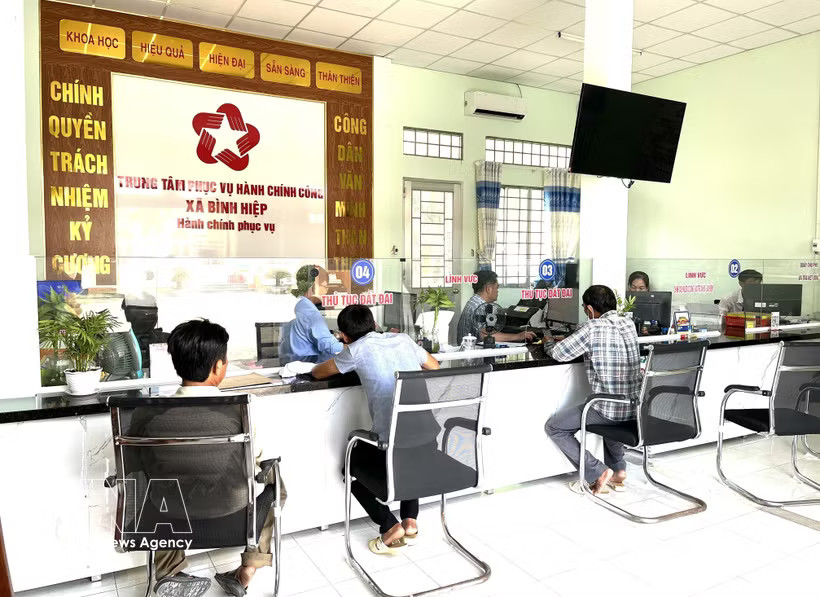
Hanoi (VNA) – Ministries and ministry-level agencies are required to complete the restructuring of their apparatus in tandem with the decentralisation and delegation of authority in October 2026 under a recently released Government action plan.
The Government has issued Resolution No. 221/NQ-CP promulgating its action plan for implementing Conclusion No. 76-KL/TW, dated July 28, 2026, of the 14th Party Central Committee on further perfecting and efficiently operating the overall organisational model of the political system and the two-tier local administration model.
The plan sets a series of tasks and measures, including fine-tuning institutional frameworks; promoting decentralisation and delegation of authority alongside adequate resources, power controls and streamlined administrative procedures; restructuring the internal apparatus of ministries, ministry-level agencies and public service units; improving the quality of officials, civil servants and public employees, particularly at the commune level; and accelerating digital transformation and data connectivity.
Others include considering the establishment of special economic zones to create new development space, and exploring a model of commune-level administrative units serving as the nuclei; reviewing and refining the criteria, standards, and economic-technical norms to ensure adequate resources for commune-level administrations; and efficiently handling public offices, assets and documents following the restructuring.
Regarding institutional reform, ministries and ministry-level agencies are tasked with speeding up the review and issuance of legal documents to thoroughly and promptly remove institutional bottlenecks for localities. Power decentralisation must be substantive and accompanied by sufficient personnel, funding, data, digital infrastructure, professional guidance, implementation tools and post-restructuring inspection mechanisms, following the principle of “localities decide, localities implement and localities take responsibility.”
The focus will be given to addressing overlapping regulations, as well as those with unclear responsibilities or that are no longer suited to the new model. This includes ensuring that each task has one lead agency and one primary point of bearing responsibility, supported by a shared data source, an integrated coordination process, and a mechanism for inspection and supervision.
The Ministry of Home Affairs, in coordination with the Ministry of Justice and relevant ministries, will amend or propose amendments to the regulations concerning apparatus structures, with completion required in October 2026. It will also work with other ministries, agencies and localities to review and improve regulations on encouraging and protecting officials who demonstrate innovation, creativity and willingness to take responsibility for the common interest.
The Ministry of Finance is tasked with updating regulations on mechanisms, norms and criteria for allocating budgets to the commune-level administrative units, as well as guiding the decentralisation of power in the management of public assets and infrastructure facilities following restructuring.
Meanwhile, the Ministry of Education and Training will reorganise public higher education institutions, including transferring multidisciplinary institutions to the ministry or local authorities for management, and merging institutions located in the same locality, to reduce the number of public higher education institutions by at least 20% before April 1, 2027. Public vocational and continuing education institutions will also be reorganised, with the number to be reduced by at least 30% before October 1 this year.
The Ministry of Health will reorganise hospitals and higher education institutions under its management, and streamline forensic and psychiatric assessment units. It will also complete the model for commune-level health stations, ensure adequate medical personnel and equipment, develop electronic health records on VNeID, and connect health data from the commune to provincial levels, with completion expected by this October.
The plan also calls for continued restructuring of public service units and educational and healthcare facilities at the local level, with relevant ministries and provincial-level administrations responsible for completing specified tasks in accordance with the set deadlines./.