

Messages from General Secretary and President To Lam at the opening of the 14th Party Central Committee’s third plenumFour strategic shifts driven by practical demands
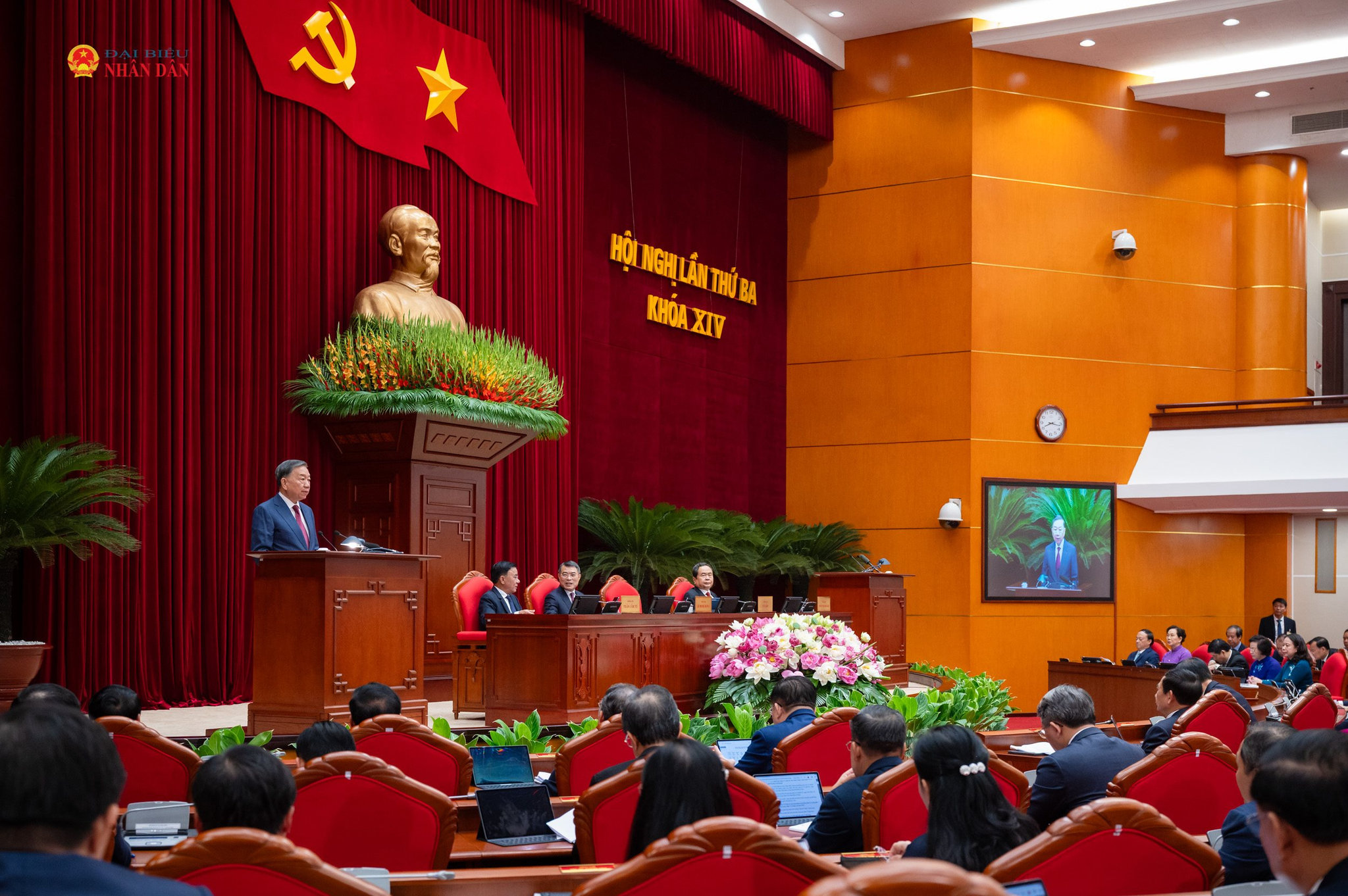
In his opening address to the third plenum of the 14th Party Central Committee, General Secretary and President To Lam stressed that every decision adopted by the Central Committee must generate four strategic shifts. These requirements go beyond the agenda of a single plenum, reflecting a modern approach to national governance and the country’s need for breakthroughs in its new development stage.
From a “necessary condition” to a “sufficient condition”
Vietnam’s recent efforts to streamline its political system and reduce intermediary layers have proved both necessary and appropriate. However, as General Secretary and President To Lam pointed out, organisational restructuring is only a “necessary condition.”
The “sufficient condition” — and the ultimate objective — is to ensure more effective Party leadership, better State governance, faster government operations and improved services for citizens and businesses.
The first strategic shift, therefore, is from “organisational restructuring” to “operational quality.” No matter how streamlined the apparatus becomes, the goal cannot be considered achieved if procedures remain unclear, authority is not tied to accountability, or officials continue to avoid responsibility and pass difficult tasks to others.
The effectiveness of leadership should not be measured merely by the number of departments or units eliminated. More meaningful indicators are the actual speed and quality of problem-solving, together with improvements in public confidence and living standards.
Strict Party discipline must also be maintained while upright officials who dare to think, act and make breakthroughs for the common good are protected. Controlling power must go hand in hand with unlocking human potential, which ultimately determines the success of every policy.
Unified governance of development space
Another important shift is from fragmented management to the unified governance of development space. Administrative boundaries may define jurisdictions, but they should not constrain development vision. Land, natural resources, data and the marine economy must be managed as parts of an interconnected whole.
The proposed amendments to the Land Law and related regulations reflect several fundamental changes: moving from the management of individual land plots to the governance of development space; applying market principles to land valuation; and shifting from simple asset compensation to the sustainable restoration of livelihoods.
People who surrender land for development projects must be provided with new accommodation, living conditions and livelihood opportunities that are equal to or better than those at their former place of residence. Financial and tax instruments should also be used to address land speculation, abandoned land and delayed projects, while stalled projects and redundant public assets resulting from administrative restructuring must be dealt with decisively.
Land has long been described as the “bottleneck of all bottlenecks.” With appropriate mechanisms, however, it can become one of Vietnam’s greatest internal resources.
The formation of new growth poles by upgrading highly urbanised and economically capable localities is another strategic priority. This should not be understood merely as changing names or expanding administrative boundaries. The objective is to establish modern urban governance models capable of driving regional and national development.
As competition between countries increasingly becomes competition between cities and metropolitan regions for capital, technology and talent, Vietnam needs dynamic growth poles with strong ecosystems for innovation and highly skilled human resources. Development orientations for the Capital Region and the country’s four key economic regions offer important foundations for this process.
A new growth model
Vietnam must also transform its growth model. As the advantages of low-cost labour and natural resource exploitation gradually diminish, growth can no longer depend primarily on capital and resources. It must increasingly be driven by productivity, knowledge, science and technology, innovation and digital transformation.
Artificial intelligence, big data, the green economy and the digital economy are no longer trends of the distant future. They must become new engines of growth, helping improve productivity, competitiveness and the economy’s resilience to an increasingly uncertain international environment.
Every decision must produce development outcomes
The most notable message in General Secretary and President To Lam’s address was the call to shift from simply issuing policies to ensuring effective implementation and measurable results.
Every decision adopted by the Party Central Committee must clearly answer three fundamental questions: Which specific bottleneck will it remove? What new development capacity will it create for sectors, localities and the country? What conditions and resources are required for effective implementation?
These questions provide a practical remedy for the persistent problem in which resolutions are well drafted but poorly implemented, or sound policies lose much of their effectiveness by the time they reach the grassroots level.
Vietnam is entering a decisive period in the implementation of the strategic goals set by the 14th National Party Congress. The four strategic shifts outlined by General Secretary and President To Lam are therefore mandates arising directly from reality.
If every official, civil servant, public employee and Party member fully embraces the need for renewal, acts in the spirit of serving the Fatherland and the people, and assumes responsibility for final results, Vietnam will be well positioned to realise its development goals for 2030 and 2045.