

500 days and nights spent searching for names for those who have become part of the nation
"The '500-day campaign to intensify the search, collection, and identification of the remains of fallen soldiers' is not only a political, military, and scientific task, but also a cultural, ethical, and humanitarian journey. Each set of remains found, each identity confirmed, each son brought back to his family and homeland, is another way we enrich the national memory, warm the bonds of brotherhood, and illuminate the Vietnamese character in peacetime".
Paying tribute to those who dedicated their lives to the country.
There are journeys that are not measured by the number of kilometers traveled, but by the depth of their meaning. The "500-day campaign to intensify the search, collection, and identification of the remains of fallen soldiers" is one such journey. It is a journey through deep forests and high mountains, through places once marked by bombs and bullets, through gaps in memory and time, to find those sons and daughters who "laid their lives so that the Fatherland could rise again."
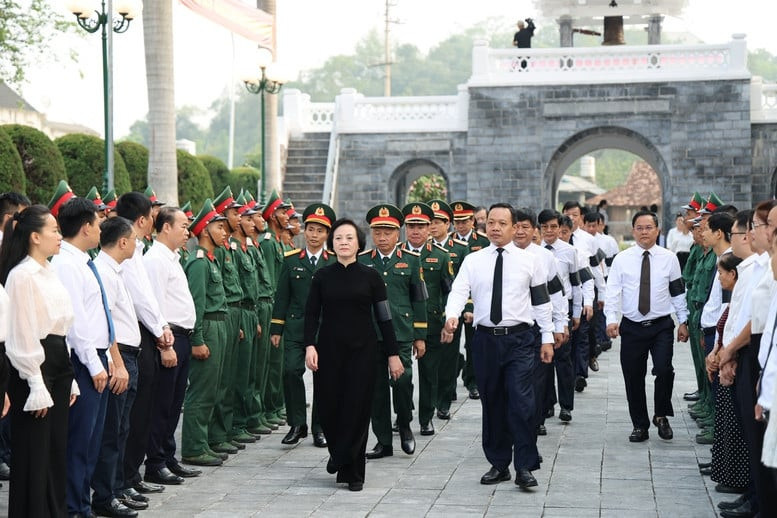
The war is long over, but the pain of war does not fade with time. In many Vietnamese families, there remains an altar without a photograph, a tombstone without a complete name, a mother who has spent her entire life waiting, a sibling or nephew who only knows about their family's fallen soldier through a few faded lines on a death certificate. There are graves bearing the inscription "Unknown soldier." This is not just missing information in records, but a silent void in the national consciousness, a reminder of the responsibility of those who are still alive.
Therefore, searching for, collecting, and identifying the remains of fallen soldiers is a sacred task. From a cultural perspective, this campaign touches upon the deepest layers of Vietnamese morality: "drinking water, remembering the source," "repaying gratitude," and "respect for the deceased is the ultimate duty." When we search for the remains of fallen soldiers, we are searching for a part of the nation's memory. When we identify the fallen soldiers, we are returning to them the most basic yet sacred things a person could have: a name, a hometown, a family, and a worthy place in history. A nation that bows before every handful of battlefield soil to find those who sacrificed for the country and its people is a nation that preserves its moral foundation. A country that does not forget those who have fallen is a country with a solid spiritual foundation to move forward.
The 500-day campaign represents 500 days and nights of responsibility, of tireless effort racing against time to alleviate the decades-long wait. It is also 500 days for the entire society to reflect on itself: what have we done to be worthy of those sacrifices? How have we lived in the eyes of those who sacrificed so that we could live? How have we educated the younger generation so that gratitude becomes a quality, an action, and a civic responsibility?
May the memory of martyrs continue to nurture the Vietnamese character.
The most important aspect of any act of gratitude is not the solemnity of the commemoration day, but the ability to transform gratitude into a daily way of life. If the War Invalids and Martyrs Day on July 27th is a sacred reminder, then the 500-day campaign is a concrete action program to ensure that this remembrance has depth, a specific purpose, results, and widespread social impact.
We need to view this campaign as a major cultural movement. Because searching for fallen soldiers is not just the job of the recovery teams; identifying their remains is not just the job of the forensic department; and caring for the martyrs' cemeteries is not just the responsibility of the relevant authorities. This is the work of the entire community. Each citizen can contribute a piece of memory, information about an old battle, a story from their ancestors, a place name mentioned in their family, a map, a letter, a memento. Often, these seemingly small details can open up significant clues for the search.
The culture of gratitude is not only expressed through offering incense to commemorate the Heroes and Martyrs on July 27th, but must also stem from respect for historical truth, from a serious attitude towards the records of martyrs, from the responsibility of preserving cemeteries, tombstones, and memorials, and from educating the younger generation to understand that today's peace did not come about naturally. Behind every road, every school, every peaceful field, every rhythm of urban life today lies the blood and bones of countless people who have fallen.
In the context of the country entering a new stage of development, with the demand for rapid, sustainable, modern development and increasingly deep integration, caring for those who have rendered meritorious service, including searching for, collecting, and identifying the remains of fallen soldiers, is of particular significance. A nation that wants to progress cannot lose its memory. A society that wants to modernize cannot disregard morality. A sustainable economy must be supported by a foundation of culture, ethics, and humanism.
Here, the cultural element needs to be properly considered. The 500-day campaign is not just about achieving specific targets, however important those targets may be. More fundamentally, the campaign must contribute to strengthening social trust, arousing patriotism, fostering a sense of responsibility, and making each citizen feel more clearly the connection between themselves and the nation's history.
Behind every recovered remains is a person who once had a youth, dreams, a family, and a homeland. Behind every DNA sample analyzed is the yearning for reunion of loved ones who have waited too long. The press, literature, art, education, museums, and grassroots cultural institutions need to participate in telling these stories in a humane, moving, appropriate, and impactful language.
Local authorities should also view this as an opportunity to review, renovate, digitize, and revitalize memorial spaces. Martyrs' cemeteries should become spaces for traditional education, where students, youth union members, and young people can hear historical stories told through familiar historical evidence in their hometowns.
In particular, the younger generation needs to be placed at the center of a culture of gratitude. They were born in peace, grew up in the digital world, but they need to understand that peace is a value that must be preserved through character, responsibility, and action. When young people participate in cemetery care, learn about local history, assist in digitizing data on fallen soldiers, share information to find relatives, and recount stories of gratitude through digital platforms, then gratitude is no longer an abstract moral lesson, but becomes a living experience.
The ethics of peacetime are not just about living well today, but also about living responsibly in the past. Therefore, the 500-day campaign needs to be carried out with both passionate hearts and clear minds; with both political determination and scientific standards; with both speed of action and humane caution. The more urgent the task, the more precise it must be. The more forces involved, the closer the coordination must be. The bigger the goal, the more transparency, respect for the truth, respect for the families of fallen soldiers, and respect for the sacredness of the deceased must be ensured.
A nation that seeks out its fallen sons and daughters, bringing them back to their names, hometowns, families, and comrades, is a nation that will never lose its noblest aspect: its humanity and compassion. 500 days and nights is not just the duration of a campaign. It is a solemn promise to history, to the heroic martyrs, to the mothers who waited for their sons in tears, and to the families still yearning to find a part of their flesh and blood. And above all, it is a reminder to each of us today: to live in a way that is worthy of those who sacrificed their lives for the enduring existence of the Fatherland.