

Full text of the opening speech at the 3rd Plenum of the 14th Central Committee by General Secretary and President To Lam
On the morning of July 20th, the 3rd Plenum of the 14th Central Committee of the Communist Party of Vietnam was solemnly inaugurated in Hanoi. General Secretary and President To Lam delivered an important speech providing guidance and direction. Nghe An Newspaper and Television respectfully present the full text of the speech by the General Secretary and President.
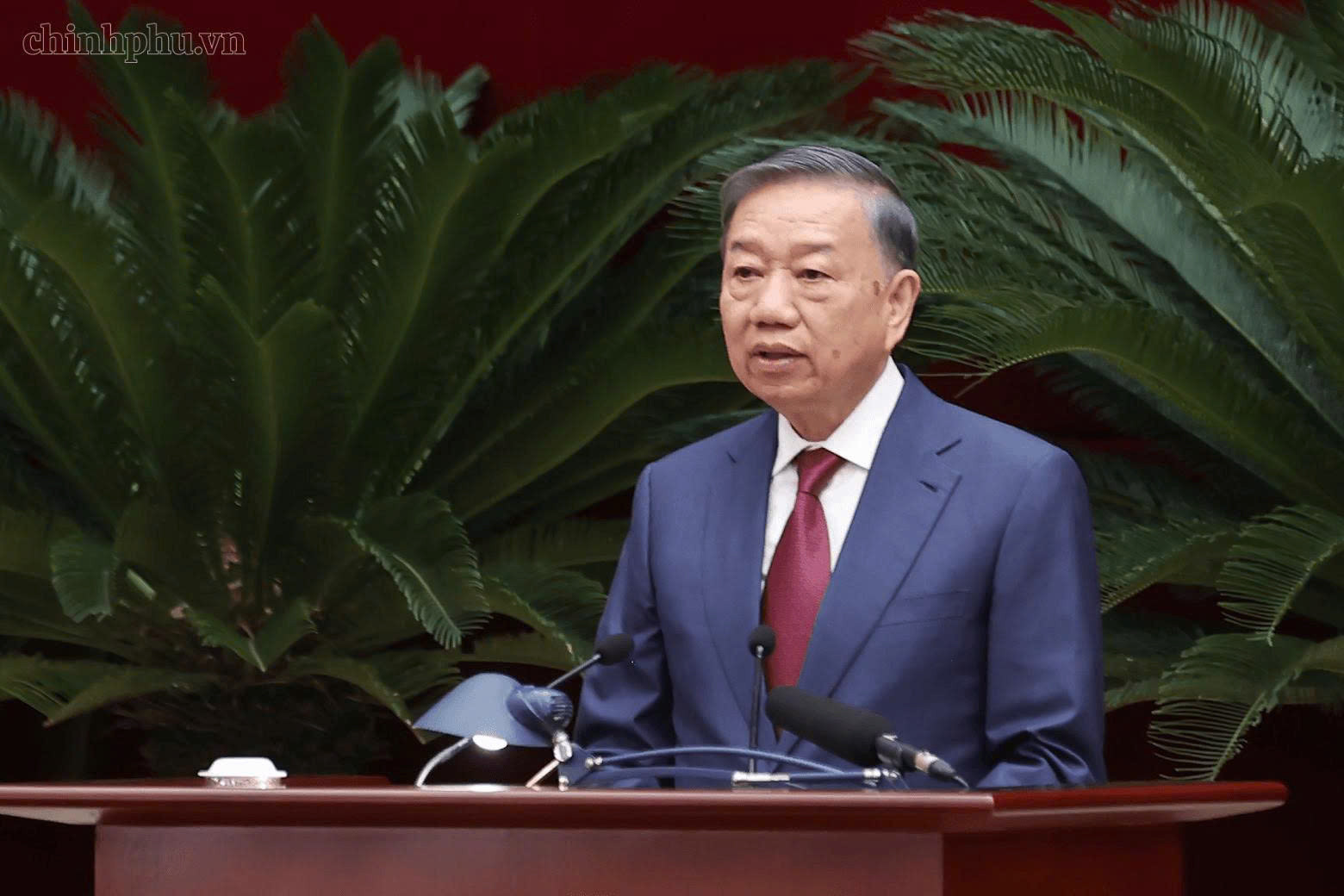
Dear members of the Politburo, members of the Secretariat, and members of the Central Committee of the Party,
Distinguished delegates attending the Conference,
Today, the 14th Central Committee of the Communist Party of Vietnam opens its 3rd Conference to consider and decide on important issues in implementing the Resolution of the 14th National Congress of the Party, focusing on Party building, the political system, and national development in the new period. On behalf of the Politburo and the Secretariat, I warmly welcome all comrades attending the Conference.
Comrades,
The 3rd Central Committee Conference took place against a backdrop of rapid, widespread, complex, and unpredictable changes in the world and the region. Strategic competition, geopolitical conflicts, global economic differentiation, and shifts in technology, energy, and data are reshaping the development environment. Climate change, non-traditional security threats, and artificial intelligence present both opportunities and new risks, requiring us to enhance strategic autonomy, resilience, adaptability, and national action capacity.
Domestically, the entire Party, people, and army are urgently implementing the Resolution of the 14th National Congress of the Party. GDP growth is projected to increase in the first six months of 2026.8.18%Although it did not meet the target, it was the highest for the same period.16Over the past year, the macroeconomic situation has remained fundamentally stable, major balances have been ensured; national defense and security have been maintained; foreign relations, international integration, culture, and society have continued to develop; and social welfare has been guaranteed. These results are commendable, but we must continue to overcome limitations and remove bottlenecks in institutions, growth quality, self-reliance, resource mobilization, and implementation.
The 14th National Congress defined the guidelines, objectives, and major strategic directions; the 2nd Central Committee Conference laid the organizational foundation and operating rules for the term. The 3rd Central Committee Conference must translate those directions into policy decisions to remove bottlenecks, unlock resources, and create new development capabilities.13The discussions at the Conference covered many fields but all aimed at a higher goal: building capacity for leadership, governance, administration, action, development, and national defense in the new era. Therefore, the decisions adopted by the Central Committee must create4 steps to shift strategy:The first:to enhance the leadership capacity, governance, and operational quality of the Party and the State apparatus;Monday:Unified management of development space, maximizing the effective use of national resources;Tuesday:Establishing a development model based on productivity, knowledge, technology, and people;Wednesday:Proactive prevention, enhancing resilience and adaptability, and firmly protecting the country.These are the objectives that the Conference must achieve.
I propose that the Central Committee focus on answering the question: What bottlenecks does each policy address? What new capabilities does it create? And what conditions are necessary for effective implementation and execution? In that spirit, I would like to offer some suggestions.4This is the main topic for your discussion.
I. The shift from organizational restructuring to enhancing the leadership capacity, governance, and operational quality of the Party and the political system.
The reorganization of the administrative apparatus has created a more streamlined structure. But streamlining is only a condition; the goal is for the Party to lead more effectively, the State to govern better, the apparatus to operate faster, the people to be better served, and the people's real living standards to be raised. This transition must ensure strict discipline, clear organization, controlled power, and enforced responsibility; the quality of policy decisions, the effectiveness of implementation, and the people's trust should be the benchmarks.
Regulations on what Party members are not allowed to do must clearly define disciplinary limits, correctly identify new manifestations in the market economy, digital transformation, and power-interest relations. Strict discipline must go hand in hand with protecting honest officials who dare to think, dare to act, and dare to take responsibility for the common good. The amendment and supplementation of Regulation No. 20 must clarify the names, functions, tasks, authority, responsibilities, and working relationships of different types of Party organizations, addressing overlaps, gaps in responsibility, and existing problems."facility within a facility"", ensuring unified and smooth operation.
The report summarizing one year of operation of the overall organizational model of the political system and the two-tiered local government model, and the report on Party building and the political system in the first six months of 2026, along with the direction and tasks for the last six months of 2026, must help the Central Committee realistically assess the quality of the political system's operation after restructuring: Is the apparatus smooth, are authority and responsibility clear, are decisions quick and accurate, and are citizens and businesses better served? The measure should not only be the reduction in the number of administrative units but also the effectiveness of leadership, management, and the quality of service to the people. Decentralization must be accompanied by increased authority, resources, human resources, data, tools for implementing and controlling power; the provincial level should be strong in planning and coordination; and the commune level should be close to the people and capable of handling work in the new model. Cadres must be evaluated based on their qualities, capabilities, output, progress, and reputation; the head of each organization should be the center of responsibility.
II. The shift from decentralized management to unified governance of national development space and resources.
Administrative space cannot limit development thinking. Land, sea, urban areas, infrastructure, resources, and data must be viewed as a whole, organized according to national strategy, regional advantages, and overall efficiency. This shift must create new development spaces, bring resources to where they are used effectively, harmonize the interests of the State, the people, and businesses, and connect local advantages into national strength.
The proposals for establishing Quang Ninh City and Bac Ninh City as centrally-governed cities must be considered in the context of forming new growth poles, improving urban governance capacity, and strengthening regional linkages. Changes in administrative status must create substantive changes in governance capacity, the efficiency of resource mobilization, and the ripple effect of development. A thorough assessment of infrastructure conditions, resources, operating costs, and the impact on the people is necessary, ensuring that each proposal creates new development value for the locality, the region, and the entire country.
The preliminary review of the implementation of Resolution No. 18, dated June 16, 2022, of the 13th Central Committee; the determination of the viewpoint on amending the Land Law and related laws; and the summary of the implementation of Resolution No. 36, dated October 22, 2018, of the 12th Central Committee, along with the issuance of the Central Committee's Resolution on building and developing Vietnam into a strong maritime nation, must be considered within the framework of unified territorial governance. The Central Committee needs to clarify the requirement to shift land management from individual land parcels to spatial governance; from being heavily bureaucratic to facilitating and creating resources; and from property compensation to rebuilding lives, ensuring housing, livelihoods, and living conditions that are equivalent to or better than the existing ones. The sea is a space for survival, development, and the protection of sovereignty; it must be managed comprehensively, connected with the mainland, seaports, logistics, economic corridors, and international cooperation. Facilitating resources must go hand in hand with protecting legitimate rights and interests. Decentralization must be linked to controlling speculation, waste, and vested interests; data must be unified and interconnected.
III. The shift from growth heavily reliant on expanding inputs to development based on productivity, knowledge, technology, and human resources.
The report on the socio-economic situation in the first six months of the year, key tasks and solutions for the last six months of 2026, and the plan for reforming Vietnam's development model must be presented in the same context: the report should address immediate actions needed in the last six months; the plan needs to answer the question: How will the country create wealth and competitiveness in the long term? GDP growth in the first six months of the year.8.18%That's a positive result, but the growth target is at least...10%The entire year presents a very challenging task. We must strive to achieve the 2026 targets while simultaneously laying the foundation for sustainable double-digit growth; ensuring macroeconomic stability, major balances, facilitating investment, addressing stalled projects, strengthening business capacity, and guaranteeing jobs and income. The scenarios must be quantified down to the sector and locality level, taking into account both favorable and unfavorable factors, and linked to the responsibility of the leaders; the crucial element is implementation.
In the long term, we must shift from dependence on capital, resources, outsourcing, and cheap labor to reliance on productivity, knowledge, data, technology, innovation, high-quality human resources, and modern management; building an independent, self-reliant, and effectively integrated economy. We need to strengthen the management and facilitation role of the State and the role of the market in mobilizing and allocating resources; ensuring that the state-owned economy truly plays a leading role, and the private economy is the most important driving force of the national economy; linking foreign investment with technology transfer and enhancing endogenous capacity. Science, technology, innovation, digital transformation, and artificial intelligence must truly translate into productivity, quality, added value, and competitiveness.
The project to build a disciplined, safe, civilized, harmonious, and developed society is the foundation and goal of the development model. Development must lead to a larger economy, a better society, more comprehensive human development, a more cohesive community, and strengthened trust. We must not allow material wealth to be accompanied by cultural, moral, and humanistic poverty; nor should growth exacerbate inequality or marginalize the vulnerable. We must prioritize people, with culture as the foundation, law and discipline as the pillars; combining rule of law with moral governance, and power with responsibility. The ultimate measure is the quality of life, opportunities for development, and happiness of the people.
IV. The shift from addressing individual threats to proactive prevention, enhancing resilience, and firmly protecting the country.
In a world of intertwined risks and cascading impacts, security cannot be ensured solely on a sectoral basis; the environment cannot be addressed only after damage occurs. This shift requires moving from reactive to predictive, from incident-based response to proactive prevention; ensuring the security, safety, and continuous operation of political, economic, social, technological, and essential infrastructure systems. Security is a condition for development; sustainable, inclusive, and resilient development is the foundation of security.
National security strategy and summary of the implementation of Resolution No.24,The conclusion of the 11th Central Committee on environmental protection and proactive response to climate change in the new era, issued on June 3, 2013, must be placed within a unified mindset between national protection and development; shifting strongly from responding to and mitigating consequences to proactively identifying, forecasting, and preventing early and distant impacts; enhancing national resilience against traditional and non-traditional risks and cascading impacts. It is essential to firmly protect the Party, the State, the People, the regime, independence, sovereignty, and territorial integrity; while simultaneously ensuring human security, data security, the safety of critical infrastructure, and strengthening social trust. National defense and security must be closely integrated with foreign affairs and international integration, leveraging combined strength to protect the Fatherland early and from afar, maintaining a peaceful and stable environment, expanding development space, and enhancing Vietnam's position and prestige in the region and the world.
Environmental and climate policies must shift from remediation to prevention, adaptation, and recovery; from management based on geographical boundaries to governance based on ecosystems, river basins, and marine areas; and transform green transformation into a driving force for technological innovation and enhanced competitiveness. The central government needs to clearly identify core interests to protect and risks to be prevented early and proactively; and establish mechanisms for command, coordination, and early warning. Large projects must fully consider carrying capacity, environmental costs, data security, and intergenerational responsibility.
Comrades,
The four strategic shifts outlined above form a cohesive whole: Organizations and people create the capacity for action; space and institutions unlock resources; development models transform resources into productivity, wealth, and quality of life; and preventive and protective capabilities ensure that this process is safe, continuous, and sustainable. Any delay in any step will hinder the others. The outcome of the Conference must be reflected in a high degree of consensus on understanding, the correctness of the decisions, and tangible changes following the Conference.
In accordance with Regulation No. 206, dated June 30, 2026, of the Politburo on organizing the Central Committee Conference, the documents have been meticulously prepared. The conference time is limited, the workload is substantial, and many issues are of great importance. Therefore, it is requested that Central Committee members focus on in-depth discussions in their respective groups, clearly express their views in the plenary session, and directly contribute to the Draft Resolution, Program, and Action Plan. Speeches should be concise, directly addressing the issues, clearly stating opinions, arguments, recommendations, and proposed options; contributing directly to the refinement of the Central Committee's decisions. All choices must prioritize the national interest, the legitimate rights and interests of the people, and the long-term effectiveness of the country above all else.
Following this Conference, each Resolution and Conclusion must be immediately concretized into a Program and Action Plan, ensuring clear objectives, tasks, authority, resources, responsibilities, deadlines, deliverables, and results; resolutely overcoming the situation where policies are correct but institutionalization is slow, implementation is not strict, and effectiveness is low.
With a spirit of unity, democracy, discipline, breakthrough, and development, on behalf of the Politburo and the Secretariat, I declare the opening of the 3rd Conference of the 14th Central Committee of the Communist Party of Vietnam.
I wish our conference great success.