

NA President receives leaders of international audit organisations
NA President Man called on the State Audit Office of Vietnam to selectively adopt international experience, and draw lessons from its own practical work to share with international partners, thereby making more substantive contributions to the global public audit community.
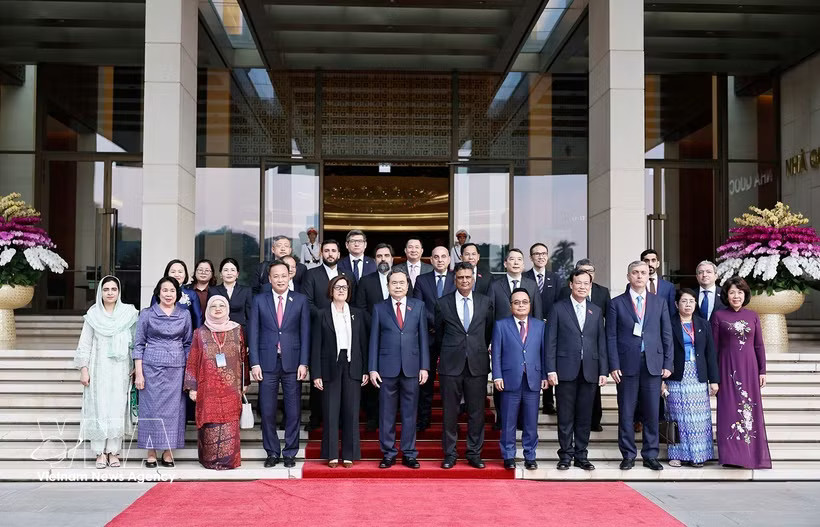
Hanoi (VNA) – National Assembly (NA) President Tran Thanh Man outlined Vietnam's priorities in international audit cooperation while receiving a delegation of leaders from international audit organisations in Hanoi on October 27.
The delegation is in Vietnam to attend an international conference organised by the State Audit Office of Vietnam.
The top legislator said Vietnam is entering a new stage of development, striving to become a developing country with modern industry and upper-middle income by 2030, and a developed, high-income country by 2045.
Highlighting the role of the State audit sector in this process, NA President Man underlined five principles for the sector to meet the requirements and challenges ahead.
First, good governance is a resource, while public trust is a strategic asset. Through independence, objectivity and evidence-based work, supreme audit institutions (SAIs) must serve as reliable pillars for strengthening financial discipline, enhancing accountability and safeguarding public confidence.
Second, institutional frameworks must be strong, ensuring genuine independence alongside accountability. There is no single model suitable for every country. The key is to ensure that audit institutions have sufficient authority and necessary conditions to perform their duties objectively, professionally and with integrity. Independence is not an end in itself, but a prerequisite for auditing that respects the truth and protects the public interest.
Third, the value of auditing should be measured by positive changes in governance, rather than solely by the amount of money recommended for recovery or adjustment. Auditing must take a proactive role in preventing violations, identify institutional shortcomings and help revise mechanisms, remove bottlenecks and unlock resources. Detecting violations is necessary, but early and preventive action is what creates lasting value for a country.
Fourth, innovation must be pursued proactively in the digital era, with greater technological advancement accompanied by higher standards of human responsibility. Digital transformation and the application of artificial intelligence must go hand in hand with changes in mindset and the development of legal frameworks for data and information security. Technology enables faster and deeper analysis, but human competence, ethics and judgement remain decisive.
Fifth, international cooperation must be substantive, equitable and focused on creating shared value. The NA leader called for more effective use of mechanisms within the International Organisation of Supreme Audit Institutions (INTOSAI), the Asian Organisation of Supreme Audit Institutions (ASOSAI) and the ASEAN Supreme Audit Institutions (ASEANSAI).
He also urged stronger cooperative auditing, greater sharing of methodologies and more training for highly qualified personnel. Each institution should actively learn from others while making its own contributions to the international community.
NA President Man called on the State Audit Office of Vietnam to selectively adopt international experience, and draw lessons from its own practical work to share with international partners, thereby making more substantive contributions to the global public audit community.
He emphasised that despite differences in organisational models, all supreme audit institutions shared a common mission: protecting the public interest, improving the efficiency of national resource use, strengthening accountability and serving the people.
The NA leader noted that auditing should not merely assess the past, but, more importantly, support present-day governance and help shape the future. The core value of auditing should not be confined to the pages of reports, but should be reflected in stronger institutions, stricter discipline across the public apparatus, more effective use of resources and the public's enduring trust.
At the meeting, K. Sanjay Murthy, Chair of ASOSAI and Comptroller and Auditor General of India, stressed that the rapidly changing global landscape is presenting countries with numerous new challenges, ranging from climate change and complex infrastructure projects to rising public expectations.
Supreme audit institutions, therefore, need to continue strengthening their professional capabilities, improving their systems and renewing their approaches to meet emerging demands. Digital skills will enhance their capacity for analysis and assessment, but could not replace auditors' professional expertise, he said.
According to Murthy, the ultimate goal of national governance is to improve people's lives. In fulfilling their role, supreme audit institutions must maintain independence in their assessments, continuously innovate their working methods and fully discharge their accountability obligations. These requirements are essential to improving governance, ensuring the efficient use of public resources and delivering better services to the people.
He expressed his confidence that the conference's outcomes will help promote cooperation among supreme audit institutions and strengthen their capacity to respond to future challenges./.