

NA debates amendments to Social Insurance Law, focusing on fund safety, risk control
Several deputies supported expanding compulsory social insurance coverage to include digital platform workers and those without formal employment contracts, particularly informal workers, delivery workers and technology-based drivers. However, they stressed the need for an appropriate roadmap and clear regulations on contribution obligations, calculation methods and the responsibilities of digital platforms.
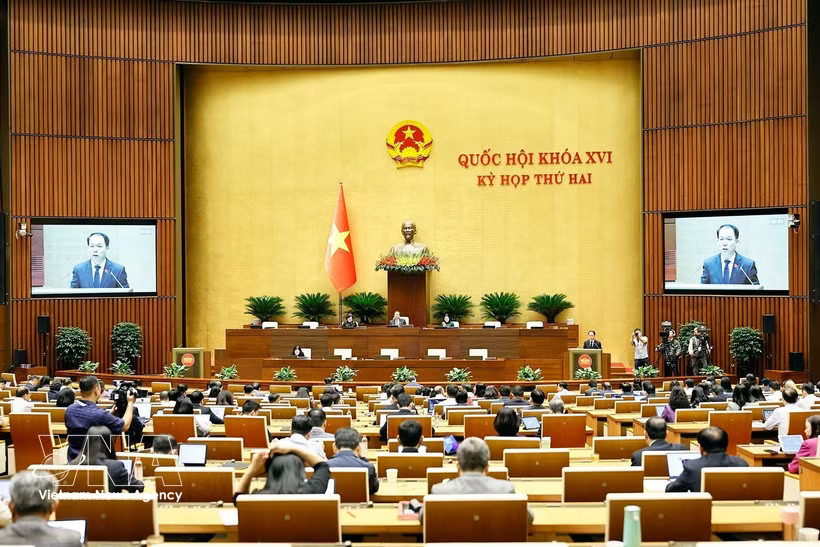
Hanoi (VNA) - Social insurance is not only a pillar of social welfare but also directly affects the income, employment and present and future livelihoods of tens of millions of workers. Expanding coverage must therefore go hand in hand with ensuring feasibility, while the social insurance fund must be managed safely, transparently and effectively, with workers’ legitimate rights and interests at the centre.
These issues were highlighted by National Assembly deputies during a discussion on November 9 on the draft Law amending and supplementing several articles of the Law on Social Insurance, as part of the second session of the 16th legislature.
Several deputies supported expanding compulsory social insurance coverage to include digital platform workers and those without formal employment contracts, particularly informal workers, delivery workers and technology-based drivers. However, they stressed the need for an appropriate roadmap and clear regulations on contribution obligations, calculation methods and the responsibilities of digital platforms.
Deputy Le Huu Tri of Khanh Hoa province warned that overly broad regulations without clear implementation mechanisms could lead to disputes and impose additional financial burdens on low-income workers with unstable earnings. For workers receiving payment by trip or order, or working across multiple platforms, determining contributory income and allocating responsibilities among parties would be particularly complicated.
He proposed assessing the impact on each worker group and considering implementation from 2028 for digital platform workers if conditions are not yet in place. This will allow time to refine the legal framework, connect databases among social insurance and tax agencies and digital platforms, and build public consensus.
Deputy Pham Van Hoa of Dong Thap province also called for careful consideration of the timing of expanding compulsory coverage. He suggested prioritising compliance among groups already covered, particularly in the private business sector, before reviewing the results of five years of implementing the Law on Social Insurance and considering the inclusion of the two proposed groups of digital platform workers and those without formal employment contracts.
Meanwhile, deputy Nguyen Van Huy of Hung Yen province called for stronger protection of workers whose employers delay or evade social insurance contributions. He noted that workers may have their contributions deducted from their wages but still face interrupted contribution records and delays in receiving sickness, maternity or pension benefits because employers fail to transfer the money.
He urged the draft law to establish mechanisms to protect workers’ entitlements and clearly define employers’ responsibilities for paying outstanding contributions and compensating for losses, without making workers wait for employers to fulfil their obligations.
Regarding risk control in the social insurance fund’s investment, deputy Duong Khac Mai of Lam Dong province welcomed the proposed principles of safety, capital preservation, sustainability, efficiency and transparency in investing the social insurance fund. He said stronger risk controls are essential, given that the fund’s investment balance has reached 1.5 quadrillion VND (58.8 billion USD), while its average investment return in 2025 was 3.72%, compared with consumer price growth of 3.31%.
He cautioned against excessive concentration of capital in a single investment channel, which could expose the fund to risks or low returns. He proposed annual assessments of the effectiveness of each investment channel, public disclosure of results and stronger accountability for the fund’s management council.
Tri also stressed that investment performance must be commensurate with the fund’s scale and its long-term social welfare mission. Any expansion of investment channels should be based on a clear legal framework, sound risk management and independent supervision. Key indicators, including investment structure, returns, management costs and risk levels, should be disclosed regularly to enable workers to monitor the use of their contributions.
In response, Minister of Home Affairs Nguyen Tien Hai said the drafting agency will report to the Government on retaining the current provision authorising the Government to propose additional groups for compulsory social insurance participation to the NA Standing Committee. This could include people without formal employment relationships and digital platform workers when they meet the relevant conditions.
The agency will also continue studying the issue as part of preparations for broader social insurance policy reform and a comprehensive revision of the law in 2027–2028.
Regarding the fund’s investment portfolio, the drafting agency plans to propose adding principles of safety, capital preservation, sustainability, efficiency and transparency to the draft law. The Government will be tasked with specifying criteria and mechanisms for investment assessment, selection, supervision and risk control, as well as a roadmap for diversifying the fund’s investment portfolio and methods.
The agency will coordinate with the Ministry of Finance to submit detailed regulations to the Government following the law’s adoption./.