

Japan attaches great importance to top Vietnamese leader’s visit: Japanese Ambassador
Japanese Ambassador to Vietnam Ito Naoki expressed his pleasure at the trip, describing it as highly significant in further promoting friendship and cooperation between Japan and Vietnam within the framework of their Comprehensive Strategic Partnership for Peace and Prosperity in Asia and the World.
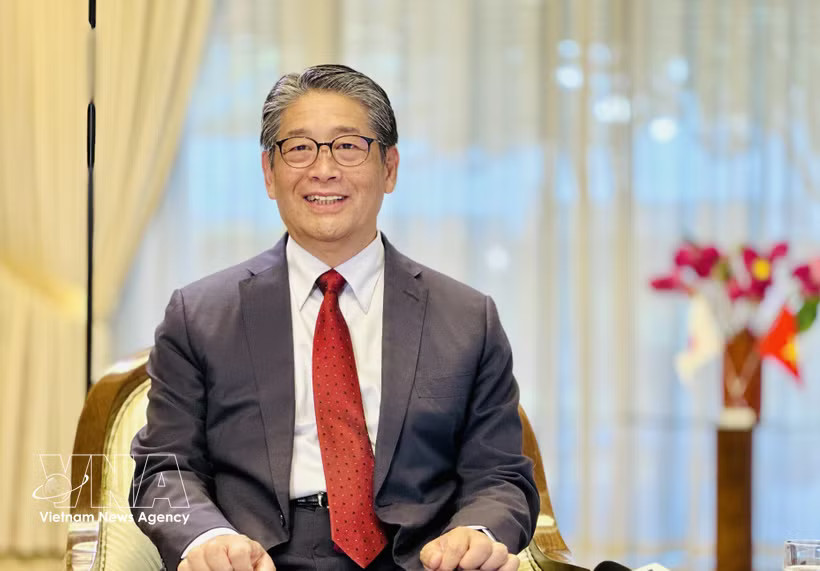
Hanoi (VNA) – The upcoming official visit to Japan from November 8 to 11 by General Secretary of the Communist Party of Vietnam (CPV) Central Committee and President To Lam, his spouse and a high-ranking Vietnamese delegation will provide an opportunity to elevate the bilateral Comprehensive Strategic Partnership to a new level, according to Japanese Ambassador to Vietnam Ito Naoki.
Ito expressed his pleasure at the trip, describing it as highly significant in further promoting friendship and cooperation between Japan and Vietnam within the framework of their Comprehensive Strategic Partnership for Peace and Prosperity in Asia and the World.
It will be the first visit to Japan by a General Secretary of the CPV Central Committee since that by General Secretary Nguyen Phu Trong in 2015, and the fifth by a Vietnamese Party chief to the East Asian nation, he noted.
Japan attaches great importance to the visit, particularly as it takes place in the first year of General Secretary To Lam's five-year term following his election at the CPV’s 14th National Congress. This demonstrates the CPV's strong regard for relations with Japan, he assessed.
Japan looks forward to working closely with Vietnam to ensure the visit achieves substantive and successful outcomes, Ito stated, affirming that following Japanese Prime Minister Sanae Takaichi's visit to Vietnam in May this year, the top Vietnamese leader’s trip will provide an opportunity to lift the bilateral Comprehensive Strategic Partnership to new heights.
Regarding the priorities for cooperation during the visit, the diplomat identified three major areas. First, amid increasingly complex international developments and mounting challenges to the international order, Japan and Vietnam need to strengthen collaboration and jointly contribute to maintaining regional peace and stability.
Second, building on the agreement reached during PM Sanae's visit to Vietnam in May to promote cooperation in economic security, supply chain resilience and innovation, the two countries are expected to advance practical cooperation in these areas. Their leaders have identified artificial intelligence (AI), semiconductors, digital transformation, green transition, critical minerals, food security and agriculture as priority fields. Japan hopes to further translate previous discussions into concrete cooperation programmes and make every effort to achieve the set objectives.
Third, people-to-people and cultural exchanges remain important priorities. The number of Japanese visitors to Vietnam and vice versa has continued to rise. The number of Vietnamese visitors to Japan is expected to exceed 700,000 this year, while Japanese arrivals in Vietnam are projected to approach 900,000. Japan wishes to further promote exchanges between the two peoples, expand local-level exchanges and strengthen cooperation between local authorities. These issues are also expected to feature in discussions between the two countries' leaders, the ambassador shared.
On cooperation in advanced sectors, including semiconductors, AI, green transition and digital transformation, Ito highlighted high-quality human resources development as a particular focus, noting that during this visit, the two sides are expected to announce six additional joint research projects. Japan aims to train a total of 250 Vietnamese semiconductor specialists through doctoral programmes in Japan, while the Vietnamese side has also showed interest in doctoral-level cooperation in AI.
Japan is considering expanding its NEXUS (Networked Exchange, United Strength for Stronger Partnerships between Japan and ASEAN) programme, which currently focuses on semiconductor human resources development, to include AI training. Through the visit, Japan hopes to further promote joint research and doctoral training programmes in both fields.
Through the Japan International Cooperation Agency (JICA), Japan also plans to provide Vietnam with a programme loan to support the development of policies and mechanisms related to AI. Currently, around 200 students are enrolled in semiconductor training programmes at Vietnam-Japan University. Japan will continue working with the Vietnamese Government to improve the learning environment and strengthen research facilities and equipment, thereby supporting both students and training and research activities of the university.
In the energy sector, Japan seeks to promote cooperation between the two governments and private businesses to ensure energy supplies meet Vietnam's growing demand amid economic development. Under the Asia Zero Emission Community (AZEC) initiative, Japanese companies are considering building liquefied natural gas (LNG)-fired power plants in Vietnam. Japan welcomes Vietnam's ongoing efforts to amend its Electricity Law and expects challenges concerning financial viability, particularly mechanisms to ensure investment cost recovery, to be gradually addressed.
The ambassador also stressed the importance of stronger links between the Government, businesses and academia in Vietnam to create a favourable environment for cooperation with Japanese agencies, universities and enterprises. Establishing a bilateral dialogue framework involving government agencies, universities, research institutes and businesses to discuss innovation and promote concrete cooperation activities will also be highly practical, he noted.
Regarding bilateral trade, Ambassador Ito said two-way trade turnover rose 15% year-on-year to 43.7 billion USD in the first nine months of 2026. At the current growth rate, it is expected to reach approximately 58 billion USD for the whole year.
Over the past decade, bilateral trade has expanded 1.8-fold. Based on this momentum, the diplomat forecast that the two countries could achieve a trade turnover of 75 billion USD by 2030, exceeding the original target of 60 billion USD. Vietnam is increasingly positioning itself as a promising manufacturing hub in Asia. Electrical equipment, electronic components and automobile parts are expected to remain major growth drivers of bilateral trade.
Agricultural trade also holds considerable potential. The two countries are expected to open their markets to new products, including Japanese grapes and Vietnamese pomelos, which could be among the outcomes of the upcoming high-level talks. Japan also expects its exports of products such as sake and Wagyu beef to Vietnam to increase as incomes rise and the country's middle class expands.
Japanese businesses are stepping up investment in the electrical and electronics sectors, including semiconductor wafer material production and the processing and inspection of polarising films for displays. Further investment in these fields is expected to increase demand for imported components and production materials from Japan, thereby boosting bilateral trade. The ambassador expressed his hope that expanding trade will also help attract high-quality foreign direct investment (FDI), contributing to Vietnam's transition towards a new growth model.
On people-to-people exchanges, Ito noted that travel between the two countries is vibrant in both directions. He expected the total number of visitors travelling between Japan and Vietnam to reach two million before 2030.
The 55th anniversary of diplomatic relations between the two countries will fall in 2028. In preparation for this milestone, the visit is expected to offer an opportunity to set out orientations for further promoting bilateral tourism and local-level exchanges. Increasing direct and charter flights will be important to boosting travel, while both sides will seek to promote their respective countries' attractions to each other's people.
The third Vietnam-Japan Local Cooperation Forum, scheduled to take place in Vietnam in 2027, is expected to further promote exchanges and cooperation among localities of the two countries.
The ambassador also highlighted opportunities for cultural cooperation, noting that Vietnam is focusing on developing its cultural industries while Japan is promoting its content industry, including manga, anime and J-pop. He expressed his hope that the visit will help Vietnamese people gain greater exposure to Japanese culture, thereby encouraging exchanges among younger generations and enhancing mutual understanding between the two peoples./.