

India's semiconductor strategy complementary to Vietnam's chip sector: expert
Sudhanshu Mittal, Director of Engineering Solutions at the National Association of Software and Service Companies (Nasscom) of India, noted that during the state visit to India by General Secretary of the Communist Party of Vietnam Central Committee and President To Lam in May, the two countries signed a number of cooperation agreements, with semiconductors identified as a priority area alongside artificial intelligence (AI), cybersecurity, and advanced technologies.
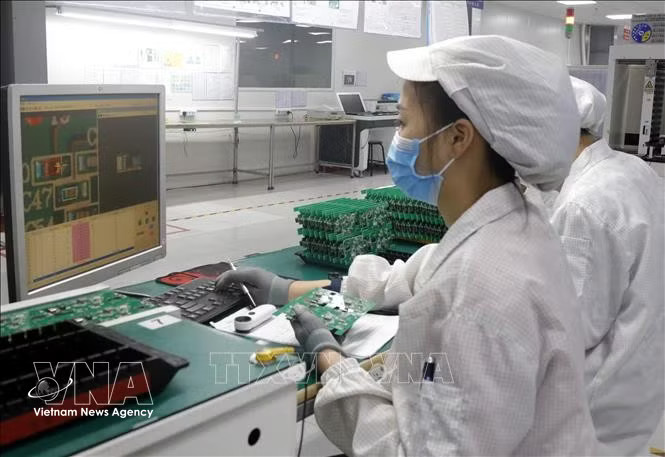
India is not only focused on building domestic capabilities but also regards international cooperation as a key pillar of its semiconductor development strategy. Vietnam is seen as a partner with complementary strengths, particularly following the state visit to India by General Secretary of the Communist Party of Vietnam Central Committee and President To Lam in May, an Indian expert has said.
Speaking to the Vietnam News Agency, Sudhanshu Mittal, Director of Engineering Solutions at the National Association of Software and Service Companies (Nasscom) of India, noted that during the visit, the two countries signed a number of cooperation agreements, with semiconductors identified as a priority area alongside artificial intelligence (AI), cybersecurity, and advanced technologies.
According to Mittal, Vietnam and India possess complementary rather than competing strengths. While India accounts for around 20% of the world's semiconductor design engineers, Vietnam is emerging as a major hub for electronics manufacturing and export-oriented assembly. If effectively combined, the two countries could establish a regional value chain, with India leveraging its strengths in design, research and technology, and Vietnam taking on manufacturing, assembly and testing.
He also said the connection between India's Unified Payments Interface (UPI) and the National Payment Corporation of Vietnam (NAPAS) demonstrates the potential for expanding cooperation into digital technologies, technical standards, and research and development (R&D).
One of the areas offering significant potential for bilateral cooperation is rare earths and critical minerals. Mittal said Vietnam has an estimated 22 million tonnes of rare earth reserves, the world's second-largest, while India has around 6.9 million tonnes, ranking third. However, resource advantages will be difficult to translate into industrial strength without technologies for extraction, separation, and refining.
He called the Memorandum of Understanding between IREL (formerly Indian Rare Earths Limited) and the Vietnam Atomic Energy Institute (Vintatom) a key strategic move, bringing together India’s expertise in rare earth processing with Vietnam’s rich resources. This partnership matters not just for mining but also for the semiconductor industry, since rare earths and materials like gallium are crucial for making rare earth magnets, compound semiconductors, and power electronics.
Turning to lessons Vietnam could draw from India's experience, the expert said the country should identify the right segments for development rather than seek to participate in the entire semiconductor value chain. Vietnam should clearly identify areas where it has an advantage, such as final assembly, chip testing, or the development of specialised materials.
The second lesson is human resources development. Both Vietnam and India need to invest early in specialised training programmes to anticipate the industry's growing demand. At the same time, the two countries could work together to develop supply chains for essential inputs, ranging from specialised gases and ultra-pure materials to rare earths and technological equipment.
Mittal also stressed that the MOU can only deliver its full value when translated into concrete projects. As global technology groups accelerate the restructuring of their supply chains, Vietnam and India should seize the current “window of opportunity” to speed up the implementation of joint projects.
For Vietnam, with semiconductors identified as a strategic industry, India's experience could provide a useful reference as the country develops its semiconductor ecosystem and seeks deeper integration into global value chains, he noted./.