

General Secretary and President To Lam hosts welcome ceremony for Panama President José Raúl Mulino
The Panamanian President’s visit is expected to contribute to further deepening and making the traditional friendship and cooperation between the two nations more substantive and effective.
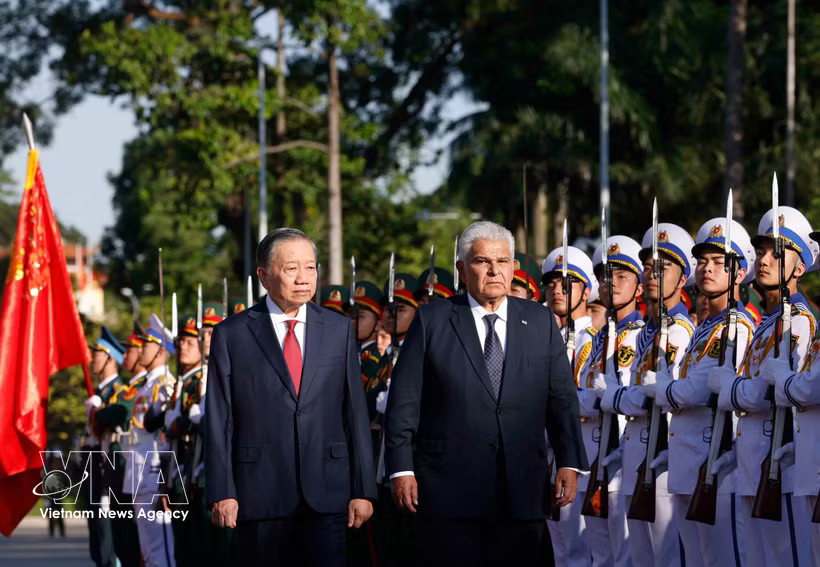
Hanoi (VNA) – General Secretary of the Communist Party of Vietnam Central Committee and President To Lam and his spouse hosted an official welcome ceremony in Hanoi on October 6 afternoon for Panamanian President José Raúl Mulino and his spouse, who are paying an official visit to Vietnam from October 5-8.
Following the playing of the national anthems of the two countries, the two leaders inspected the Guard of Honour of the Vietnam People’s Army.
After the welcome ceremony, General Secretary and President Lam and President Mulino and their respective high-ranking delegations held talks.
Vietnam and Panama officially established their diplomatic relations on August 28, 1975. Over the past more than five decades, the friendship and multifaceted cooperation between the two countries have been nurtured through high-level visits, cooperation agreements and close coordination at various international forums.
Bilateral trade has maintained steady growth, with Panama consistently ranking among Vietnam’s top 10 trading partners in Latin America. The two economies have strong potential for complementarity, particularly in areas such as trade, logistics, maritime transport, finance, agriculture, renewable energy and tourism. With its strategic location, Panama can serve as a gateway for Vietnamese goods to access the Americas, while Vietnam can act as a bridge for Panama to expand its presence in the ASEAN market.
The Panamanian President’s visit is expected to contribute to further deepening and making the traditional friendship and cooperation between the two nations more substantive and effective. It is set to advance bilateral ties in three key aspects, first and foremost by providing high-level political impetus to turn the potential and orientations agreed upon by the two sides into concrete programmes, action plans and projects with tangible results.
Economic, trade and investment cooperation is expected to be strengthened across various areas, including agriculture, banking, telecommunications, infrastructure, maritime transport and education and training, as well as other areas with potential.
Cooperation documents expected to be signed during the visit will provide a solid legal foundation for the bilateral relationship to deepen and develop in a stable and sustainable manner./.