

80 Years of the First Constitution – The Foundation of a State of the People
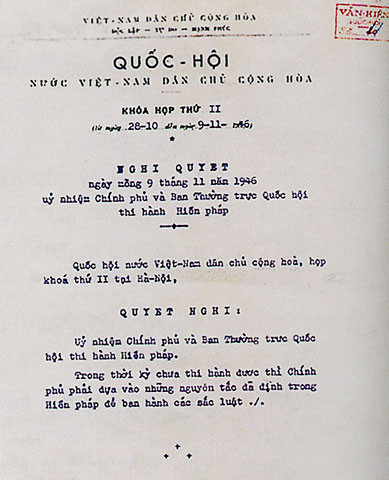
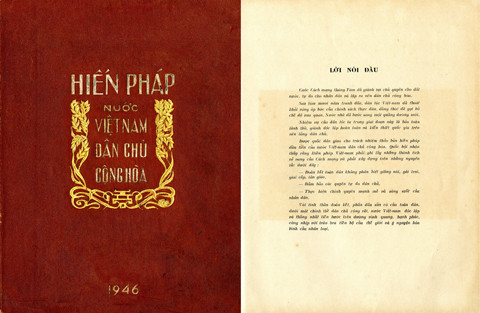
On November 9, 1946, the First National Assembly of the Democratic Republic of Vietnam adopted the country’s first Constitution. Eighty years later, the core values enshrined in that historic document – national unity, the guarantee of democratic freedoms, and the establishment of a strong and enlightened government of the people – remain a benchmark against which we must measure ourselves today.
From a nation without a constitution to a Constitution of the People
Following the success of the August Revolution in 1945, the Democratic Republic of Vietnam was established. On September 3, 1945, at the first meeting of the Council of Government, President Ho Chi Minh identified the organisation of a general election and the drafting of a constitution as key tasks. He pointed out that under the absolute monarchy and subsequently colonial rule, Vietnam had had no constitution and its people had enjoyed no democratic freedoms. Therefore, “we must have a democratic constitution”.
On September 20, 1945, a seven-member Constitution Drafting Committee, headed by President Ho Chi Minh, was established. On January 6, 1946, amid immense difficulties, the country held its first general election to elect the First National Assembly. At its Second Session, following open and democratic debates, the National Assembly adopted the Constitution on November 9, 1946, laying the first cornerstone of modern constitutional development in Vietnam. Its Preamble set out three fundamental principles: national unity, without distinction of race, gender, class or religion; the guarantee of democratic freedoms; and the establishment of a strong and enlightened government of the people.
“Article 1 affirms that all power in the country belongs to the entire Vietnamese people. The people have the right to recall their elected representatives and to decide by referendum on the Constitution and matters concerning the destiny of the nation. These were powerful mechanisms of direct democracy, even by comparison with many long-established democracies at the time”.
Since the 1946 Constitution, Vietnam has adopted four more constitutions, each associated with a distinct stage of national development. The 1959 Constitution was linked to the construction of socialism in the North and the struggle for national reunification. The 1980 Constitution was the first constitution of reunified Vietnam. The 1992 Constitution, amended in 2001, reflected the Doi Moi (Renewal) process and recognised a multi-sector economy. The 2013 Constitution, for the first time, devoted an entire chapter to human rights and the fundamental rights and obligations of citizens, while affirming the goal of building a socialist rule-of-law state. It was amended and supplemented in 2025 to reorganise the state apparatus and establish a two-tier local government system.
“The foundational values of the 1946 Constitution have been inherited and further developed. The principle that all state power belongs to the people runs through all five constitutions. The fundamental freedoms recognised in 1946 have evolved into the principle that human rights and citizens’ rights may only be restricted by law in cases of genuine necessity. On this foundation, Vietnam has transformed itself from a poor economy devastated by war into an upper-middle-income country deeply integrated into the world”.
President Ho Chi Minh and the First National Assembly: The founders
In 1919, in his poem Vietnam’s Demands, Nguyen Ai Quoc (the name used by Ho Chi Minh at the time) wrote: “A hundred things require the rule of law.” Twenty-seven years later, that aspiration became reality. He personally headed the Constitution Drafting Committee and consistently maintained that the Constitution should be concise, easy to understand, suited to practical circumstances and rooted in the will of the people.
The First National Assembly embodied the great national unity bloc, bringing together representatives of various political parties, social classes, religions and ethnic groups. During discussions on the draft Constitution, delegates engaged in heated debates over the parliamentary system, the powers of the President and the rights of the people. Therefore, the 240 votes in favour out of 242 were not the result of formal unanimity, but the outcome of a genuinely democratic process. Having served two terms as a National Assembly deputy, I deeply appreciate the standards set by previous generations: representatives must speak the truth, have the courage to debate and place the interests of the people above all else.
Whenever I recall the 1946 Constitution, I think of two people: my father-in-law, the late Lieutenant General Dong Sy Nguyen, Hero of the People's Armed Forces, and Ngo Thi Hue, wife of the late General Secretary Nguyen Van Linh, affectionately known by people in the South as Aunt Bay Hue. Both were deputies to the First National Assembly. They have since passed away, but the stories they left behind remain with us – simple and warm, just like the people they were.
In 1946, Dong Sy Nguyen was only 23 years old. At the time, he was Chairman of the Viet Minh organisation and Commander of the provincial armed forces. He was elected by the people of Quang Binh to the National Assembly, becoming one of its youngest members. Later, despite becoming a general who served through two resistance wars, the story he most often recounted when the family gathered was still that of 1946.
He recalled how preparations for the election were carried out in haste but with careful organisation. For an entire month, the Women's Union and the Association of the Elderly went from house to house to encourage people to vote. Flags and slogans were displayed everywhere. Many residents could not read or write, so rhymes and folk verses were created to remind them to go to the polls and choose the right candidates. More than 95% of eligible voters in Quang Binh cast their ballots that day.
He also recounted that, during the Second Session of the National Assembly, a delegate proposed changing the national flag, creating a tense atmosphere in the assembly hall. President Ho Chi Minh stood up and said that apart from the 25 million compatriots, no one had the right to demand a change to the national flag. His brief statement brought the room to silence.
I understand why my father-in-law remembered those words for decades. They embodied the first lesson in the Constitution that the 23-year-old deputy learned: decisions of national importance belong to the people.
Aunt Bay Hue was born in 1918. She had participated in the Southern Uprising and had been sentenced to life imprisonment with hard labour by the French colonial authorities. In 1946, voters in Bac Lieu elected her as one of the ten women deputies in the First National Assembly.
In her memoirs, she recalled how women in her hometown wrote her name on banana leaves and scraps of wrapping paper, passing them from hand to hand to encourage people to vote for her. In March 1946, she received orders to travel to Hanoi to attend the National Assembly session. By then, the French had returned to occupy southern Vietnam. Delegates had to board fishing boats at Cape Ca Mau, cross the sea to Thailand and then travel via China. It was not until October that they finally reached Hanoi, just in time for the session at which the Constitution was adopted.
That woman had overcome countless dangers and travelled for more than half a year simply to raise her hand and cast her vote on the Constitution on behalf of the people of Bac Lieu.
I was fortunate enough to meet her twice. The first time was on June 25, 2015, during the Ninth Session of the 13th National Assembly. Standing before a deputy of the country's first National Assembly, I felt that history was not confined to the pages of books; it was right there in front of me.
The second meeting took place on October 2, 2018, when I accompanied National Assembly Vice Chairman Phung Quoc Hien on a visit to her in Ho Chi Minh City. She had reached the age of 100 and was in hospital, yet her mind remained remarkably clear. As she looked through the Official Gazette of the First National Assembly that we had brought along, she spoke of her pride in witnessing the first time the entire population directly elected its representatives to the National Assembly.
“The name written on a banana leaf, the fishing boat departing from Cape Ca Mau, the 23-year-old young man listening to President Ho Chi Minh speak about the rights of 25 million compatriots – the 1946 Constitution was built by people like them. They had nothing in their hands except the trust of their voters and their aspiration for an independent and democratic Vietnam. What those predecessors would hope for from today's deputies is perhaps just as simple: never forget that they are entrusted with the people's confidence, and ensure that the Constitution remains forever a Constitution of the People”.
The Constitution today: Supreme in law, supreme in everyday life
The Constitution has the highest legal authority, but this supreme status does not automatically translate into reality. It becomes meaningful only when it is respected in every decision made by state agencies, every action taken by public officials and every undertaking of citizens.
November 9, the anniversary of the adoption of the country's first Constitution, has been designated Vietnam Law Day since 2013. Honouring the law means, first and foremost, honouring the Constitution – and therefore honouring the people's right to mastery.
“November 9, the anniversary of the adoption of the country's first Constitution, has been designated Vietnam Law Day since 2013. Honouring the law means, first and foremost, honouring the Constitution – and therefore honouring the people's right to mastery”.
I recognise that no matter how effectively the law is disseminated, this cannot compensate for shortcomings in the law itself. People will only comply with the law voluntarily when it is clear, stable and fair, and when it is applied equally to everyone, including those holding positions of power.
Public officials and Party members, especially those in leadership positions, must set the highest standards of example. Leading by example means respecting people's rights in every administrative procedure, every official decision and every interaction with citizens.
Eighty years ago, having just emerged from feudal rule and facing threats from both internal and external enemies, the First National Assembly presented the nation with a democratic and progressive Constitution.
Commemorating the 80th anniversary of the first Constitution is not simply an occasion to take pride in the past. It is also an opportunity to ask ourselves how fully the values set out by our predecessors in 1946 have been realised today, and what more we must do to put them into practice.
That is the most meaningful way to pay tribute to President Ho Chi Minh and the generations of National Assembly deputies who laid the foundations for Vietnam's constitutional development.
Translated by Hong Nhung